Introduction
In a competitive landscape where agencies strive to stand out, understanding the nuances of effective marketing performance is crucial. This article explores proven strategies that empower agencies to:
- Refine their unique value propositions
- Leverage data-driven creativity
- Optimize user-generated content
- Foster cross-functional collaboration
However, the challenge remains: how can agencies not only implement these strategies but also adapt them to the ever-evolving market dynamics? Exploring this question opens the door to transformative growth and engagement in agency marketing.
Define Your Agency's Unique Value Proposition
To define your agency's , begin by pinpointing the your target clients encounter and how your services uniquely address these challenges. Conduct thorough to gain insights into your competitors and identify gaps in their offerings. As Ashley Friedlein emphasizes, this foundational step is crucial. Leverage this information to craft a concise statement that highlights your agency's strengths, such as your expertise in or . For example, MediaNug's focus on positions it as a leader in the sector, directly appealing to brands looking to enhance their social media outcomes.
Regularly revisit and refine your UVP to ensure it stays relevant as market dynamics evolve. Notably, 65% of B2B companies have established a solid , underscoring the significance of this practice among successful agencies. Additionally, be aware of common pitfalls in developing a UVP, such as being overly generic or overlooking the pain points of your target audience. As Richard Branson aptly states, ',' highlighting the necessity of adaptability in branding and marketing strategies.

Leverage Data-Driven Creative Strategies
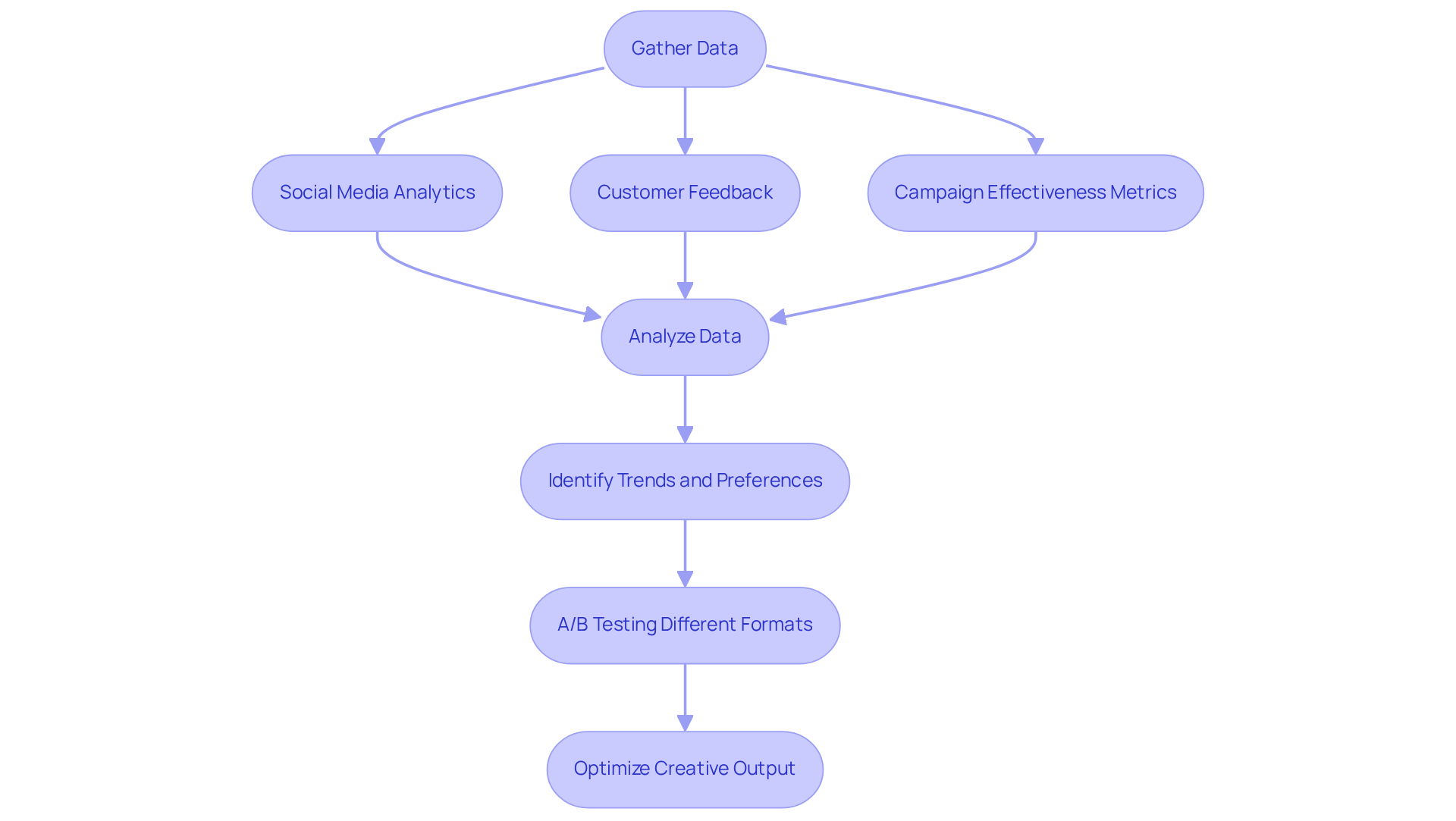
To effectively implement , begin by gathering and analyzing information from a variety of sources, including:
This data is crucial for identifying trends and preferences within your target audience. For instance, MediaNug employs a distinctive system for crafting and assessing , seamlessly blending with .
Furthermore, regularly testing different creative formats and messages through most with your audience. This iterative approach not only fosters creativity but also ensures that every piece of content is grounded in solid data, maximizing its impact. By leveraging these strategies, you can enhance your while ensuring it aligns with audience preferences.
Optimize User-Generated Content for Engagement
To effectively optimize (), brands must actively encourage their audience to share experiences through engaging contests, unique hashtags, or enticing incentives. Establishing clear guidelines for submissions is crucial to maintain quality and relevance. Once a robust collection of is gathered, it should be curated and prominently showcased across various marketing channels, including social media, websites, and email campaigns.
For instance, to highlight , thereby enhancing credibility and fostering deeper engagement. Furthermore, evaluating the performance of is essential; understanding which types of content resonate best with audiences enables brands to refine their strategies accordingly. Research indicates that see a remarkable 50% increase in engagement, with Instagram posts experiencing 70% more interaction when is included.
In addition, can significantly when integrated into SEO strategies. By prioritizing , brands tap into its , ultimately and building trust. Notably, 85 percent of marketers agree that is more economical than traditional and influencer approaches, reinforcing the importance of this method.
Are you ready to harness the power of ? Engage with MediaNug today to explore how you can elevate your brand's presence through authentic customer experiences.

Foster Cross-Functional Collaboration for Cohesive Branding
To foster effective , establishing regular communication channels among promotional, sales, and product development teams is essential. Consider this: joint brainstorming sessions can be particularly beneficial, harnessing diverse perspectives to generate innovative ideas. For instance, could implement shared dashboards to monitor campaign results and customer insights, facilitating alignment in strategies across teams. Furthermore, forming cross-functional teams for specific projects can significantly enhance . This collaborative method not only improves the quality of but also ensures that all teams are united in pursuing common objectives, ultimately strengthening the .
As industry leaders have noted, is crucial for achieving . In fact, 73% of employees engaged in collaborative work report improved performance. Conversely, organizations with high levels of collaboration are 37% less likely to achieve their revenue goals, underscoring the importance of effective collaboration. As Michael Jordan famously stated, 'Talent wins games, but win championships.' By fostering a culture of collaboration, organizations can unlock the full potential of their marketing efforts and drive impactful branding outcomes with the help of an agence .

Conclusion
Defining a unique value proposition and harnessing data-driven creative strategies are not just essential; they are critical for enhancing agency marketing performance. What specific challenges do your target clients face? By articulating how your agency's services uniquely address these issues, you can effectively position yourself in a competitive landscape. This clarity not only attracts the right clients but also fosters a deeper connection with your audience.
The article has highlighted several key strategies to improve marketing effectiveness. It emphasizes the importance of leveraging user-generated content to boost engagement and credibility. Furthermore, it encourages cross-functional collaboration among teams to ensure cohesive branding. Each of these strategies plays a vital role in enhancing creativity and innovation while aligning efforts towards shared objectives that resonate with audiences.
Ultimately, the significance of implementing these proven strategies cannot be overstated. Agencies that embrace a clear value proposition, utilize data to inform creative decisions, optimize user-generated content, and foster collaboration are better positioned to thrive in an ever-evolving market. By taking action on these insights, agencies can enhance their marketing performance and build lasting relationships with clients, driving sustained success in the future. Are you ready to elevate your agency's marketing strategy?
Frequently Asked Questions
What is a unique value proposition (UVP) for an agency?
A unique value proposition (UVP) is a clear statement that outlines how an agency's services specifically address the problems faced by its target clients, showcasing the agency's strengths and differentiating it from competitors.
How can an agency define its UVP?
An agency can define its UVP by identifying the specific challenges its target clients encounter, conducting market research to understand competitors and their gaps, and crafting a concise statement that highlights the agency's unique strengths.
Why is it important to regularly revisit and refine the UVP?
Regularly revisiting and refining the UVP is important to ensure it remains relevant as market dynamics change, allowing the agency to adapt its messaging and strategies effectively.
What percentage of B2B companies have established a solid value statement?
Approximately 65% of B2B companies have established a solid value statement, highlighting the importance of having a well-defined UVP among successful agencies.
What are some common pitfalls in developing a UVP?
Common pitfalls in developing a UVP include being overly generic and failing to address the specific pain points of the target audience, which can weaken the agency's position in the market.
How can quotes from industry leaders, like Richard Branson, inform the development of a UVP?
Quotes from industry leaders emphasize the importance of adaptability in branding and marketing strategies, suggesting that agencies should commit to their values, reinvent their approaches as needed, and connect with their audience to effectively communicate their UVP.
List of Sources
- Define Your Agency's Unique Value Proposition
- The Power of a Strong Value Proposition: How to Stand Out in a Crowded Market (https://frictionlesshq.com/strong-value-proposition-how-to-stand-out-in-a-crowded-market)
- ramotion.com (https://ramotion.com/blog/branding-quotes)
- sevenfigureagency.com (https://sevenfigureagency.com/developing-your-agencys-distinct-value-proposition)
- 57+ Content Marketing Statistics To Help You Succeed in 2025 (https://contentmarketinginstitute.com/content-marketing-strategy/content-marketing-statistics)
- goodreads.com (https://goodreads.com/quotes/tag/value-proposition)
- Leverage Data-Driven Creative Strategies
- professional.dce.harvard.edu (https://professional.dce.harvard.edu/blog/ai-will-shape-the-future-of-marketing)
- cmswire.com (https://cmswire.com/digital-marketing/future-proof-marketing-build-a-data-driven-marketing-strategy-for-2025)
- forbes.com (https://forbes.com/councils/forbestechcouncil/2025/07/18/why-the-best-marketing-in-2025-is-data-driven)
- andersoncollaborative.com (https://andersoncollaborative.com/knowledge-base/what-is-data-driven-marketing-strategy-tools-and-trends-for-2025)
- fifthcolor.com (https://fifthcolor.com/blogs/news/5-data-driven-marketing-trends-to-watch-for-the-rest-of-2025)
- Optimize User-Generated Content for Engagement
- UGC Best Practices, Expert Tips & Trends to Grow in 2026 (https://embedsocial.com/blog/ugc-best-practices-and-future-trends)
- emarketer.com (https://emarketer.com/content/social-media-marketers-eye-ugc-influencer-content-growth-burnout-threatens)
- UGC Is Redefining Social Media Marketing in 2025—Here’s How to Leverage It • The Shelf (https://theshelf.com/the-blog/ugc-is-redefining-social-media-marketing-in-2025-heres-how-to-leverage-it)
- What is User-Generated Content? (https://metricool.com/user-generated-content)
- lbbonline.com (https://lbbonline.com/news/user-generated-content-5-tips-for-winning-gen-z-customers)
- Foster Cross-Functional Collaboration for Cohesive Branding
- bluleadz.com (https://bluleadz.com/blog/great-teamwork-quotes-to-foster-collaboration-in-the-workplace)
- cubeo.ai (https://cubeo.ai/25-ai-marketing-statistics-every-cmo-should-know-in-2025)
- proofhub.com (https://proofhub.com/articles/workplace-collaboration-statistics)
- gartner.com (https://gartner.com/en/newsroom/press-releases/2024-05-14-gartner-survey-reveals-eighty-four-percent-of-marketers-report-experiencing-high-collaboration-drag-from-cross-functional-work)
- forbes.com (https://forbes.com/councils/forbesagencycouncil/2024/02/20/how-marketers-can-build-strong-relationships-with-sales-teams)