
Introduction
Understanding the return on advertising spend (ROAS) is essential for marketers who want to maximize the effectiveness of their campaigns. This critical performance metric not only indicates how much revenue is generated for every dollar spent on ads but also informs strategic budget allocation across various marketing initiatives. However, with industry benchmarks varying widely and common pitfalls lurking in calculations, how can brands ensure they are optimizing their ad spend effectively?
This article explores the essential steps for mastering ROAS, providing insights and strategies that can elevate advertising performance in an increasingly competitive landscape. By delving into these strategies, marketers can not only enhance their understanding of ROAS but also implement actionable steps that lead to improved advertising outcomes.
Define ROAS and Its Importance in Advertising
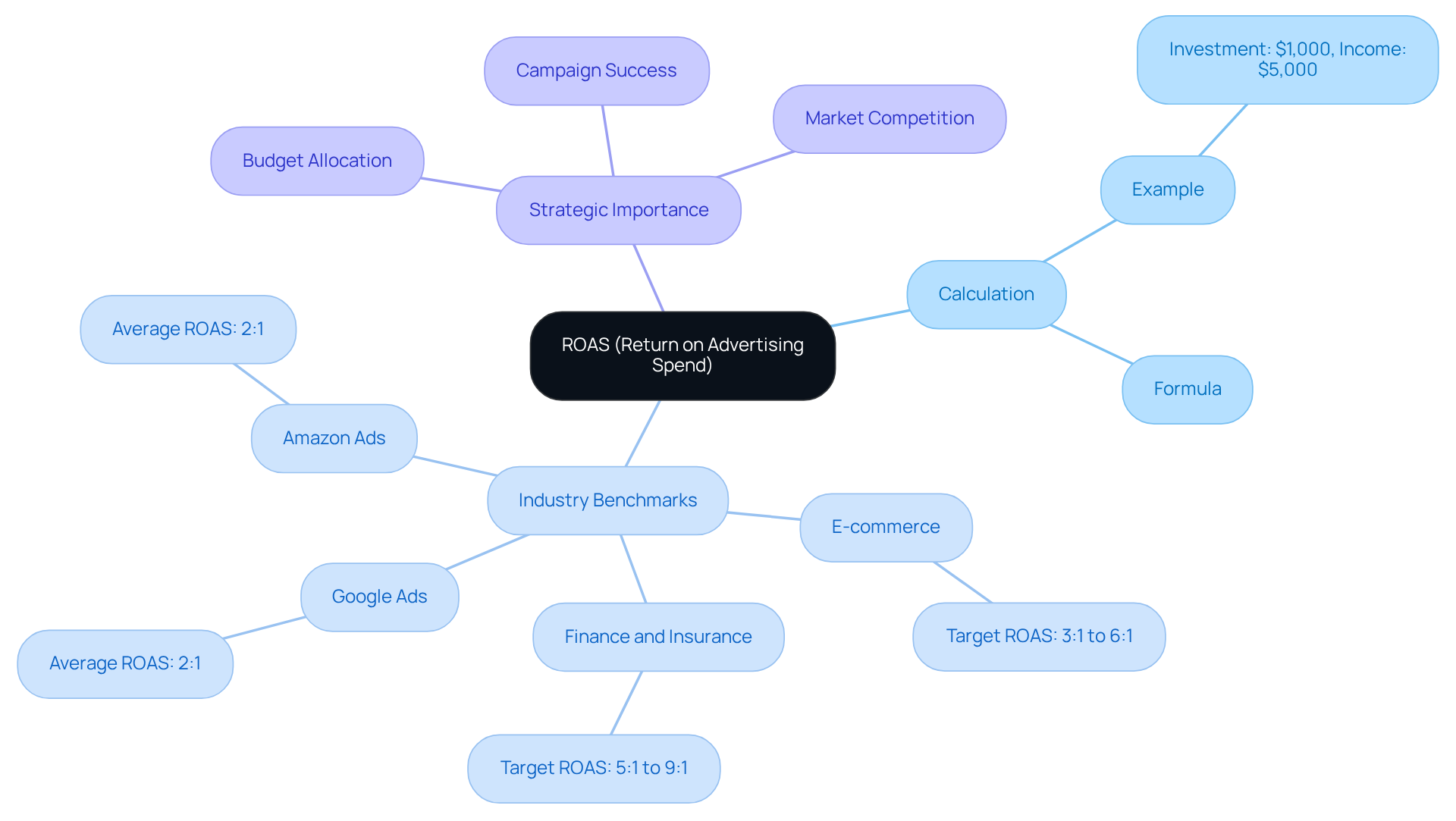
The formula for ROAS is a critical performance metric that measures the income generated for each dollar invested in advertising. It’s calculated by dividing the total income attributed to ads by the total advertising cost. For instance, if a brand invests $1,000 in advertisements and generates $5,000 in income, the resulting ROAS is 5:1, meaning five dollars are earned for every dollar spent.
In 2026, average ROAS benchmarks vary significantly across industries. E-commerce sellers typically aim for a ROAS between 3:1 and 6:1, while sectors like finance and insurance target a higher range of 5:1 to 9:1 due to their substantial customer lifetime value. Interestingly, Google ads average around 2:1, with Amazon ads hovering near this figure. Understanding these benchmarks is essential for marketers to set realistic expectations and effectively assess performance according to the formula for ROAS.
The importance of the formula for ROAS extends beyond immediate financial returns; it significantly influences advertising strategies. The formula for ROAS indicates that a higher return on ad spend reflects a more successful campaign, allowing brands to allocate budgets more strategically and enhance their marketing efforts. For example, initiatives focused on revenue generation often require a higher ROAS to be deemed successful, whereas campaigns aimed at brand awareness may accept a lower ROAS. Market competition also impacts ROAS, as increased competition can diminish revenue potential, necessitating strategic adjustments by brands.
Experts emphasize that having a clearly defined formula for ROAS not only helps in evaluating campaign effectiveness but also informs long-term marketing decisions. Nikita Bykadarov notes that the optimal ROAS can vary widely based on the industry and business objectives, highlighting the need for brands to establish tailored ROAS targets. Continuous monitoring and adjustment based on the formula for ROAS can enhance profitability and ensure more effective utilization of the marketing budget. As competition intensifies, understanding and optimizing ROAS will be vital for brands seeking to maximize their promotional impact in 2026 and beyond.
Explain the ROAS Calculation Formula
The formula for ROAS is essential for any business looking to maximize its advertising effectiveness.
ROAS = Revenue from Ads / Cost of Ads
To effectively apply this formula, follow these steps:
- Determine Income: First, identify the total income generated from your advertising efforts. This includes all sales that can be directly attributed to the ads.
- Calculate Costs: Next, sum up all costs associated with the ads. This encompasses creative production, media buying, and any platform fees that may apply.
The formula for ROAS is essential for measuring advertising effectiveness. To apply the formula for ROAS, finally divide the total income by the total ad spend. For instance, if your advertisements produced $10,000 in revenue and expenses were $2,000, your return on advertising spend would be 5 ($10,000 / $2,000 = 5).
This calculation provides a clear picture of how effectively your advertising dollars are being spent. By understanding ROAS, you can make informed decisions that enhance your marketing strategy.

Provide Practical Examples of ROAS Calculation
Here are practical examples illustrating how to calculate ROAS in different scenarios, along with important benchmarks and insights to consider:
-
E-commerce Campaign: A clothing retailer invests $1,500 in Facebook ads, resulting in $7,500 in sales.
- ROAS = $7,500 / $1,500 = 5.0 (or 500%)
- This indicates that for every dollar spent, the retailer earned five dollars. Targeting a return on advertising spend between 2:1 and 4:1 is typically regarded as favorable for e-commerce, rendering this campaign highly effective.
-
Lead Generation Campaign: A software company allocates $2,000 to Google Ads, acquiring leads that generate $8,000 in revenue.
- ROAS = $8,000 / $2,000 = 4.0 (or 400%)
- This reflects a strong return on their investment in lead generation. It's important to use the formula for ROAS to measure return on ad spend over time periods, such as 30 days, to align with user monetization patterns and evaluate long-term effectiveness.
-
Event Promotion: An event organizer spends $500 on Instagram ads, leading to $2,000 in ticket sales.
- ROAS = $2,000 / $500 = 4.0 (or 400%)
- This demonstrates effective use of ad spend to drive ticket sales. Note that social platforms often produce lower immediate return on ad spend compared to search platforms, so context is key when assessing performance.
These examples emphasize how the formula for ROAS can differ across various campaign types, providing marketers with insights into the efficiency of their advertising strategies. Furthermore, enhancing landing pages can greatly boost conversion rates, further improving return on advertising spend. Understanding these calculations and benchmarks is crucial for optimizing ad spend and achieving better returns.

Identify Common Mistakes in ROAS Calculation
When using the formula for ROAS, marketers often encounter several common pitfalls that can lead to inaccurate assessments.
- Ignoring Hidden Costs: Many marketers overlook additional expenses like platform fees, creative production costs, and labor. These should be factored into the total ad spend for accurate calculations. As Allie Mistakidis points out, "Many people focus only on ad spend but forget other expenses."
- Not Tracking Income Precisely: Failing to accurately assign income to specific initiatives can inflate ROAS figures. It’s crucial to account for all sales generated from ads. Misassigning income can distort the true effectiveness of your initiatives.
- Short-Term Focus: Some marketers only consider immediate revenue, neglecting customer lifetime value (CLV). A campaign might show a low initial return on ad spend but could lead to high-value repeat customers. Case studies reveal that businesses considering CLV often enjoy improved long-term returns.
- Inconsistent Time Frames: Comparing return on advertising spend across different periods without accounting for seasonal variations or market changes can mislead performance assessments. External factors like seasonality can significantly impact ad effectiveness, and ignoring these can lead to misinterpretation of data.
- Neglecting Attribution Models: Relying on a single attribution model may fail to capture the full customer journey. Implementing multi-touch attribution offers a more comprehensive view of ad effectiveness. Companies using multi-touch attribution have demonstrated notable enhancements in their return on advertising spend accuracy, facilitating better distribution of advertising expenditures.
By recognizing these pitfalls, marketers can sharpen the precision of their calculations using the formula for ROAS and make more informed decisions. For example, the average return on advertising spend across sectors hovers around 2:1, and understanding this standard can help marketers set realistic expectations for their campaigns. Moreover, a breakeven return on ad spend for a profit margin of 25% is calculated as 4, underscoring the importance of accounting for all expenses in ROAS evaluations.

List Tools and Resources for Tracking ROAS
To effectively track and optimize your return on ad spend (ROAS), consider leveraging these powerful tools and resources:
- Google Analytics: This extensive platform monitors website traffic and conversions, allowing you to assess ad performance while gaining insights into user behavior.
- Facebook Ads Manager: It provides comprehensive insights into ad performance, including a specific formula for ROAS metrics for campaigns on Facebook and Instagram, enabling an accurate assessment of your promotional efforts.
- HubSpot: This tool integrates seamlessly with multiple advertising platforms, offering marketing analytics that monitor ad performance and compute the formula for ROAS, thereby empowering data-informed decision-making.
- Northbeam: Specializing in multi-touch attribution, Northbeam helps marketers understand the full impact of their promotional efforts across various channels, enhancing overall strategy effectiveness.
- Adjust: As a mobile measurement partner, Adjust provides insights into app performance and the formula for ROAS for mobile campaigns, which is crucial for brands that focus on mobile user engagement.
- True ROAS: This sophisticated ad monitoring and enhancement platform is designed to optimize the formula for ROAS across various channels, delivering actionable insights for refining your promotional strategies.
- StoreHero: A profit-first analytics platform that integrates cost of goods sold (COGS) into its reporting, making it ideal for brands focused on profitability.
- Triple Whale: Recognized as the best all-in-one ecommerce ROI dashboard, it offers a unified view of ad spend, revenue, and creative performance across major platforms.
These tools empower marketers to precisely assess their return on advertising spend through the formula for ROAS, facilitating informed choices that enhance advertising strategies. It's essential to maintain a consistent methodology in tracking the formula for ROAS in return on ad spend. Review the formula for ROAS data daily for active campaign optimization, weekly for strategic adjustments, and monthly for budget allocation decisions. Furthermore, utilizing AI tools can assist in predicting return on ad spend and identifying under-performing channels, thereby enhancing your marketing efforts.

Suggest Strategies to Improve ROAS in Campaigns
To enhance your ROAS, consider implementing the following strategies:
- Refine Targeting: Are you reaching the right audience? Utilize data analytics to pinpoint and engage high-value customer segments. Tailoring your ads to specific demographics can significantly boost conversion rates. In fact, users who click retargeting ads are 70% more likely to convert compared to non-targeted efforts.
- Optimize Ad Creatives: Invest in high-quality visuals and compelling copy that resonate with your audience. Consistently updating ad creatives is crucial; brands achieving a 4.0+ return on ad spend typically experiment with 5-10 new creative ideas each week. This ensures your content remains captivating and efficient.
- Leverage Retargeting: Have you considered retargeting? Implement strategies to re-engage users who have previously interacted with your brand. Retargeting can raise conversion rates by as much as 150% and boost ad engagement rates by up to 400%. This makes it a powerful resource for improving your return on advertising spend.
- Modify Bidding Techniques: Test different bidding methods, such as cost-per-click (CPC) or target return on ad spend bidding. Determine the most efficient strategy for your initiatives. Utilizing Cost Caps can help maintain profitability by controlling spending based on conversion potential.
- Monitor and Analyze Performance: Regularly review your campaign performance metrics to identify trends and areas for improvement. Insights from performance data can guide data-driven adjustments to your strategies, ensuring continuous optimization.
- Enhance Landing Pages: Are your landing pages optimized for conversions? A seamless user experience can greatly influence your return on ad spend by decreasing bounce rates and boosting sales. Aligning landing page content with ad messaging fosters user trust and promotes conversions.
By applying these strategies, marketers can effectively enhance their advertising investments using the formula for ROAS to maximize returns.

Conclusion
Understanding and mastering the formula for ROAS is not just beneficial; it's essential for any marketer looking to optimize their advertising spend. Accurately calculating return on ad spend empowers businesses to make informed decisions that directly influence profitability and strategic direction. The insights gained from ROAS not only guide immediate campaign adjustments but also shape long-term marketing strategies that align with overarching business objectives.
Key points throughout this article underscore the importance of precise calculations, the influence of industry benchmarks, and the common pitfalls to avoid. Practical examples illustrate how effective ROAS calculations can lead to better decision-making and enhanced campaign performance. Furthermore, strategies for boosting ROAS - such as refining targeting, optimizing ad creatives, and leveraging retargeting - have been discussed to empower marketers in maximizing their returns.
Ultimately, the significance of ROAS cannot be overstated. It serves as a critical metric that informs budget allocation and campaign effectiveness in an increasingly competitive landscape. By embracing the strategies and tools outlined here, marketers can enhance their advertising investments and drive substantial growth. Now is the time to take action to optimize ROAS; doing so will not only improve current campaigns but also lay the groundwork for sustained success in future advertising endeavors.
Frequently Asked Questions
What does ROAS stand for and why is it important in advertising?
ROAS stands for Return on Advertising Spend. It is important because it measures the income generated for each dollar invested in advertising, helping brands assess the effectiveness of their advertising strategies and allocate budgets more strategically.
How is ROAS calculated?
ROAS is calculated using the formula: ROAS = Revenue from Ads / Cost of Ads. This involves determining the total income generated from advertising efforts and summing up all associated costs, then dividing the total income by the total advertising cost.
Can you provide an example of how to calculate ROAS?
Yes, for instance, if a business generates $10,000 in revenue from ads and spends $2,000 on those ads, the ROAS would be calculated as follows: $10,000 / $2,000 = 5. This means the business earns $5 for every dollar spent on advertising.
What are the average ROAS benchmarks across different industries?
In 2026, e-commerce sellers typically aim for a ROAS between 3:1 and 6:1, while finance and insurance sectors target a higher range of 5:1 to 9:1. Google ads average around 2:1, and Amazon ads hover near this figure.
How does ROAS influence advertising strategies?
A higher ROAS indicates a more successful advertising campaign, allowing brands to allocate their budgets more effectively. Campaigns focused on revenue generation often require a higher ROAS for success, while those aimed at brand awareness may accept a lower ROAS.
Why is it important to continuously monitor and adjust ROAS?
Continuous monitoring and adjustment of ROAS can enhance profitability and ensure more effective utilization of the marketing budget. As competition increases, understanding and optimizing ROAS will be vital for brands to maximize their promotional impact.
What factors can affect ROAS?
Factors that can affect ROAS include market competition, the specific goals of advertising campaigns, and the overall customer lifetime value in different industries. Brands may need to adjust their strategies based on these factors to maintain or improve their ROAS.
List of Sources
- Define ROAS and Its Importance in Advertising
- aijourn.com (https://aijourn.com/roas-in-2026-why-app-advertising-now-lives-or-dies-on-ai-driven-discovery)
- linkedin.com (https://linkedin.com/pulse/digital-news-watch-google-ads-ties-new-customer-value-john-adwce)
- triplewhale.com (https://triplewhale.com/blog/whats-a-good-roas)
- almcorp.com (https://almcorp.com/blog/google-ads-advanced-tactics-to-maximize-roas-for-2026)
- Return on Ad Spend (ROAS): Formula & Benchmarks 2026 (https://improvado.io/blog/return-on-ad-spend)
- Explain the ROAS Calculation Formula
- What Is a Good ROAS in 2026? - Benchmarks by Industry (https://landingi.com/digital-advertising/good-roas)
- humblytics.com (https://humblytics.com/blog/how-to-calculate-return-on-ad-spend-for-real-results)
- mountain.com (https://mountain.com/blog/return-on-ad-spend)
- ROAS Statistics 2026 – First Page Sage (https://firstpagesage.com/reports/roas-statistics)
- How to Calculate ROAS: Formula, Examples, and Common Mistakes | Triple Whale (https://triplewhale.com/blog/how-to-calculate-roas)
- Provide Practical Examples of ROAS Calculation
- ROAS: What it is, How to Calculate, and 4 Tips to Improve (https://salesforce.com/marketing/return-on-ad-spend)
- What Is a Good ROAS in 2026? - Benchmarks by Industry (https://landingi.com/digital-advertising/good-roas)
- leverdigital.co.uk (https://leverdigital.co.uk/post/what-is-a-good-roas-for-google-ads)
- segwise.ai (https://segwise.ai/blog/roas-benchmarks-industry-standards)
- envive.ai (https://envive.ai/post/ai-roas-statistics)
- Identify Common Mistakes in ROAS Calculation
- intense.ng (https://intense.ng/return-on-ads-spent-roas-common-errors-in-ad-spend-calculation-and-strategy-and-how-to-fix-them)
- calibermind.com (https://calibermind.com/articles/keys-to-calculating-roas)
- How to Calculate ROAS: Formula, Examples, and Common Mistakes | Triple Whale (https://triplewhale.com/blog/how-to-calculate-roas)
- linkedin.com (https://linkedin.com/pulse/common-pitfalls-roas-calculation-indicocompany-ndorc)
- List Tools and Resources for Tracking ROAS
- cometly.com (https://cometly.com/post/roas-vs-roi)
- linkedin.com (https://linkedin.com/pulse/best-ai-tools-ecommerce-roas-reporting-2026-roiminds-u8x7c)
- benly.ai (https://benly.ai/learn/ai-marketing/best-roas-tracking-tools-2026)
- Suggest Strategies to Improve ROAS in Campaigns
- webfx.com (https://webfx.com/blog/marketing/remarketing-statistics)
- demandsage.com (https://demandsage.com/retargeting-statistics)
- getkoro.app (https://getkoro.app/blog/increase-roas-paid-ads-guide-2026)
- Ad Retargeting in Numbers – Statistics and Trends - Invesp (https://invespcro.com/blog/ad-retargeting-2)
- Retargeting Statistics 2026: 97+ Stats & Insights [Expert Analysis] - Marketing LTB (https://marketingltb.com/blog/statistics/retargeting-statistics)