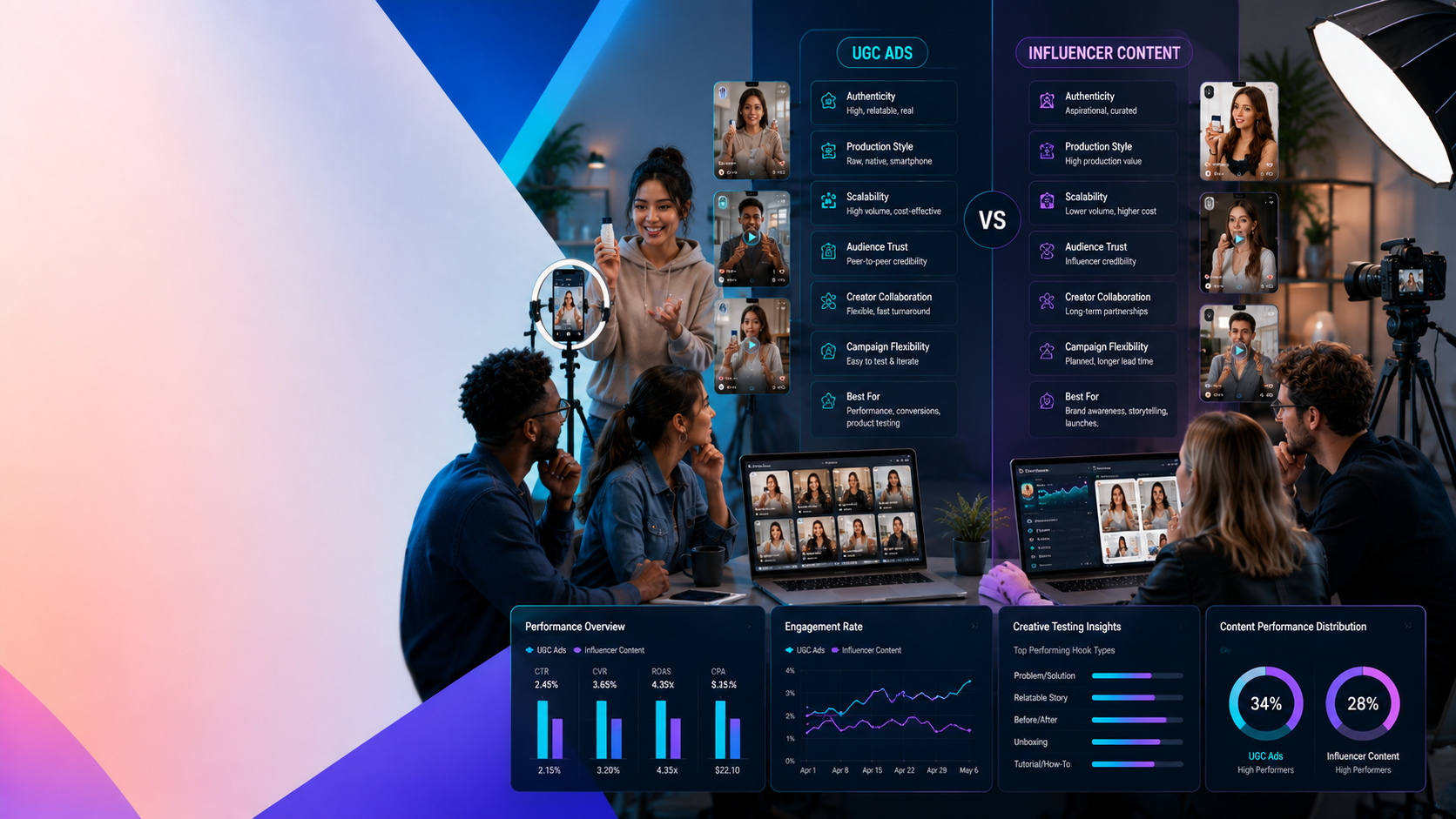
UGC Ads vs Influencer Content
UGC ads and influencer content are often grouped together, but they are not the same thing.
Both involve creators.
Both can feel more human than traditional brand advertising.
Both can help brands build trust, explain products, and show real-life use cases.
But they serve different purposes.
Influencer content is usually built around distribution through the creator’s own audience. The brand works with a creator because that creator has reach, influence, trust, or authority with a specific community.
UGC ads are usually built around content production. The brand works with a creator to produce assets that the brand can use in its own paid social campaigns, landing pages, organic posts, email campaigns, or other marketing channels.
The difference matters because paid social teams do not always need more influencer reach.
They often need more creative.
More hooks. More formats. More product demos. More testimonials. More comparison ads. More creator types. More assets to test before campaigns fatigue.
That is where UGC ads become especially valuable.
This guide explains the difference between UGC ads and influencer content, when brands should use each, and why UGC creators have become an important part of paid social creative pipelines.
What Are UGC Ads?
UGC ads are paid social ads created in a user-generated style.
They often feature creators, customers, or real people speaking directly to camera, demonstrating a product, sharing an experience, comparing alternatives, or explaining a problem in a natural, social-native format.
UGC ads are commonly used across:
- TikTok;
- Instagram;
- Facebook;
- YouTube Shorts;
- Snapchat;
- Pinterest;
- LinkedIn;
- landing pages;
- product pages;
- email campaigns.
Examples of UGC ads include:
- product demo videos;
- testimonial ads;
- unboxing videos;
- comparison ads;
- problem-solution videos;
- routine integrations;
- objection-handling videos;
- listicle ads;
- screen recording ads;
- creator-led direct-response ads.
The brand usually uses the content through its own channels.
That means the creator’s follower count is not always the main factor.
For UGC ads, what matters more is whether the creator can produce content that feels believable, relevant, and useful as paid social creative.
What Is Influencer Content?
Influencer content is content created by a creator who has an audience that the brand wants to reach.
In influencer marketing, the creator usually posts the content on their own channel.
The brand is paying for access to the creator’s audience, credibility, community, and distribution.
Influencer content may include:
- sponsored posts;
- product reviews;
- creator stories;
- Reels or TikToks posted by the creator;
- YouTube integrations;
- affiliate content;
- brand collaborations;
- creator-led campaigns;
- event coverage;
- product seeding content.
The value of influencer content often depends on:
- follower count;
- audience demographics;
- engagement rate;
- niche authority;
- creator credibility;
- community trust;
- distribution reach;
- brand alignment.
Influencer content can be powerful when the goal is awareness, social proof, audience access, or credibility within a specific community.
But it is not always the same as performance-ready ad creative.
The Core Difference: Distribution vs. Production
The simplest way to understand the difference is this:
Influencer content is usually about distribution.
UGC ads are usually about production.
Influencer content asks:
“Who has the right audience for us to reach?”
UGC ads ask:
“Who can create the right content for our audience to respond to?”
This distinction affects almost every part of the campaign.
With influencer content, the brand cares about the creator’s audience, reach, engagement, and trust.
With UGC ads, the brand cares about the creator’s ability to produce usable assets for paid social testing.
That does not mean UGC creators cannot have audiences.
And it does not mean influencer content cannot be used in ads.
But the primary purpose is different.
UGC ads are usually built to feed the brand’s creative pipeline.
Influencer content is usually built to activate the creator’s audience.
UGC Ads vs Influencer Content: Key Differences
Here are the main differences brands should understand.
1. Campaign Goal
UGC ads are usually used to produce creative assets for the brand’s own paid or organic channels.
The goal is often to:
- create more paid social ads;
- test hooks and formats;
- fight creative fatigue;
- produce product demos;
- generate testimonials;
- build a creative pipeline;
- improve ad variation;
- support conversion and retargeting.
Influencer content is usually used to reach the creator’s audience.
The goal is often to:
- build awareness;
- generate social proof;
- access a niche community;
- create brand association;
- drive influencer-led traffic;
- support product launches;
- build credibility;
- encourage organic discovery.
Both can support growth.
But they solve different problems.
2. Where the Content Is Used
UGC ads are usually used by the brand.
The brand may run them as:
- paid social ads;
- whitelisted ads, if rights allow;
- organic posts;
- landing page videos;
- product page assets;
- email content;
- retargeting ads;
- creative testing assets.
Influencer content is usually posted by the creator.
The creator publishes the content on their own:
- TikTok;
- Instagram;
- YouTube;
- newsletter;
- blog;
- podcast;
- LinkedIn;
- community channel.
The brand may also negotiate paid usage rights, but that is not always included by default.
For UGC ads, usage rights are central.
For influencer content, posting and distribution are usually central.
3. Importance of Follower Count
Follower count matters more in influencer marketing.
If the creator is posting on their own channel, the size and quality of their audience can affect the campaign’s reach.
For UGC ads, follower count is usually less important.
If the brand is running the asset through its own paid media account, the content will reach the audience through the brand’s media spend.
That means creator fit, content quality, delivery style, format ability, and paid social readiness often matter more than audience size.
A creator with a small following can produce a stronger UGC ad than a creator with a large following if they are better matched to the campaign.
For UGC ads, the question is not:
“How many followers does this creator have?”
The better question is:
“Can this creator produce an ad that feels relevant and believable to the target audience?”
4. Creative Control
UGC ads usually give the brand more control over the final asset.
The brand can define:
- campaign objective;
- target audience;
- creative angle;
- talking points;
- product shots;
- hook options;
- CTA;
- deliverables;
- usage rights;
- editing needs.
The creator still needs room for natural delivery, but the asset is usually briefed for a specific marketing use case.
Influencer content often requires more creator freedom because the content needs to feel natural to the creator’s own audience.
If the brand over-controls influencer content, it may underperform because the post can feel scripted or disconnected from the creator’s usual style.
UGC ads are usually more structured.
Influencer content is usually more creator-led.
5. Performance Measurement
UGC ads are often measured like paid social creative.
Common metrics include:
- hook rate;
- hold rate;
- CTR;
- CPC;
- CPA;
- CAC;
- ROAS;
- conversion rate;
- cost per lead;
- demo booking rate.
Influencer content is often measured through creator-channel performance.
Common metrics include:
- reach;
- impressions;
- engagement;
- saves;
- shares;
- comments;
- profile visits;
- link clicks;
- affiliate sales;
- promo code usage;
- earned media value;
- follower growth.
There can be overlap, especially if influencer content is used as paid media.
But the primary measurement model is often different.
UGC ads are evaluated as ad assets.
Influencer content is evaluated as creator-distributed content.
6. Usage Rights
Usage rights are one of the most important differences.
For UGC ads, brands usually need the right to use, edit, and run the content in paid media.
That may include:
- paid social usage;
- organic usage;
- landing page usage;
- product page usage;
- email usage;
- editing rights;
- raw footage usage;
- usage duration;
- platform permissions.
For influencer content, those rights are not always included automatically.
An influencer may agree to post content on their own channel, but that does not necessarily mean the brand can run the content as an ad or edit it into multiple variations.
Brands should always clarify usage rights before production begins.
This is especially important if the content will be used in paid media.
7. Production Speed
UGC ads are often designed for speed and creative volume.
Brands can brief multiple creators, request variations, collect raw footage, and turn creator content into multiple ad assets.
This makes UGC ads useful for paid social teams that need frequent creative refreshes.
Influencer content can take longer because it may require:
- creator negotiation;
- content calendar alignment;
- audience fit review;
- creative concepting;
- posting schedules;
- approvals;
- reporting;
- exclusivity negotiations.
Influencer campaigns can be very effective, but they are not always built for fast creative iteration.
UGC ads are usually easier to plug into a performance creative pipeline.
8. Role in the Funnel
UGC ads can be used across the funnel.
For example:
- awareness: problem-solution videos;
- consideration: product demos and comparisons;
- retargeting: testimonials and objection-handling videos;
- conversion: offer-led creator ads;
- retention: routine integration or product education videos.
Influencer content is often strongest for:
- awareness;
- brand discovery;
- social proof;
- community access;
- product launches;
- trust building;
- cultural relevance.
Influencer content can support conversion, especially with strong audience trust or affiliate offers.
But UGC ads are often easier to adapt across different paid social funnel stages because the brand controls how and where the asset is used.
9. Scalability
UGC ads are often easier to scale as creative inputs.
A brand can work with many creators, request multiple hooks, produce different formats, and test creative variations regularly.
This supports:
- creative testing;
- campaign refreshes;
- creator-type testing;
- hook testing;
- format testing;
- creative fatigue management.
Influencer content can also scale, but scaling influencer campaigns usually requires more relationship management, budget planning, creator coordination, and campaign tracking.
For paid social teams that need new ads consistently, UGC ads often provide a more direct path to creative volume.
When to Use UGC Ads
UGC ads are especially useful when your brand needs more creative for paid social.
Use UGC ads when you want to:
- produce more ad variations;
- test different hooks;
- test different creator types;
- explain product benefits;
- create product demos;
- build testimonial-style ads;
- reduce creative fatigue;
- refresh paid social campaigns;
- create retargeting assets;
- collect raw footage for editing;
- build a creative pipeline;
- support performance marketing.
UGC ads are a strong fit when the main problem is not audience access, but creative supply.
If your paid social team needs more assets to test, UGC ads can help.
When to Use Influencer Content
Influencer content is especially useful when your brand wants to reach a creator’s audience.
Use influencer content when you want to:
- build brand awareness;
- enter a niche community;
- borrow creator credibility;
- drive creator-led discovery;
- launch a product with social proof;
- build cultural relevance;
- generate engagement;
- activate affiliate or promo code campaigns;
- create brand association with a specific creator;
- reach audiences through trusted voices.
Influencer content is a strong fit when the creator’s audience is part of the value.
If the creator has trust, reach, and relevance with a group your brand wants to access, influencer content can be powerful.
When to Use Both Together
UGC ads and influencer content do not need to compete.
Many brands benefit from using both.
For example, a brand might use influencer content to build awareness and UGC ads to scale paid social testing.
A combined strategy could look like this:
- Partner with influencers to create awareness and social proof.
- Use UGC creators to produce performance-focused ad assets.
- Secure usage rights for selected influencer content.
- Turn strong creator content into paid social variations.
- Test UGC ads across funnel stages.
- Use performance data to guide future creator briefs.
- Use influencer learnings to identify strong audience segments and messages.
Influencer content can help generate cultural relevance and audience trust.
UGC ads can help turn creator-style content into scalable paid social creative.
The best strategy depends on the campaign goal.
Example: UGC Ads vs Influencer Content for a Product Launch
Imagine a brand launching a new skincare product.
An influencer campaign might involve working with beauty creators who post about the product to their own audiences.
The goal could be:
- awareness;
- credibility;
- community discussion;
- product discovery;
- social proof.
The creator might post a Reel, Stories, or TikTok showing the product and explaining why they like it.
A UGC ad campaign would be different.
The brand might work with vetted UGC creators to produce:
- product demo ads;
- morning routine videos;
- texture close-ups;
- testimonial-style videos;
- objection-handling ads;
- comparison ads;
- multiple hook variations.
The brand would run those assets through its own paid social account.
The goal would be:
- creative testing;
- paid social performance;
- retargeting;
- conversion;
- creative refresh;
- reduced ad fatigue.
Both approaches can help the launch.
But they play different roles.
Example: UGC Ads vs Influencer Content for a SaaS Product
For a SaaS product, influencer content might involve a creator or industry expert sharing the tool with their professional audience.
The goal could be:
- credibility;
- category awareness;
- thought leadership;
- community trust;
- referral traffic.
UGC ads might involve creators producing:
- screen recording walkthroughs;
- problem-solution videos;
- “old way vs. new way” ads;
- founder-style explanations;
- testimonial-style reviews;
- objection-handling ads for retargeting.
The brand would use these assets in paid social campaigns to test which messages drive clicks, signups, or demo bookings.
Again, the difference is clear.
Influencer content helps the brand reach a trusted audience.
UGC ads help the brand create more performance-focused creative assets.
How UGC Ads Support Paid Social Creative Testing
UGC ads are especially useful for creative testing because they make variation easier.
Paid social teams can use UGC ads to test:
- hooks;
- creators;
- product benefits;
- objections;
- formats;
- CTAs;
- platform-specific edits;
- creator archetypes;
- levels of polish.
For example, a brand might test:
- product demo vs. testimonial;
- expert creator vs. everyday user;
- problem-led hook vs. curiosity hook;
- comparison ad vs. objection-handling ad;
- polished creator vs. lo-fi creator.
This helps teams identify patterns.
Instead of guessing what kind of creative will work, the brand can use performance data to decide what to brief next.
UGC ads make that learning system easier to run.
How Influencer Content Supports Brand Trust
Influencer content is valuable because creators can have established trust with their audiences.
A recommendation from the right creator can feel more credible than a brand saying the same thing directly.
Influencer content can help brands:
- enter new communities;
- build credibility;
- create social proof;
- generate conversation;
- humanize the product;
- associate with a lifestyle or identity;
- drive awareness through trusted voices.
This is especially useful when the creator’s audience is highly relevant and engaged.
However, influencer content should still be chosen carefully.
A large audience does not guarantee strong brand fit.
The creator’s audience, tone, values, category relevance, and content style should match the campaign.
Common Mistakes Brands Make
Mistake 1: Treating UGC and Influencer Content as the Same Thing
Both involve creators, but they are used differently.
Before choosing a creator, define whether the goal is distribution, content production, or both.
Mistake 2: Overvaluing Follower Count for UGC Ads
Follower count is not the main factor when the brand is running the content through its own paid media.
For UGC ads, creator fit and content quality usually matter more.
Mistake 3: Not Clarifying Usage Rights
Never assume influencer content can be used as paid social creative.
Usage rights, editing rights, platform permissions, and duration should be agreed in advance.
Mistake 4: Using Influencer Content Without Paid Social Structure
An influencer post may not automatically work as an ad.
Paid social creative usually needs stronger hooks, tighter pacing, clearer CTAs, and more focused messaging.
Mistake 5: Under-Briefing UGC Creators
UGC creators still need a clear brief.
The brief should define the campaign objective, target audience, creative angle, talking points, deliverables, and usage rights.
Mistake 6: Choosing Creators Without Campaign Fit
Whether working with influencers or UGC creators, brand fit matters.
The creator should feel believable for the product, audience, message, and campaign goal.
How to Decide Which One Your Brand Needs
To decide between UGC ads and influencer content, start with the problem you are trying to solve.
Choose UGC Ads If You Need:
- more paid social creative;
- more ad variations;
- faster creative testing;
- product demos;
- testimonials;
- retargeting assets;
- hooks and CTA variations;
- fresh creative to fight fatigue;
- content for your own paid channels;
- a repeatable creative pipeline.
Choose Influencer Content If You Need:
- creator distribution;
- audience reach;
- community access;
- brand awareness;
- social proof;
- cultural relevance;
- creator credibility;
- affiliate sales;
- product launch amplification;
- trust from a specific audience.
Choose Both If You Need:
- awareness and performance creative;
- social proof and paid social testing;
- creator reach and reusable assets;
- campaign buzz and conversion assets;
- brand trust and creative volume.
The best choice depends on the campaign goal.
How NugVerse Helps Brands Create UGC Ads for Paid Social
NugVerse helps brands connect with vetted UGC creators matched to their campaign goals.
Instead of relying only on influencer content or manually searching for creators, brands can use NugVerse to produce paid social-ready UGC ads with creators aligned to their audience, product category, creative format, and campaign objective.
NugVerse uses AI-powered matching to help brands find better-fit creators faster.
That makes it easier to:
- produce more UGC ads;
- test more hooks and formats;
- find vetted UGC creators;
- improve creator-brand fit;
- create assets for paid social campaigns;
- reduce manual creator sourcing;
- fight creative fatigue;
- keep the creative pipeline full.
For paid social teams, NugVerse is built around the creative production problem.
The goal is not just to work with creators.
The goal is to create more performance-ready assets your team can test, learn from, and scale.
Final Takeaway
UGC ads and influencer content both use creators, but they are built for different goals.
Influencer content is usually about distribution, audience trust, and creator-led reach.
UGC ads are usually about creative production, paid social testing, and reusable assets.
Influencer content helps brands access communities.
UGC ads help brands feed the creative pipeline.
For paid social teams, UGC ads are especially valuable because they provide more hooks, formats, creators, testimonials, demos, and variations to test.
The strongest brands understand the difference.
They use influencer content when they need reach and credibility.
They use UGC ads when they need scalable paid social creative.
And when the campaign requires both awareness and performance, they use the two together.
Ready to Create More UGC Ads for Paid Social?
NugVerse connects brands with vetted UGC creators matched to their campaign goals.
Find better-fit creators. Produce more UGC ads. Keep your paid social creative pipeline full.
Start your first project with NugVerse.
Related Articles
- UGC Creators for Paid Social Ads: How to Find, Vet, and Scale Winning Creative
- What Are UGC Ads?
- UGC Ads Examples for Paid Social
- Why Creator-Brand Fit Matters More Than Follower Count
FAQ
What is the difference between UGC ads and influencer content?
UGC ads are usually created for the brand to use in its own paid social or marketing channels. Influencer content is usually created for the creator to post on their own channel and distribute to their audience.
Are UGC creators the same as influencers?
Not always. Influencers are usually valued for their audience and distribution. UGC creators are often valued for their ability to produce content that the brand can use in ads, organic posts, landing pages, or other channels.
Do UGC ads require creators with large followings?
No. For UGC ads, follower count is usually less important than creator-brand fit, content quality, delivery style, and ability to create usable paid social assets.
Can influencer content be used as UGC ads?
Yes, but only if the brand has the right usage rights. Influencer content may also need to be edited or adapted to work as paid social creative.
When should a brand use UGC ads?
A brand should use UGC ads when it needs more paid social creative, product demos, testimonials, hook variations, retargeting assets, or fresh content to fight creative fatigue.
When should a brand use influencer content?
A brand should use influencer content when it wants to reach a creator’s audience, build awareness, generate social proof, or access a specific niche community.
Are UGC ads better than influencer content?
One is not automatically better than the other. UGC ads are better for scalable paid social creative production. Influencer content is better for creator-led distribution and audience trust.
Why are UGC ads important for paid social?
UGC ads are important for paid social because they give teams more creative variations to test, including different creators, hooks, formats, benefits, objections, and CTAs.