
Introduction
Crafting effective call to action ads is essential in the digital marketing landscape, where the difference between a click and a missed opportunity can hinge on a single phrase. Did you know that a well-placed CTA can increase conversion rates by up to 200%? With the right strategies, marketers can significantly enhance engagement, transforming casual browsers into committed customers. However, many businesses still struggle to implement CTAs that truly resonate. What best practices can turn a simple prompt into a powerful motivator for action?
To begin with, understanding your audience is key. By tailoring your CTAs to meet the specific needs and desires of your target demographic, you can create a sense of urgency that compels action. For instance, using phrases like "Limited Time Offer" or "Join Now for Exclusive Benefits" can spark interest and drive conversions. Furthermore, incorporating data-driven insights into your strategy can help refine your approach, ensuring that your CTAs are not only compelling but also effective.
In addition, testing different variations of your CTAs can provide valuable feedback. A/B testing allows you to see which phrases resonate most with your audience, enabling you to optimize your messaging for maximum impact. Remember, the goal is to create a seamless experience that guides potential customers toward taking action.
Ultimately, the right call to action can be the difference between a missed opportunity and a successful conversion. By implementing these best practices, you can transform your CTAs into powerful tools that drive engagement and foster customer loyalty. So, what are you waiting for? Start refining your CTAs today!
Define the Call to Action (CTA)
A is a vital prompt that drives users to take specific actions, such as clicking a button, signing up for a newsletter, or making a purchase. In the realm of , a is essential for guiding potential customers through the , significantly boosting . Effective s must be clear, concise, and directly aligned with the content of the ad. For example, a straightforward CTA like 'Shop Now' provides users with explicit guidance on their next step.
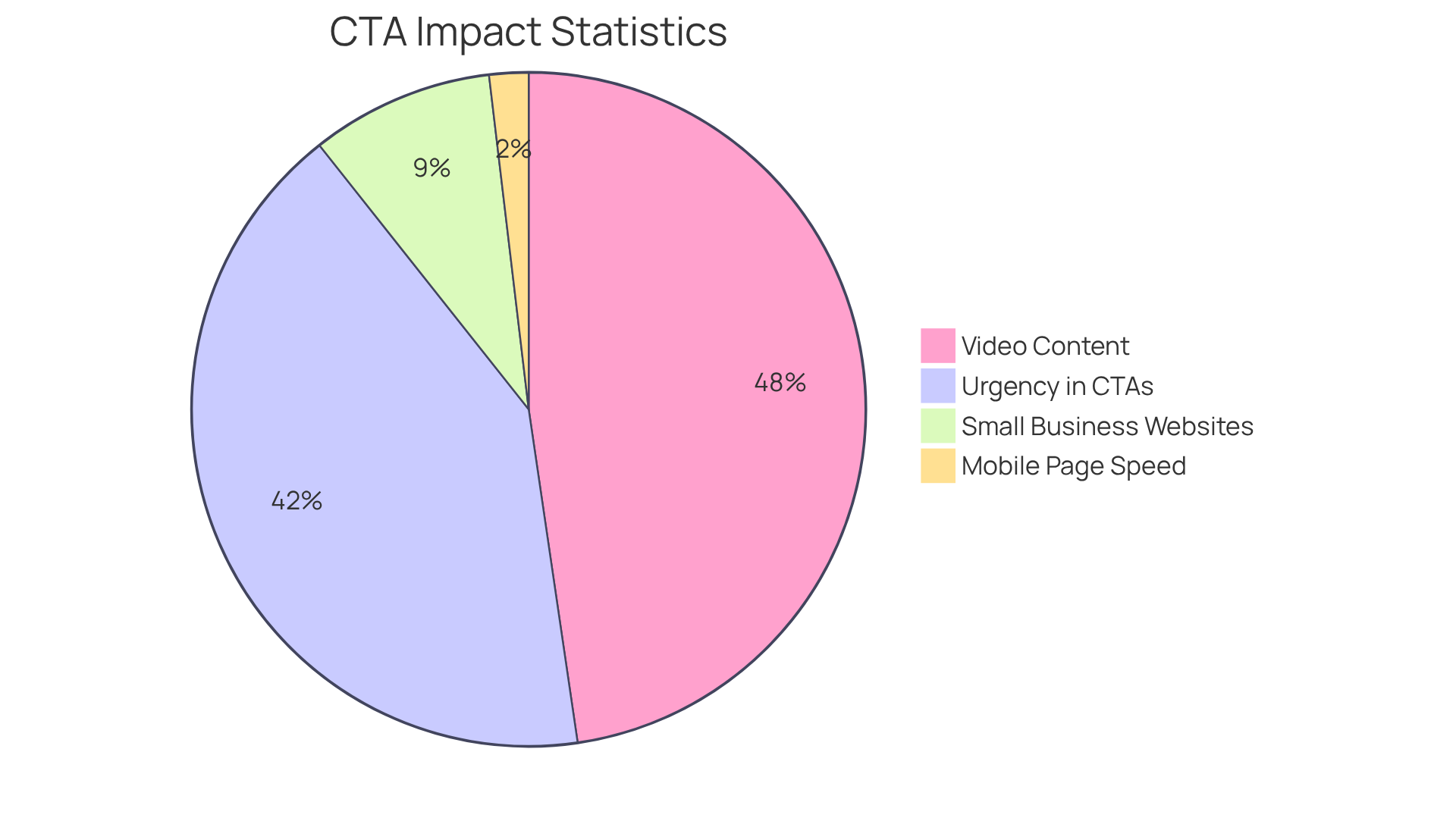
Research reveals that a embedded within video content can enhance conversions by an astounding 380% compared to traditional placements. Furthermore, instilling a sense of urgency in a can lead to that are 332% higher. Additionally, featuring CTAs that load in two seconds or less achieve 15% higher , underscoring the critical role of page speed in user engagement.
Significantly, 70% of small business websites lack a clear , which emphasizes the necessity of in marketing strategies. By grasping the purpose of a CTA, marketers can craft compelling messages that resonate with their audience, ultimately driving desired actions and enhancing overall campaign performance.
Leverage Psychological Triggers in CTAs
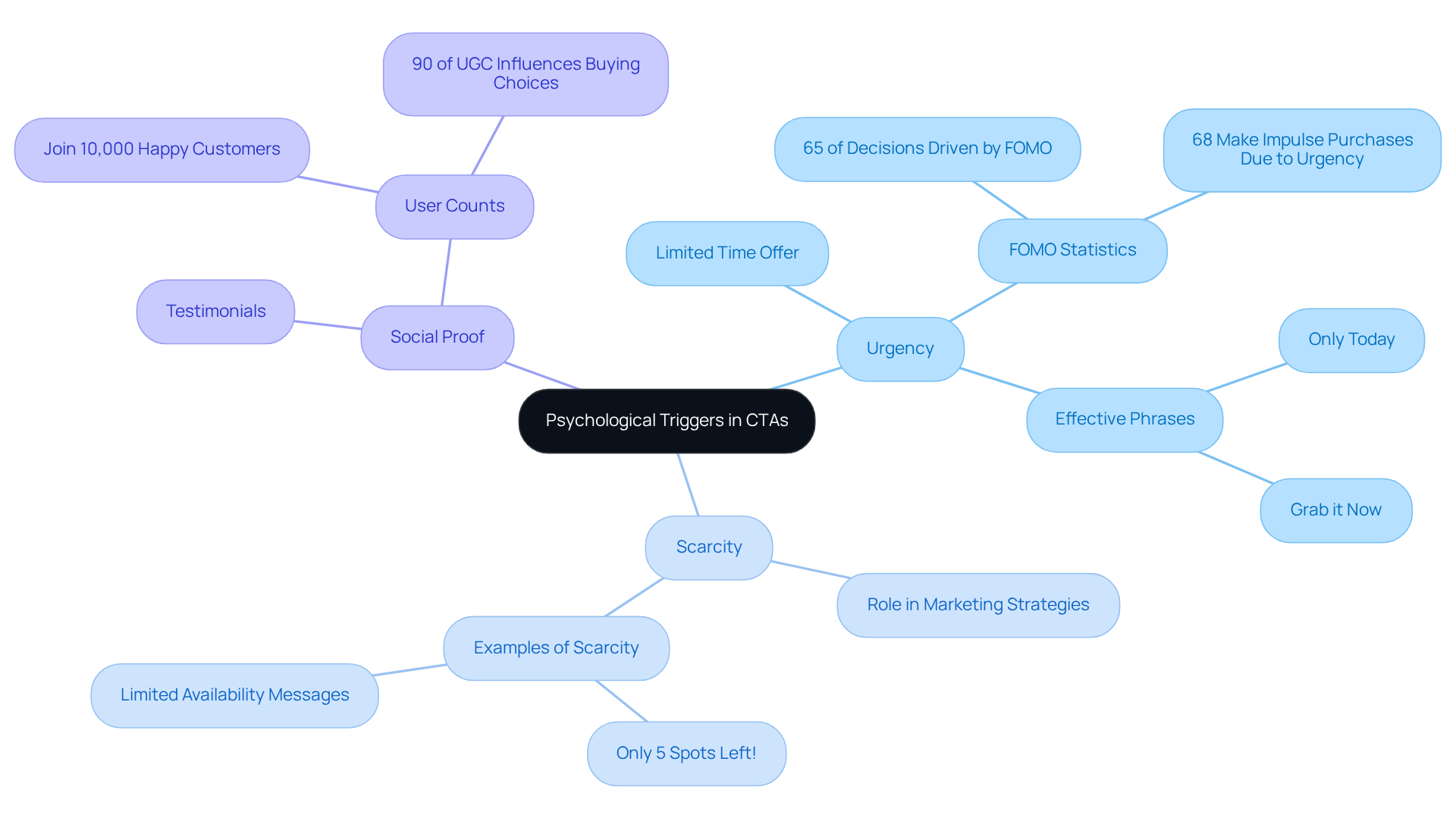
can dramatically boost the effectiveness of call to action ads. Consider this: phrases such as '' instill a sense of urgency, compelling users to act swiftly. Research shows that a staggering 65% of purchasing decisions stem from the , highlighting the critical role urgency plays in marketing strategies.
Furthermore, showcasing testimonials or user counts - like '' - leverages social proof, instilling confidence in potential customers. In fact, , reinforcing the power of social proof in calls to action. However, marketers must tread carefully; overusing FOMO can backfire, leading to negative perceptions if consumers feel manipulated.
Thus, it's vital to thoughtfully consider which align with your brand message and audience. This approach ensures that the call to action ad resonates deeply and drives engagement. Incorporating emotional appeals can further enhance this connection, as they engage consumers on a personal level, prompting them to take action.
Utilize Strong Action Words and Emotional Appeals
Using like 'Discover', 'Join', or 'Get Started' can ignite a and enthusiasm in your . - such as happiness, fear of missing out, or a sense of belonging - can significantly amplify their effectiveness. For example, a CTA that states 'Unlock Your Potential Today!' not only encourages immediate action but also resonates with users' aspirations.
Research indicates that a designed as a button can lead to a 45% increase in clicks, while a can enhance by 42%. Furthermore, a that evokes emotions can boost engagement by up to 75%. Marketers should continuously test various phrases and psychological triggers to discover the most compelling combinations for their audience. Understanding can increase customer value by up to 52%. Notably, one CTA can increase clicks by over 371% and sales by an astonishing 1,617%.
Consider the Always 'Like a Girl' campaign, which resulted in a remarkable rise in favorable associations with the phrase from 19% to 76%. This illustrates how impactful narratives can shift perceptions and motivate action. It is essential to integrate into your marketing strategies while being mindful of the potential pitfalls of emotional advertising, such as the risk of being perceived as manipulative.

Test and Optimize CTAs for Maximum Impact
stands as a formidable strategy for optimizing . By developing two distinct versions of a CTA and meticulously measuring their performance, marketers can pinpoint which elements truly resonate with their audience. Key factors to test encompass:
- Wording
- Color
- Size
- Placement
For instance, a simple shift from 'Learn More' to 'Get Your Free Guide' can significantly .
Furthermore, and offers invaluable insights into the effectiveness of various CTAs. This data empowers marketers to make informed, that enhance overall campaign performance through a . Are you ready to leverage to and ?

Conclusion
Crafting effective call to action ads is not just important; it's essential for driving user engagement and boosting conversion rates. By grasping the core components of a successful CTA, marketers can create compelling messages that truly resonate with their audience, guiding potential customers seamlessly through the sales funnel.
This article highlights several key practices that can elevate your marketing game:
- Defining clear CTAs is crucial.
- Leveraging psychological triggers can significantly enhance your message's impact.
- Utilizing strong action words and implementing A/B testing are strategies that not only improve the effectiveness of call to action ads but also underscore the importance of emotional connections and data-driven decision-making in marketing.
Research shows that these tactics lead to substantial improvements in engagement and conversion rates, proving that well-crafted CTAs can indeed transform marketing efforts.
In conclusion, the significance of effective call to action ads cannot be overstated. Marketers must adopt these best practices to refine their strategies, engage their audience on a deeper level, and drive desired actions. Embracing the power of CTAs will not only enhance individual campaigns but also contribute to long-term marketing success. Are you ready to take your marketing to the next level?
Frequently Asked Questions
What is a call to action (CTA) ad?
A call to action ad is a prompt that encourages users to take specific actions, such as clicking a button, signing up for a newsletter, or making a purchase. It is essential for guiding potential customers through the sales funnel and boosting conversion rates.
Why are clear and concise CTAs important?
Clear and concise CTAs are important because they provide users with explicit guidance on their next steps, which helps to improve the effectiveness of the ad and increase conversion rates.
How much can video content with embedded CTAs enhance conversions?
Research shows that a call to action ad embedded within video content can enhance conversions by an astounding 380% compared to traditional placements.
What effect does urgency have on conversion rates in CTAs?
Instilling a sense of urgency in a call to action ad can lead to conversion rates that are 332% higher.
How does page speed impact conversion rates for mobile pages with CTAs?
Mobile pages featuring CTAs that load in two seconds or less achieve 15% higher conversion rates, highlighting the importance of page speed in user engagement.
What percentage of small business websites lack a clear call to action ad?
70% of small business websites lack a clear call to action ad, indicating the necessity of effective CTAs in marketing strategies.
How can marketers benefit from understanding the purpose of a CTA?
By understanding the purpose of a CTA, marketers can craft compelling messages that resonate with their audience, driving desired actions and enhancing overall campaign performance.
List of Sources
- Define the Call to Action (CTA)
- agilitypr.com (https://agilitypr.com/pr-news/marketing-news/how-to-get-the-most-return-on-calls-to-action-in-influencer-marketing)
- 25 New Call to Action (CTA) Statistics in 2026 (https://wisernotify.com/blog/call-to-action-stats)
- The Power of the Call to Action (https://realnet.co.uk/news/the-power-of-the-call-to-action)
- 30+ Call-to-Action Statistics & Facts | Stats on Marketing CTAs (https://sixthcitymarketing.com/call-to-action-stats)
- Leverage Psychological Triggers in CTAs
- Emotional Triggers in CTAs for High-Quality Lead Generation (https://b2brocket.ai/blog-posts/emotional-triggers-ctas-lead-generation)
- eunbs.com (https://eunbs.com/the-scarcity-effect-and-fear-of-missing-out-fomo-how-the-psychology-of-urgency-drives-sales)
- forbes.com (https://forbes.com/sites/sherzododilov/2024/11/20/the-black-friday-effect-harnessing-scarcity-to-drive-innovation)
- demandscience.com (https://demandscience.com/resources/blog/science-behind-effective-display-ad-design)
- signundsinn.com (https://signundsinn.com/blog-beitrag/The-Psychology-Behind-Successful-CTAs-How-Placement-Color-Choice-and-Wording-Influence-Conversion-Rates)
- Utilize Strong Action Words and Emotional Appeals
- zappi.io (https://zappi.io/web/blog/should-brands-appeal-to-emotion-in-advertising-examples)
- 30+ Call-to-Action Statistics & Facts | Stats on Marketing CTAs (https://sixthcitymarketing.com/call-to-action-stats)
- system1group.com (https://system1group.com/blog/emotions-key-role-in-digital-ad-effectiveness)
- news.illinois.edu (https://news.illinois.edu/paper-emotionally-appealing-ads-may-not-always-help-consumer-memory)
- pmc.ncbi.nlm.nih.gov (https://pmc.ncbi.nlm.nih.gov/articles/PMC7498694)
- Test and Optimize CTAs for Maximum Impact
- A/B test your calls-to-action (CTAs) (https://knowledge.hubspot.com/ctas/ab-test-your-calls-to-actions)
- impulse-analytics.com (https://impulse-analytics.com/en/the-importance-of-a-b-testing-in-optimizing-your-campaigns)
- 30 Key A/B Testing Statistics: A Comprehensive Guide | Wingify (https://vwo.com/blog/ab-testing-statistics)
- 43 Conversion Rate Optimization Statistics [2026] | VWO (https://vwo.com/conversion-rate-optimization/conversion-rate-optimization-statistics)
- marketingsherpa.com (https://marketingsherpa.com/video/optimizing-cta-maximizing-conversions)