
Introduction
Crafting a successful marketing plan isn’t just a checklist; it’s a strategic blueprint that can propel a business toward its goals. Have you ever wondered how a well-structured marketing plan can align your efforts with overarching business objectives while resonating with your target audience? By following a structured outline, marketers can navigate the complexities of creating a winning marketing plan. This article breaks down the process into six straightforward steps, offering insights that can transform marketing strategies and drive measurable results.
Furthermore, these steps are designed to not only enhance your marketing efforts but also to ensure that they are effective and impactful. Let’s explore how you can take actionable steps toward developing a marketing plan that truly works for your business.
Define the Purpose of Your Marketing Plan
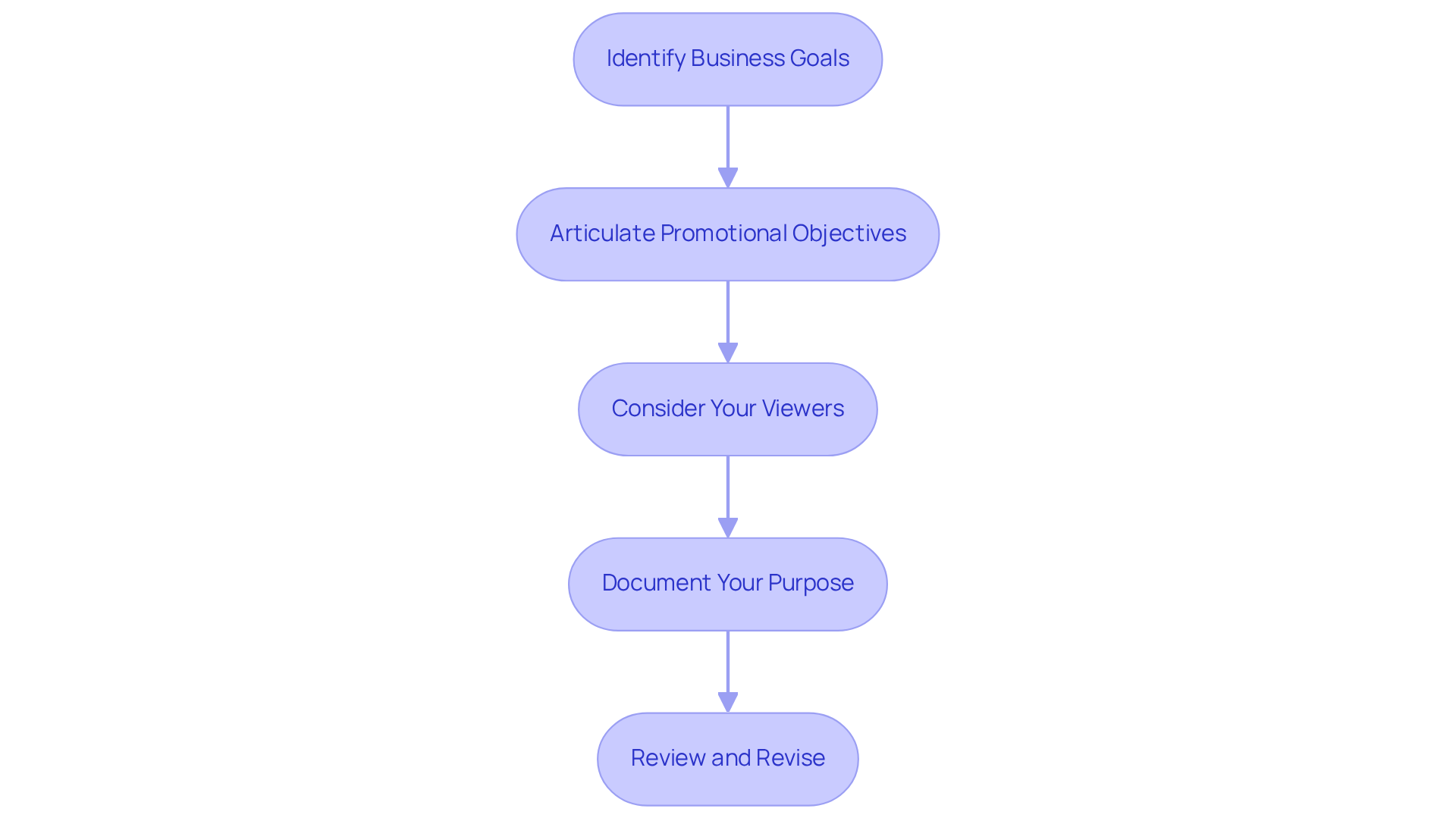
To define the purpose of your marketing plan, follow these steps:
- Identify : Start by reviewing your company's overarching objectives. Key outcomes may include increasing sales, expanding market share, or enhancing brand awareness. In 2026, .
- Articulate : Transform your business aims into specific . For instance, if your aim is to increase sales by 20%, your promotional objective could be to generate 1,000 new leads each month. Notably, only about 30% of companies establish objectives that align with their , highlighting a significant opportunity for improvement. Furthermore, 4. This is part of the marketing plan outline4. This is part of the marketing plan outline% of businesses lack a quantitative understanding of their promotional efforts' impact, underscoring the necessity of defining clear objectives for promotion.
- Consider Your Viewers: Reflect on how your promotional efforts will address the needs of your . Understanding the problems you solve for them will and tactics, ensuring relevance and engagement. As Leah Messenger states, 'If you don’t know your audience, you will struggle to reach them - and no plan in the world can save you.'
- Document Your Purpose: Craft a clear statement that encapsulates the purpose of your promotional plan. This statement should be concise and act as a guiding principle for all promotional activities, reinforcing the importance of a unified approach across channels.
- Review and Revise: As your business evolves, revisit your purpose statement regularly to ensure it remains relevant and aligned with your current goals. This adaptability is crucial in a dynamic business landscape, where ongoing adjustments can lead to improved outcomes. is essential.
Conduct a Situation Analysis
To conduct a effectively, follow these essential steps:
- : Start by collecting relevant data on your market, competitors, and internal capabilities. This includes sales figures, customer feedback, and market research reports that provide a comprehensive view of your landscape.
- Perform a : Next, identify your organization's Strengths, Weaknesses, Opportunities, and Threats. This framework is crucial for evaluating both internal and external factors that could impact your promotional efforts.
- : Delve into your competitors' strategies to understand their strengths and weaknesses. What methods are they employing? How do they position themselves in the market? This insight is invaluable for refining your approach.
- Identify : Keep an eye out for . Are there shifts in consumer behavior or technological advancements that could shape your promotional strategy? Recognizing these trends early can give you a competitive edge.
- Summarize Findings: Finally, document your findings clearly and concisely. This summary will serve as a vital reference point for , ensuring that your strategies are informed and effective.

Identify Your Target Audience
To effectively identify your , follow these essential steps:
- Analyze Existing Customers: Begin by reviewing your current to pinpoint common characteristics. Examine . This foundational analysis sets the stage for deeper insights.
- Conduct : Engage in thorough using surveys, focus groups, and interviews to gather valuable insights about potential customers. What are their ? What drives their purchasing decisions? Understanding these elements is crucial for tailoring your promotional strategies.
- Create : Develop detailed profiles of your ideal customers, encompassing their demographics, interests, and challenges. As noted, " are detailed profiles of your ideal customers that include demographics, behaviors, motivations, and ." This visualization enhances your strategy by clarifying who your audience truly is.
- Segment Your Groups: Divide your audience into segments based on . Effective include demographic segmentation, where customers are grouped by age, gender, income, education, or occupation. This approach allows for more focused promotional efforts that directly address each group's unique needs.
- Test and Refine: Continuously evaluate your across various demographic groups. Utilize analytics to track engagement and adjust your approach based on what resonates best. With a in the U.S. projected at 83% in 2025, regularly updating your is vital to ensure your strategies align with evolving customer preferences and market trends.
Looking ahead to 2026, understanding your will increasingly depend on insights derived from both qualitative and quantitative data. This shift emphasizes that s will form around shared moments of need, rather than merely shared platforms.

Set SMART Goals and Objectives
To set and objectives, follow these essential steps:
- Specific: Define . Instead of saying, "increase sales," specify, "." This clarity sets a focused direction for your efforts.
- Measurable: . This enables you to monitor progress effectively and identify when the objective has been reached. How will you know when you've succeeded?
- Achievable: Set that can be accomplished within the given timeframe and with the available resources. Consider past performance and market conditions. Are your goals attainable?
- Relevant: . Ensure that reaching these objectives will contribute to the overall success of the organization. Do these goals resonate with your company’s mission?
- Time-bound: for achieving each objective. This creates a sense of urgency and helps prioritize tasks. What’s your timeline for success?
- : Write down your and share them with your team to ensure everyone is aligned and accountable. This step fosters commitment and clarity among all members.

Outline Your Marketing Strategies and Tactics
To effectively outline your , consider these essential steps:
- : Identify which channels - such as social media, email, or content marketing - will best connect with your target demographic. Where do your viewers spend their time? Understanding this is crucial for maximizing your outreach.
- : but also compelling, resonating deeply with your audience. Your messaging should align seamlessly with your brand voice while addressing the of your customers.
- Create a : Planning your content and campaigns in advance is vital. A marketing plan outline that includes a ensures consistency and allows for strategic timing of your promotional efforts, enhancing overall effectiveness.
- : Assess what resources - be it budget, personnel, or tools - are necessary for each approach. It’s essential to ensure you have the right support to execute your plan effectively.
- : Launch your and closely track their performance. Utilize analytics to monitor engagement and be prepared to adjust tactics as needed to optimize your results.

Determine Your Budget and Resource Allocation
To effectively determine your budget and , follow these essential steps:
- Review Historical Data: Start by analyzing past and their outcomes. This analysis will provide valuable insights into what strategies have proven successful and which ones have not.
- : With your overall business objectives and anticipated income in mind, establish a total budget for your promotional efforts. This figure will guide your spending decisions moving forward.
- Allocate by Channel: Distribute your based on their expected effectiveness and alignment with your target audience. This strategic allocation ensures that your resources are utilized where they can make the most impact.
- Consider Fixed and Variable Costs: It's crucial to - and variable costs, like campaign-specific expenses. This comprehensive approach to budgeting will help you avoid unexpected financial pitfalls.
- : Regularly and results. Be prepared to adjust your allocations based on performance metrics and changing market conditions, ensuring your promotional strategy remains agile and effective.

Establish Measurement and Reporting Framework
To establish a robust measurement and reporting framework, it’s essential to follow these key steps:
- Define : What metrics will truly gauge your success? Identifying the right KPIs is crucial. Common examples include , , and . By 2026, successful marketers will prioritize business-impact indicators that clearly demonstrate ROI, moving beyond traditional metrics.
- Set Up Tracking Mechanisms: How will you ? Implementing the right tools and systems is vital. This could involve analytics software, CRM systems, and promotion automation tools. Organizations that excel in will gain a competitive edge through efficient resource allocation and improved customer targeting.
- Create Reporting Templates: Are your ? Developing standardized reporting templates is key to sharing performance data with stakeholders. Consistency and clarity in reporting are crucial for effective communication and informed decision-making.
- Schedule Regular Reviews: When was your last performance review? Establishing a routine for reviewing performance data is essential. Regular check-ins allow for prompt adjustments based on insights gained from the data. Dynamic dashboards provide live data, enhancing collaboration and reducing the need for manual analysis.
- Use Insights for Optimization: How can you leverage your data for improvement? to identify trends and areas for enhancement is vital. Utilizing insights enables the , ultimately boosting overall performance. In 2026, effective marketing KPIs will focus on understanding the complete customer journey rather than vanity metrics, ensuring that every marketing dollar is spent wisely.

Conclusion
Creating a successful marketing plan is not just a task; it’s a strategic endeavor that demands careful attention to various elements. From defining your purpose to establishing a robust measurement framework, every step is crucial. By adhering to these outlined steps, businesses can effectively align their promotional strategies with overarching goals, ensuring that each marketing initiative contributes to overall success.
Throughout this discussion, we’ve highlighted critical components such as:
- Conducting a thorough situation analysis
- Identifying the target audience
- Setting SMART goals
Each of these steps is vital in crafting a cohesive marketing strategy that resonates with potential customers and adapts to the ever-changing market dynamics. Moreover, the significance of resource allocation and performance measurement cannot be overstated; they are essential for optimizing marketing efforts and achieving desired outcomes.
Ultimately, developing a winning marketing plan is an ongoing journey that requires a steadfast commitment to continuous improvement. Embracing adaptability and leveraging insights from data will empower marketers to refine their strategies and enhance effectiveness. By prioritizing these elements, organizations can navigate the complexities of the marketing landscape and position themselves for success in the competitive environment of 2026 and beyond.
Frequently Asked Questions
What is the first step in defining the purpose of a marketing plan?
The first step is to identify business goals by reviewing the company's overarching objectives, such as increasing sales, expanding market share, or enhancing brand awareness.
How should promotional objectives be articulated?
Promotional objectives should be transformed from business aims into specific targets. For example, if the aim is to increase sales by 20%, the promotional objective could be to generate 1,000 new leads each month.
Why is it important to consider your viewers when creating a marketing plan?
Considering your viewers is important because understanding their needs and the problems you solve for them will guide your messaging and tactics, ensuring relevance and engagement.
What should a purpose statement for a promotional plan include?
A purpose statement should be clear and concise, encapsulating the purpose of the promotional plan and acting as a guiding principle for all promotional activities.
How often should the purpose statement be reviewed and revised?
The purpose statement should be revisited regularly to ensure it remains relevant and aligned with current business goals, adapting to changes in the dynamic business landscape.
What is the first step in conducting a situation analysis?
The first step is to gather relevant data on the market, competitors, and internal capabilities, including sales figures, customer feedback, and market research reports.
What does a SWOT analysis involve?
A SWOT analysis involves identifying an organization's Strengths, Weaknesses, Opportunities, and Threats to evaluate both internal and external factors impacting promotional efforts.
Why is analyzing competitors important in a situation analysis?
Analyzing competitors helps understand their strategies, strengths, and weaknesses, providing valuable insights for refining your own promotional approach.
What should be monitored to identify market trends?
Emerging trends in the industry should be monitored, including shifts in consumer behavior or technological advancements that could influence your promotional strategy.
What is the final step in conducting a situation analysis?
The final step is to summarize the findings clearly and concisely, creating a vital reference point for crafting informed and effective promotional plans.
List of Sources
- Define the Purpose of Your Marketing Plan
- optimizely.com (https://optimizely.com/insights/blog/marketing-statistics)
- Marketing Statistics: 100+ Insights for 2026 (https://salesforce.com/marketing/marketing-statistics)
- clementinecreativeagency.com (https://clementinecreativeagency.com/blog/clementine-news/7-keys-to-a-successful-marketing-plan-for-2026)
- atomicdust.com (https://atomicdust.com/marketing-planning-for-2026-everything-you-need-to-know)
- Conduct a Situation Analysis
- Unpacking the marketing industry trends forecast for 2026 (https://marketingdive.com/news/marketing-trends-outlook-2026/810740)
- linkedin.com (https://linkedin.com/posts/ang-business-services-llc_swotanalysis-businesshumor-marketingmarkup-activity-7434681507568541697-7stn)
- deepresearchglobal.com (https://deepresearchglobal.com/p/red-bull-swot-analysis-report)
- ama.org (https://ama.org/marketing-news/2026-trends-report)
- 2026 State of Marketing Report (https://hubspot.com/state-of-marketing)
- Identify Your Target Audience
- statista.com (https://statista.com/topics/2477/online-shopping-behavior?srsltid=AfmBOopTe-C76RpE-uoK6uIVg4WCwFDv_6VlCql7GuccoZHAuP57f2ph)
- Target Audiences In 2026: How Discovery And Engagement Actually Work Now - Ciente (https://ciente.io/blogs/target-audiences-in-2026)
- Target Market Analysis in 2026 (How to Identify Customers) (https://bigcommerce.com/articles/ecommerce/target-market-analysis)
- blackpugstudio.com (https://blackpugstudio.com/news/how-to-find-your-brands-audience-in-2026-a-guide-eafd55c2f1a1)
- meteorspace.com (https://meteorspace.com/2025/01/28/e-commerce-consumer-buying-behaviour-trends-and-statistics)
- Set SMART Goals and Objectives
- Setting SMART Goals for 2026: A Practical Guide for Small Business Owners (https://web.uri.edu/risbdc/setting-smart-goals-for-2026-a-practical-guide-for-small-business-owners)
- clementinecreativeagency.com (https://clementinecreativeagency.com/blog/clementine-news/7-keys-to-a-successful-marketing-plan-for-2026)
- 60+ Goal Setting Statistics You Can't Ignore in 2026 (https://mooncamp.com/blog/goal-setting-statistics)
- brainiacmedia.net (https://brainiacmedia.net/blogs/how-to-set-marketing-goals-with-smart-strategies-2026?srsltid=AfmBOooYNhkSnFsgXeuvnpoul4VEL7Ab8sdZEua23utNqFBsAIev988t)
- How to Set SMART Business Goals for 2026 - Go Succeed (https://go-succeed.com/how-to-set-smart-business-goals-for-2026)
- Outline Your Marketing Strategies and Tactics
- Unpacking the marketing industry trends forecast for 2026 (https://marketingdive.com/news/marketing-trends-outlook-2026/810740)
- 5 Marketing Trends Brands Can’t Ignore in 2026 | News & Blog (https://thepointgroup.com/5-marketing-trends-brands-cant-ignore-in-2026)
- Marketing Statistics: 100+ Insights for 2026 (https://salesforce.com/marketing/marketing-statistics)
- 2026 Marketing Strategy: What Brands Should Prioritize This Year (https://mandr-group.com/2026-marketing-strategy-what-brands-should-prioritize-this-year)
- medianug.com (https://medianug.com/blog/10-essential-marketing-channels-for-brand-success-in-2026)
- Determine Your Budget and Resource Allocation
- neilpatel.com (https://neilpatel.com/blog/marketing-budget-trends-2026)
- marketingcharts.com (https://marketingcharts.com/charts/enterprise-companies-marketing-budget-allocation-by-channel/page/9?et_blog)
- gartner.com (https://gartner.com/en/newsroom/press-releases/2025-06-02-gartner-survey-finds-digital-channels-account-for-61-point-1-percent-of-total-marketing-spend)
- discern.io (https://discern.io/metric/marketing-spend-by-channel)
- statista.com (https://statista.com/statistics/1222784/marketing-budget-share-channel?srsltid=AfmBOorCN816BokBIEKRrQrqz3RkLDHU_Hjq7XhYrILwFus4RwKloNi8)
- Establish Measurement and Reporting Framework
- Unpacking the marketing industry trends forecast for 2026 (https://marketingdive.com/news/marketing-trends-outlook-2026/810740)
- Top Marketing KPIs for Leaders in 2026: Track & Optimize ROI (https://ravetree.com/blog/top-marketing-kpis-every-leader-should-track)
- martech.org (https://martech.org/5-ways-to-improve-marketing-measurement-in-2026)
- monday.com (https://monday.com/blog/project-management/marketing-kpis)
- statista.com (https://statista.com/statistics/379580/digital-marketing-success-metrics-worldwide?srsltid=AfmBOootijACniv4MUbQv_h1P2kD_DHwU7p9i1GsGFxvKz9inT0LIlQ8)