
Introduction
Effective stock management stands as the backbone of any successful e-commerce venture. Yet, many online retailers find themselves grappling with the complexities of sourcing and inventory control. How can they navigate these challenges? Understanding how to procure stock for an online store not only meets customer demand but also protects financial health, making it a critical aspect of business strategy.
With a myriad of sourcing methods and inventory management techniques available, retailers must ask themselves: are they making the right choices to optimize their operations and meet market needs? This question is paramount. By delving into effective strategies, retailers can enhance their operational efficiency and ensure they are well-equipped to respond to market fluctuations.
In addition, successful case studies illustrate the tangible benefits of robust stock management practices. These examples not only showcase the potential for increased profitability but also highlight the importance of strategic decision-making in sourcing and inventory control. As we explore these concepts further, consider how your own practices align with these insights. What steps can you take today to improve your stock management and drive your e-commerce success?
Understand the Importance of Stock in E-Commerce
In e-commerce, effective involves knowing how to get stock for an online store, which is essential for the success of your business. Maintaining optimal satisfies client demand and protects your budget. Here are some key considerations:
- : Are you ensuring that the right products are available when customers want them? This is vital for fostering satisfaction and loyalty. Stockouts can lead to and erode trust. In fact, studies show that stockouts generate approximately $1 trillion in annually worldwide. Alarmingly, 69% of customers may turn to competitors when faced with unavailable items.
- : How efficiently are you managing your stock? Efficient is key to maintaining healthy cash flow. Overstocking ties up capital that could be better directed towards growth, while stockouts can result in missed revenue opportunities. Organizations typically carry $142,000 above actual demand, which could be redirected towards investments in marketing or technology. Furthermore, 54% of companies face challenges with , leading to surplus stock buildup.
- Market Responsiveness: Do you understand your well enough to respond swiftly to ? Understanding your enables , keeping you competitive. For instance, leading wholesale distributors maintain an average lead time of only 18.7 days, compared to 63.1 days for underperforming operations. This highlights the significance of agility in .
- : Are you streamlining your processes? Streamlined reduces costs associated with storage and handling. Real-time stock monitoring can enhance precision by 35%, minimizing mistakes that lead to shortages and surplus stock. Updating practices and utilizing technology are crucial for improving .
By grasping these concepts, you can better appreciate how to get stock for an online store and manage your inventory effectively. This understanding is vital for ensuring that your online store thrives in a competitive landscape.

Identify Your Target Market and Product Selection
Identifying your is crucial for learning how to get stock for an online store effectively. Here’s how to do it:
- Conduct : Utilize surveys, social media insights, and competitor analysis to gather valuable data on prospective clients. Efficient research techniques, such as email questionnaires and exit surveys, can offer insights into client responsibilities and preferences. Did you know that retail e-commerce sales are projected to surpass 3.6 trillion U.S. dollars globally by 2025? This statistic underscores the significance of comprehensive industry research in an expanding sector.
- Define Client Personas: Create detailed profiles of your ideal clients, incorporating demographics, interests, and . Studies show that 90% of firms utilizing gain a clearer comprehension of their , which is crucial for customizing marketing strategies. Furthermore, 93% of businesses that surpass lead and revenue objectives categorize their by . This highlights the effectiveness of this strategy in driving success.
- Analyze Trends: Stay informed about and to identify sought-after items. For instance, consumer packaged goods with ESG-related claims have experienced a 28% increase over five years. This emphasizes the importance of aligning your offerings with consumer values. Moreover, 73% of clients feel brands treat them as individuals, showcasing the necessity for personalized marketing strategies based on consumer personas.
- Test Concepts: Launch small batches of items to gauge interest before committing to larger orders. This approach enables you to enhance your offerings based on genuine and purchasing behavior, ensuring that your inventory aligns with market demand.
- Utilize Analytics Tools: Leverage tools like Google Analytics to track visitor behavior on your site. Understanding how customers engage with your online shop can assist you in and improving the overall shopping experience.
By following these steps on how to get stock for an online store, you can ensure that the items you choose resonate with your , significantly increasing the likelihood of sales.

Explore Sourcing Methods for Your Stock
After pinpointing your target market and selecting products, it’s time to delve into various sourcing methods that can elevate your business:
- is an effective method for learning by acquiring items at lower prices through bulk purchasing. This strategy can significantly boost profit margins, which typically range from 10% to 20%. As noted by , fostering can lead to long-term savings and improved product quality. Brands that rely on unsupervised supplier networks risk losing up to 30% more due to quality defects, underscoring the necessity of .
- Dropshipping: This model enables you to sell products without holding inventory, drastically reducing initial costs. The global , with a remarkable CAGR of 23.4% from 2024 to 2029. This flexibility allows retailers to quickly test new products and adapt to market trends while understanding without the burden of unsold stock.
- Manufacturers: Engaging directly with manufacturers can yield customized products or lower costs. While this approach often involves longer lead times-typically 3 to 6 months from concept to listing-it can result in higher profit margins, especially for private labels, which can frequently exceed 40%.
- Online Marketplaces: Platforms such as Alibaba and Faire serve as invaluable resources for discovering suppliers and comparing prices. They provide access to a wide array of products and suppliers, streamlining the sourcing process.
- Local Craftspeople: can differentiate your offerings and attract niche audiences. This approach not only bolsters but also enriches your brand's storytelling.
Understanding involves recognizing that each comes with its own set of advantages and challenges. Therefore, it’s crucial to assess them based on your business model and the specific needs of your target market.

Implement Inventory Management Strategies
Knowing how to get stock for an is essential for and the success of your business. Are you ready to elevate your inventory game? Here are key strategies to implement:
- Use : Invest in robust software that provides real-time tracking of stock levels, sales, and orders. This technology automates reorder point calculations, reducing manual errors and ensuring timely replenishment.
- Set Reorder Points: Establish before you run out. For instance, if your average daily sales rate is 5.3 units and your lead time is 2 days, a reorder point of 10 units guarantees you maintain adequate stock. As noted by Aratum, " by accounting for lead times and potential operational delays."
- : Perform periodic inventory audits to verify stock accuracy and identify discrepancies. This practice helps prevent stockouts and overstock situations, which can harm customer satisfaction and increase holding costs.
- Adopt : Implement the First In, First Out (FIFO) method for managing perishable goods or items with expiration dates. This approach minimizes waste and ensures that older stock is sold first, maintaining product quality.
- : Regularly review sales data to identify trends and adjust stock levels accordingly. Understanding seasonal demand fluctuations can help you optimize safety stock levels, ensuring you are prepared for peak periods without overcommitting resources. A case study of Best Vinyl illustrates this, as they successfully decreased their stock by 50% through effective demand and supply planning strategies.
By implementing these strategies, you will understand how to get stock for an , maintain optimal stock levels, reduce costs, and enhance customer satisfaction. Take action now to drive growth for your !

Analyze Stock Performance and Optimize Inventory
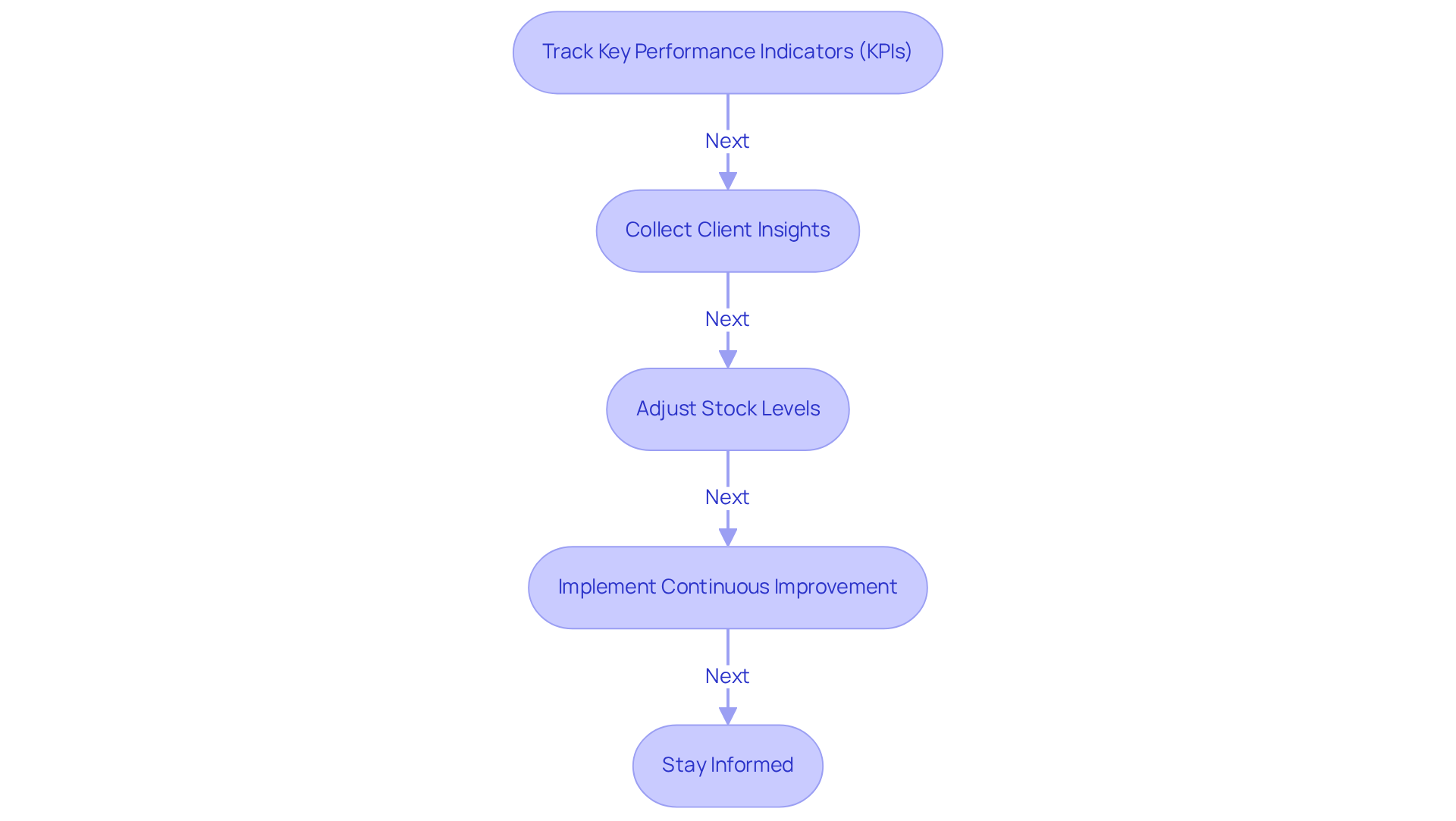
To ensure effective inventory management, regularly analyzing stock performance and optimizing your inventory is essential through the following strategies:
- Track Key Performance Indicators (KPIs): Monitor critical metrics such as , stockout rate, and . These KPIs provide insights into how well your inventory is performing and highlight areas for improvement.
- Collect Client Insights: Actively request client feedback to determine which items resonate with your audience and which do not. Research indicates that utilizing . This makes it an essential tool for comprehending product performance. As Jeff Bezos emphasizes, "" is vital in driving business success.
- Adjust Stock Levels: Utilize performance data to make informed decisions about stock levels. By aligning stock with actual demand, you can avoid overstocking and reduce , ultimately enhancing profitability. and cut lost sales due to stockouts by up to 65% compared with traditional methods.
- Implement Continuous Improvement: Regularly review and refine your stock management processes. This iterative method enables you to adjust to evolving conditions and enhance .
- Stay Informed: Keep abreast of industry trends and shifts in consumer behavior. Grasping these dynamics allows you to modify your stock strategy proactively, ensuring your online store stays competitive. The , is expected to expand to nearly $60 billion by 2030. This emphasizes the significance of effective stock management in a swiftly changing environment.
By continuously analyzing and optimizing your inventory, you can enhance your online store's responsiveness to market demands and improve overall performance.
Conclusion
Effective stock management stands as a cornerstone of successful e-commerce, underscoring the critical need to understand how to acquire stock for an online store. By mastering the steps outlined in this guide, businesses can not only meet customer demand but also optimize their financial resources. This balance is essential for fostering customer loyalty and driving long-term growth.
Throughout this article, we’ve highlighted key strategies - from identifying target markets and selecting the right products to exploring various sourcing methods and implementing robust inventory management techniques. The significance of maintaining optimal stock levels cannot be overstated; it directly influences customer satisfaction, cash flow, and overall operational efficiency. By leveraging insights from market research and analytics, businesses can refine their offerings and adapt to shifting consumer preferences.
In today’s rapidly evolving retail landscape, prioritizing effective stock management is vital for thriving. Embracing these essential steps not only enhances inventory control but also positions online stores to respond swiftly to market trends and consumer needs. Taking action now to implement these strategies will pave the way for sustainable success in the competitive world of e-commerce.
Frequently Asked Questions
Why is stock management important in e-commerce?
Effective stock management is crucial for the success of an e-commerce business as it helps maintain optimal stock levels, satisfies customer demand, and protects the budget.
How does stock availability affect customer satisfaction?
Ensuring the right products are available when customers want them is vital for customer satisfaction and loyalty. Stockouts can lead to lost sales and erode trust, with studies indicating that stockouts result in approximately $1 trillion in lost sales annually worldwide.
What impact does efficient stock management have on cash flow?
Efficient stock management helps maintain healthy cash flow by preventing overstocking, which ties up capital, and stockouts, which can lead to missed revenue opportunities. Many organizations carry excess stock that could be redirected towards investments instead.
How can understanding stock levels improve market responsiveness?
Understanding stock levels allows businesses to respond quickly to market trends and consumer demands, keeping them competitive. Leading wholesale distributors have significantly shorter lead times compared to underperforming operations.
What role does operational efficiency play in stock management?
Streamlined stock management processes reduce costs associated with storage and handling. Real-time stock monitoring enhances precision and minimizes mistakes, which is essential for maintaining optimal stock levels.
How can businesses identify their target market effectively?
Businesses can identify their target market by conducting market research, defining client personas, analyzing trends, testing concepts, and utilizing analytics tools to understand customer behavior.
What methods can be used for conducting market research?
Methods for conducting market research include surveys, social media insights, competitor analysis, email questionnaires, and exit surveys to gather data on prospective clients.
Why is defining client personas beneficial for businesses?
Creating detailed profiles of ideal clients helps businesses understand their target audience better, which is crucial for customizing marketing strategies. Companies that use buyer personas tend to have clearer insights into their customers.
How can businesses test product concepts before large-scale orders?
Businesses can launch small batches of items to gauge interest and gather genuine client feedback, ensuring that their inventory aligns with market demand before committing to larger orders.
What tools can businesses use to analyze customer behavior?
Tools like Google Analytics can be leveraged to track visitor behavior on an online store, assisting businesses in optimizing item selection and improving the overall shopping experience.
List of Sources
- Understand the Importance of Stock in E-Commerce
- blog.megaventory.com (https://blog.megaventory.com/2025/12/ecommerce-inventory-forecasting-why-it-matters-for-small-businesses-in-2026)
- hbr.org (https://hbr.org/2024/10/how-online-retailers-can-avoid-costly-out-of-stock-issues)
- retalon.com (https://retalon.com/blog/ecommerce-inventory-management)
- anchorgroup.tech (https://anchorgroup.tech/blog/wholesale-inventory-management-statistics)
- mirakl.com (https://mirakl.com/blog/out-of-stocks-ecommerce-inventory-management-problem)
- Identify Your Target Market and Product Selection
- How to Build Customer Personas (https://business.com/articles/build-customer-personas)
- cmswire.com (https://cmswire.com/customer-experience/customer-personas-do-you-really-know-your-customers)
- pollfish.com (https://pollfish.com/resources/blog/survey-guides/how-to-identify-and-build-customer-personas-with-market-research)
- statista.com (https://statista.com/topics/871/online-shopping?srsltid=AfmBOop2iNINa8u5vbrkBa8ekZSPqdL_UVEmbrDK8ZBn2CKPiji_EQGP)
- The Beginner’s Guide to Defining Buyer Personas | Digital Marketing Institute (https://digitalmarketinginstitute.com/blog/the-beginners-guide-to-defining-buyer-personas)
- Explore Sourcing Methods for Your Stock
- qogita.ghost.io (https://qogita.ghost.io/blog/how-to-source-products-2026)
- research.g2.com (https://research.g2.com/insights/drop-shipping-for-e-commerce-entrepreneurs)
- unicargo.com (https://unicargo.com/best-sourcing-alternatives-china-amazon-sellers-2026)
- topdawg.com (https://topdawg.com/blog/top-benefits-of-dropshipping-for-ecommerce-retailers)
- sana-commerce.com (https://sana-commerce.com/blog/the-pros-and-cons-of-dropshipping)
- Implement Inventory Management Strategies
- retail-support.lightspeedhq.com (https://retail-support.lightspeedhq.com/hc/en-us/articles/115000271633-Setting-reorder-points-and-desired-inventory-levels)
- quickbooks.intuit.com (https://quickbooks.intuit.com/ca/resources/accounting/reorder-point)
- netstock.com (https://netstock.com/blog/reorder-point-formula)
- aratum.com (https://aratum.com/perspective/reorder-points)
- support.finaleinventory.com (https://support.finaleinventory.com/hc/en-us/articles/115007486128-How-do-I-set-reorder-points-for-my-products)
- Analyze Stock Performance and Optimize Inventory
- Top Inventory Management Trends to Watch for in 2026 (https://unleashedsoftware.com/blog/inventory-management-trends)
- Customer Feedback: What It Is and 6 Ways to Collect It in 2026 (https://contentsquare.com/guides/customer-feedback)
- Top 19 Inventory Management Trends to Know in 2026 | Dynamic Distributors (https://dynamicdis.com/post/inventory-management-trends)
- nasdaq.com (https://nasdaq.com/articles/hidden-in-plain-sight-how-to-decode-customer-reviews-for-investment-insights)