
Introduction
Understanding the complexities of ad rank is crucial for marketers who want to maximize their online advertising effectiveness. In the fiercely competitive realm of digital marketing, especially on platforms like Google Ads, enhancing ad rank can significantly boost visibility, increase click-through rates, and ultimately drive better conversions. However, the challenge lies in navigating the various factors that influence ad rank, including bid amounts and quality scores.
How can marketers strategically optimize these elements to ensure their ads not only reach the right audience but also achieve the desired impact? By focusing on these critical aspects, marketers can position themselves for success in a crowded marketplace.
Understand Ad Rank: Definition and Importance
Ad position is a pivotal metric that dictates your ad's placement on search engine results pages (SERPs). It’s determined by several factors, including your bid amount, the quality of your ads, and the expected impact of ad extensions. A higher , which can significantly enhance and conversions. As of 2026, the stands at 3.17%, underscoring the importance of effective ad positioning strategies. With Google Ads commanding an impressive 80.2% share of the global PPC market, its role in driving online traffic cannot be overstated.
Understanding ad placement is essential not just for determining where your advertisement appears, but also for influencing the (CPC). Companies that understand how to can achieve their , which averages 3.52 across sectors. This suggests that understanding how to can lead to more efficient spending and greater returns on your advertising investment.
Real-world examples illustrate the impact of ad position on performance. Companies that prioritize improving their ad quality and relevance often experience a notable increase in conversions, with the Dating and Personals sector reaching conversion rates as high as 9.64% in 2026. Experts emphasize that aligning ad messaging with user intent and optimizing for mobile can further boost visibility and engagement. Thus, it’s crucial for marketers to focus on how to as a priority in their campaign strategies.

Identify Key Factors: Bids and Quality Score
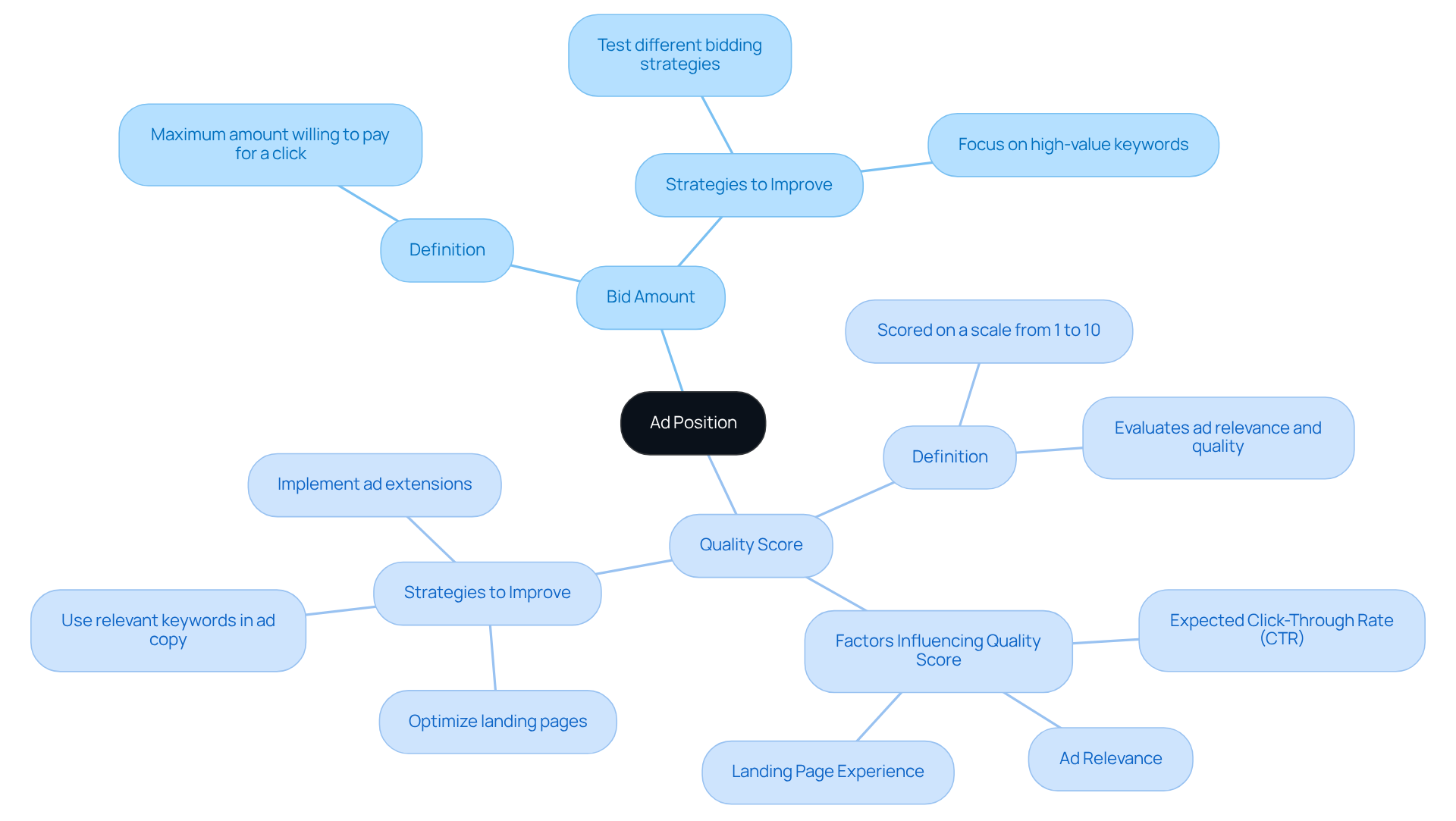
Ad position hinges on two pivotal factors:
- Your
- Your Quality Score
Your represents the maximum you're willing to pay for a click on your ad. Conversely, , keywords, and destination sites. Scored on a scale from 1 to 10, higher scores signify better quality.
To elevate your , learn how to . This can be achieved through relevant ad content and . By understanding and improving these elements, you can discover how to improve and significantly boost your .
Enhance Quality Score: Strategies for Improvement
To enhance your , consider implementing these powerful strategies:
- Improve : Align your closely with targeted keywords. Using language that resonates with your audience can significantly boost engagement. Brands that prioritize often see improved performance metrics; ads that match user intent lead to higher click-through rates (CTR).
- Optimize Landing Zones: A seamless is crucial. Ensure your site loads quickly-preferably within 5 seconds-since . The content should be relevant and directly related to the ad, creating a cohesive user journey that enhances both user experience and . Notably, the is approximately 26%, serving as a benchmark for effectiveness.
- : Craft compelling that encourages clicks. Strong calls to action and engaging headlines can lead to a conversion rate increase of 250-300%. Testing different variations of your ads can help identify the most effective messaging.
- Utilize : Regularly filter out by employing . This practice not only improves your CTR but also enhances your by ensuring that your ads are shown to a more targeted audience.
- Leverage : Incorporating video on landing sites can boost conversions by as much as 86%. Given that 38.6% of marketers recognize video as having the most significant positive impact on conversion rates, this strategy can be a game-changer for and engagement.
- Monitor and Adjust: Continuously analyze your ad performance and landing site metrics. Brands that adapt their strategies based on data insights often see substantial improvements in and overall campaign effectiveness. For instance, companies that increase their number of landing sites can experience a 55% rise in lead generation. Furthermore, it's crucial to mention that 44% of B2B companies direct ad traffic to generic home sites instead of specific landing destinations, which is a frequent error to evade.
By focusing on these strategies, you can significantly enhance your , which will help you understand how to improve ad rank, leading to better ad placements and improved campaign performance.

Optimize Ad Relevance and Landing Page Experience
To enhance ad relevance and , consider these essential steps:
- : It's crucial to ensure that your ad copy includes the keywords you are targeting. This alignment not only increases relevance but can also significantly improve your Quality Score.
- : Your landing site must be easy to navigate, load quickly, and deliver the information promised in your ad. A smooth user experience is vital for retaining potential customers.
- Use : Make it straightforward for users to understand the action you want them to take. guide users effectively through their journey.
- : A/B testing various ad copies and landing designs is essential to discover the most effective combinations. Regularly analyze performance metrics to pinpoint areas for improvement.
By implementing these strategies, you can significantly enhance the effectiveness of your ads and discover how to to boost .

Leverage Ad Extensions for Enhanced Visibility
Ad supplements are essential tools that significantly enhance the informativeness and appeal of your ads. To maximize their effectiveness, consider these strategies:
- Utilize : These additions allow you to connect to specific pages on your website, offering individuals various routes to engage with your content. Brands that effectively employ sitelink add-ons have seen an impressive 30% increase in click-through rates, greatly enhancing engagement.
- Implement : By enabling users to contact your business directly from the ad, encourage immediate engagement. This feature is particularly effective on mobile devices, where ads with call enhancements can experience a 6-8% rise in click-through rates, fostering a more personal connection with prospective customers.
- Utilize : For businesses with a physical presence, are crucial. They help individuals easily locate your store, enhancing trust and driving foot traffic. Ads that include location add-ons can significantly boost local search visibility.
- Experiment with : These additions provide extra information about your products or services, improving ad relevance and assisting individuals in making informed choices. High-quality structured snippets can lead to improved ad performance by aligning closely with search queries.
- Incorporate : Ads featuring have seen average click-through rate increases of 10-15%, making them effective tools for attracting users ready to make a purchase.
Regularly assess the performance of your advertisements to understand how to , as continual optimization is vital for maximizing their impact. By strategically combining these extensions, you can create richer, more compelling ads that resonate with your target audience and drive measurable results.

Monitor and Adjust: Maintain High Ad Rank Performance
To maintain high , consider these essential practices:
- : Analyzing key metrics like CTR, Quality Score, and is crucial. This helps you .
- : If certain keywords or ads are performing well, increasing your bids can . Conversely, it’s wise to reduce bids on underperforming ads to optimize your budget.
- : Continuously experimenting with new ad formats, targeting options, and bidding strategies is vital. Discovering what resonates best with your audience can significantly enhance your results.
- : Keeping an eye on changes in and platform updates ensures your strategies remain effective. Regular adjustments based on data insights will help you maintain a competitive edge.
By implementing these practices, you not only learn how to improve ad rank but also position yourself for sustained success in the dynamic landscape of digital advertising.

Conclusion
Improving ad rank is not just beneficial; it’s essential for achieving effective campaign performance in the fiercely competitive realm of digital marketing. Have you ever wondered how some ads seem to dominate search results? By grasping the intricacies of ad rank-particularly the crucial roles of bid amounts and Quality Score-marketers can strategically position their ads to enhance visibility and drive higher click-through rates. This comprehensive approach not only leads to better ad placements but also optimizes spending, ultimately resulting in improved returns on investment.
Key strategies to consider include:
- Enhancing ad relevance through targeted copy
- Optimizing landing page experiences
- Leveraging ad extensions to enrich ad visibility
Furthermore, continuous monitoring and adjustment of performance metrics ensure that campaigns remain dynamic and responsive to shifts in user behavior and industry trends. By implementing these steps, businesses can significantly boost their ad rank and overall campaign effectiveness.
In a rapidly evolving digital advertising landscape, the importance of mastering ad rank cannot be overstated. Are you ready to embrace these strategies? Marketers are encouraged to remain vigilant in their efforts to optimize ad performance. By doing so, they not only enhance their visibility on search engine results pages but also foster deeper engagement with their target audience, paving the way for sustained success in their advertising endeavors.
Frequently Asked Questions
What is Ad Rank and why is it important?
Ad Rank determines your ad's placement on search engine results pages (SERPs) and is crucial for visibility, click-through rates (CTR), and conversions. A higher Ad Rank leads to better ad positioning, which can significantly enhance performance.
What factors influence Ad Rank?
Ad Rank is influenced by your bid amount, the quality of your ads, and the expected impact of ad extensions. Understanding these factors can help improve your Ad Rank.
How does Ad Rank affect cost per click (CPC)?
Ad Rank influences the cost per click (CPC); companies that improve their Ad Rank can achieve lower CPCs while maximizing their median return on ad spend (ROAS).
What is the average CTR for Google Search Ads as of 2026?
The average CTR for Google Search Ads stands at 3.17% as of 2026.
What is the average ROAS across sectors?
The average return on ad spend (ROAS) across sectors is 3.52.
How can companies improve their Ad Rank?
Companies can improve their Ad Rank by strategically increasing their bid and enhancing their Quality Score through relevant ad content and optimized landing pages.
What is Quality Score and how is it measured?
Quality Score evaluates the relevance and quality of advertisements, keywords, and destination sites, scored on a scale from 1 to 10. Higher scores indicate better quality.
What are some best practices for improving ad performance?
Best practices include aligning ad messaging with user intent, optimizing for mobile, and focusing on improving ad quality and relevance to boost visibility and conversions.
What conversion rates have been observed in the Dating and Personals sector in 2026?
The Dating and Personals sector has reached conversion rates as high as 9.64% in 2026, illustrating the impact of ad positioning on performance.
List of Sources
- Understand Ad Rank: Definition and Importance
- capsicummediaworks.com (https://capsicummediaworks.com/digital-marketing-quotes-to-inspire-you)
- wearetenet.com (https://wearetenet.com/blog/google-ads-statistics)
- 4sight.group (https://4sight.group/blog/digital-marketing-quotes-to-inspire-you)
- perion.com (https://perion.com/glossary/click-through-rate-ctr)
- designrush.com (https://designrush.com/agency/paid-media-pay-per-click/trends/google-ads-statistics)
- Identify Key Factors: Bids and Quality Score
- singlegrain.com (https://singlegrain.com/digital-marketing/9-successful-digital-marketing-case-studies)
- growmyads.com (https://growmyads.com/google-ads/ad-rank)
- spideraf.com (https://spideraf.com/articles/11-tips-to-improve-google-ads-quality-score)
- whitesharkmedia.com (https://whitesharkmedia.com/blog/google-ads/quality-score-google-ads)
- blog.milestoneinternet.com (https://blog.milestoneinternet.com/paid-media/ad-rank-analysis-and-management)
- Enhance Quality Score: Strategies for Improvement
- 100+ Landing Page Statistics You Should Know (2026) (https://involve.me/blog/landing-page-statistics)
- 20 Fresh Landing Page Statistics: The Stats to Know for 2026 (https://emailvendorselection.com/landing-page-statistics)
- 20 Timeless Quotes From SEO Experts to Apply to Your SEO Campaign - Heroes of Digital (https://heroesofdigital.com/seo/seo-quotes-to-guide-your-seo-campaign)
- 5 Important Things for Life Sciences Companies to Consider | MasterControl (https://mastercontrol.com/gxp-lifeline/quality-inspiration)
- roirevolution.com (https://roirevolution.com/blog/seo-and-ppc-boost-quality-scores)
- Optimize Ad Relevance and Landing Page Experience
- databox.com (https://databox.com/google-ads-statistics)
- unbounce.com (https://unbounce.com/average-conversion-rates-landing-pages)
- hostinger.com (https://hostinger.com/tutorials/landing-page-statistics)
- 100+ Landing Page Statistics You Should Know (2026) (https://involve.me/blog/landing-page-statistics)
- wordstream.com (https://wordstream.com/blog/2025-google-ads-benchmarks)
- Leverage Ad Extensions for Enhanced Visibility
- perrill.com (https://perrill.com/benefits-of-using-google-ads-extensions)
- mailchimp.com (https://mailchimp.com/marketing-glossary/ad-extensions)
- northcountrygrowth.com (https://northcountrygrowth.com/blog/which-google-ads-extensions-have-the-biggest-impact)
- searchscientists.com (https://searchscientists.com/adwords-help-sitelink-extensions)
- paragondigital.com (https://paragondigital.com/guides/google-ad-extensions)
- Monitor and Adjust: Maintain High Ad Rank Performance
- agencyanalytics.com (https://agencyanalytics.com/blog/google-ads-metrics)
- blog.embertribe.com (https://blog.embertribe.com/case-studies-that-prove-ad-testing-works)
- agencyanalytics.com (https://agencyanalytics.com/blog/ppc-metrics)
- ninjapromo.io (https://ninjapromo.io/ppc-statistics)
- landingi.com (https://landingi.com/ppc/optimization-case-studies-examples)