Introduction
In today's fiercely competitive landscape, understanding the true impact of marketing efforts is more crucial than ever. Measuring marketing ROI not only validates investments but also empowers companies to optimize their strategies for enhanced performance. Yet, many organizations grapple with effectively calculating and interpreting this vital metric. What are the key steps to mastering marketing ROI? How can brands leverage this knowledge to drive sustainable growth?
By addressing these questions, brands can unlock the potential of their marketing strategies. The ability to measure ROI accurately allows companies to make informed decisions, ensuring that every dollar spent contributes to their overall success. Furthermore, as the market evolves, adapting these strategies becomes essential for maintaining a competitive edge.
In conclusion, mastering marketing ROI is not just about numbers; it's about driving sustainable growth. Brands that embrace this knowledge will not only validate their investments but also position themselves for long-term success. Are you ready to take the next step in optimizing your marketing efforts?
Understand Marketing ROI and Its Importance
ROI (Return on Investment) is a vital metric for evaluating the effectiveness of . It’s calculated by comparing the revenue generated from promotional activities to the costs incurred. Understanding how to is essential for companies, as it not only validates but also aids in and enhances overall . A positive ROI signals that promotional efforts are yielding profitable returns, whereas a negative ROI indicates a need for strategic reevaluation.
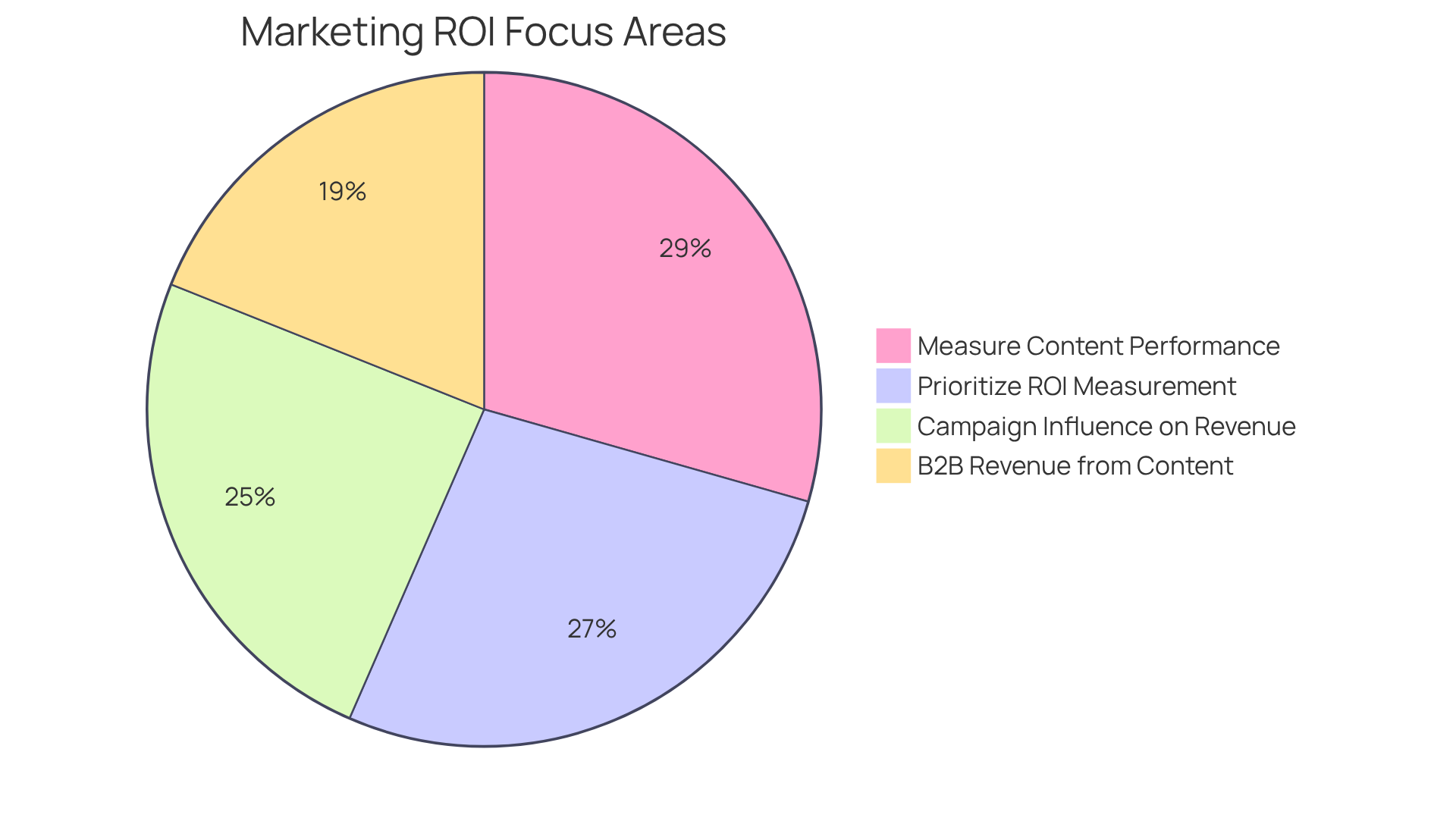
In 2026, successful brands are increasingly leveraging to refine their . A striking 90% of top-performing organizations consistently measure for optimization. Furthermore, 83% of promotional leaders prioritize demonstrating , highlighting its critical role in strategic planning. This focus on ROI is crucial, as three-quarters of companies report that their . Notably, 58% of B2B advertisers attribute revenue generation to their content efforts.
As - expected to increase by 10% between 2023 and 2024 - 63% of enterprises have elevated their in recent years. Brands must prioritize understanding in order to allocate resources effectively. By recognizing the importance of ROI, companies can make informed decisions that not only enhance promotional effectiveness but also drive sustainable growth.
Identify Key Metrics for Measuring ROI
To effectively measure , brands must focus on several :
- : This metric reveals the total income generated from sales directly linked to promotional initiatives, providing crucial insight into the financial impact of marketing efforts.
- : This encompasses all costs associated with promotional campaigns, including creative development, media purchasing, and personnel expenses. Understanding these costs is vital for .
- : CAC is calculated by dividing total promotional expenses by the number of new customers acquired. This metric is critical for assessing the effectiveness of promotional strategies in attracting new clients. Brands that optimize their advertising spend can significantly lower CAC, thereby enhancing profitability.
- : This percentage reflects the proportion of users who complete a desired action, such as making a purchase or signing up for a newsletter. In 2026, the average for digital promotion campaigns is projected to be around 7.04%. Brands should prioritize optimizing user engagement strategies to meet or exceed this benchmark, as it underscores the effectiveness of their marketing efforts.
- : CLV estimates the total revenue a business can expect from a single customer throughout their relationship. By grasping CLV, companies can make informed decisions about how much to invest in acquiring new customers.
Focusing on these metrics allows companies to measure , providing a comprehensive view of their promotional effectiveness and its direct impact, ultimately guiding . Furthermore, with 45% of marketers rating social media as highly effective in driving sales, brands should evaluate how different channels contribute to these metrics to enhance overall performance.

Calculate Marketing ROI Using Established Formulas
Calculating is essential for any business that aims to measure and assess the effectiveness of its .
ROI = (Revenue Generated - Marketing Costs) / Marketing Costs is the formula you need to know.
Gather Data: Start by collecting comprehensive information on the from your marketing campaigns alongside the total advertising costs. This foundational step is crucial. Did you know that 83% of industry leaders prioritize ? Accurate data collection is essential. Moreover, businesses that maintain a regular blog posting schedule achieve 13 times greater ROI than those that post irregularly. This highlights the importance of .
Utilize the Formula: Next, subtract your overall promotional expenses from the income produced. Then, divide that figure by the total promotional costs.
Convert to Percentage: To express ROI as a percentage, simply multiply the result by 100.
For example, if a campaign generated $10,000 in revenue and incurred $2,000 in costs, the calculation would be:
ROI = ($10,000 - $2,000) / $2,000 = 4 or 400%. This indicates that for every , the company received four dollars in return. Regularly is vital for brands to assess campaign effectiveness and make informed, .
Significantly, companies that utilize can achieve returns that greatly surpass average benchmarks. In fact, the typical ROI across sectors in 2026 is expected to reflect these strategic efforts. As Andrew Davis wisely states, ". Relationships are built on trust. Trust drives revenue.

Implement Strategies to Enhance Marketing ROI
To enhance , consider implementing the following strategies:
- : Are you reaching the right audience? Utilize data analytics to refine your audience targeting, ensuring your promotional messages connect with the most relevant consumers. Tailored communications based on real behaviors can significantly enhance customer trust and loyalty. In fact, 93% of marketers report that .
- Leverage : How do you know what works? Regularly test different versions of ads or landing pages to identify which performs better. has proven effective, with brands reporting up to a 30% based on test results. This approach is essential for ongoing enhancement in performance.
- Focus on High-Performing Channels: Which channels are yielding the best ROI? Analyze your promotional channels and allocate more resources to those that deliver results. For instance, , making it an essential channel for businesses seeking quicker returns.
- : Are your customers feeling connected? Create personalized promotional strategies that foster deeper connections with customers, increasing retention and (CLV). Personalized communications can drive repeat purchases and strengthen brand loyalty.
- : Is your process efficient? Implement automation tools to streamline processes, reduce costs, and improve efficiency. Companies utilizing automation have observed revenues rise by an average of 34%, highlighting its significance in contemporary promotional strategies.
By applying these strategies, brands can significantly measure , which leads to better overall performance and sustainable growth. What steps will you take to implement these insights?

Conclusion
Understanding and measuring marketing ROI is essential for brands that want to boost their performance and make informed decisions. By effectively evaluating returns on promotional investments, companies can optimize their budgets and refine marketing strategies to achieve sustainable growth.
Key metrics such as revenue generated, promotion expenses, customer acquisition cost, conversion rates, and customer lifetime value are crucial. These metrics offer a comprehensive view of promotional effectiveness, enabling brands to assess their marketing strategies and make data-driven decisions. Furthermore, calculating ROI using established formulas and implementing strategies like targeting optimization, A/B testing, and leveraging automation tools are vital for enhancing overall marketing performance.
In a competitive landscape, prioritizing the measurement of marketing ROI not only validates promotional efforts but also drives profitability and long-term success. Brands that commit to understanding and improving their marketing ROI will be better equipped to navigate the complexities of the digital marketplace and build meaningful relationships with their customers. Taking actionable steps toward implementing these insights can lead to significant improvements in brand performance and sustained growth.
Frequently Asked Questions
What is Marketing ROI and why is it important?
Marketing ROI (Return on Investment) is a metric used to evaluate the effectiveness of promotional investments by comparing the revenue generated from these activities to the costs incurred. It is important because it validates promotional investments, aids in budget optimization, and enhances overall promotional strategies.
How is Marketing ROI calculated?
Marketing ROI is calculated by comparing the revenue generated from promotional activities to the costs incurred in those activities.
What does a positive or negative Marketing ROI indicate?
A positive Marketing ROI indicates that promotional efforts are yielding profitable returns, while a negative ROI suggests a need for strategic reevaluation of those efforts.
How are successful brands using ROI analysis in 2026?
Successful brands are leveraging ROI analysis to refine their promotional strategies, with 90% of top-performing organizations consistently measuring content performance for optimization.
What percentage of promotional leaders prioritize measuring Marketing ROI?
83% of promotional leaders prioritize demonstrating how to measure Marketing ROI, underscoring its critical role in strategic planning.
How do promotional campaigns impact overall revenue?
Three-quarters of companies report that their promotional campaigns directly influence overall revenue, highlighting the importance of effective marketing strategies.
What is the trend in digital promotion budgets from 2023 to 2024?
Digital promotion budgets are expected to increase by 10% between 2023 and 2024, with 63% of enterprises having elevated their digital promotion budgets in recent years.
Why should companies prioritize understanding Marketing ROI?
Companies should prioritize understanding Marketing ROI to allocate resources effectively, make informed decisions, enhance promotional effectiveness, and drive sustainable growth.
List of Sources
- Understand Marketing ROI and Its Importance
- 180+ Powerful Digital Marketing Statistics for 2026 - WordStream (https://wordstream.com/blog/ws/2022/04/19/digital-marketing-statistics)
- Content Marketing ROI — 45 Statistics Every Marketing Leader Should Know in 2026 (https://genesysgrowth.com/blog/content-marketing-roi-stats-for-marketing-leaders)
- eber.co (https://eber.co/blogs/marketing-roi-in-2026-what-marketers-must-measure-to-prove-what-works)
- socialnative.com (https://socialnative.com/articles/driving-creator-marketing-roi-in-2026-and-why-it-matters)
- therankmasters.com (https://therankmasters.com/insights/benchmarks/top-ai-marketing-statistics)
- Identify Key Metrics for Measuring ROI
- 38 Customer Acquisition Cost Statistics for B2B SaaS in 2026 — GTM 8020 (https://gtm8020.com/blog/customer-acquisition-cost-statistics)
- eber.co (https://eber.co/blogs/marketing-roi-in-2026-what-marketers-must-measure-to-prove-what-works)
- 2026 Marketing Statistics, Trends, & Data (https://hubspot.com/marketing-statistics)
- 180+ Powerful Digital Marketing Statistics for 2026 - WordStream (https://wordstream.com/blog/ws/2022/04/19/digital-marketing-statistics)
- Digital Marketing Metrics To Track in 2026 (https://wsiworld.com/blog/marketing-metrics-that-matter-what-to-track-in-2026)
- Calculate Marketing ROI Using Established Formulas
- 40 Marketing Quotes To Inspire You and Your Team (https://salesforce.com/blog/marketing-quotes)
- Content Marketing ROI — 45 Statistics Every Marketing Leader Should Know in 2026 (https://genesysgrowth.com/blog/content-marketing-roi-stats-for-marketing-leaders)
- azquotes.com (https://azquotes.com/quotes/topics/roi.html)
- aha.elliance.com (https://aha.elliance.com/2014/01/03/the-ball-drops-five-favorite-roi-quotes-to-ponder-for-the-new-year)
- praxie.com (https://praxie.com/top-marketing-quotes)
- Implement Strategies to Enhance Marketing ROI
- Content Marketing ROI — 45 Statistics Every Marketing Leader Should Know in 2026 (https://genesysgrowth.com/blog/content-marketing-roi-stats-for-marketing-leaders)
- 13 Marketing Automation Statistics to Empower Your 2026 Strategy (https://emarsys.com/learn/blog/marketing-automation-statistics)
- Top Marketing Statistics for 2026: Channels That Deliver Maximum ROI - Martal Group (https://martal.ca/marketing-statistics-lb)
- 2026 Marketing Statistics, Trends, & Data (https://hubspot.com/marketing-statistics)