
Introduction
A/B testing stands as a cornerstone of modern marketing, empowering brands to make informed decisions through data-driven insights. By comparing various marketing elements, businesses can identify what resonates most with their audience, enhancing engagement and boosting conversion rates.
But here's the challenge: how can marketers effectively navigate the complexities of A/B testing to maximize results? This guide unpacks the step-by-step process of mastering A/B testing, revealing best practices and common pitfalls to avoid.
With these insights, every marketing campaign can be optimized for success.
Define A/B Testing and Its Importance
, often called split experimentation, is a powerful method for comparing two versions of a marketing element to determine which one performs better. In digital advertising, this might involve testing different ad copies, images, or calls to action. The importance of lies in its ability to provide that empower marketers to make informed decisions. Brands can optimize their campaigns and enhance engagement and conversion rates by identifying which variant resonates more with the audience through . This approach not only reduces guesswork but also of marketing budgets.
Furthermore, consider the impact of on your . Have you ever wondered how a slight change in wording or imagery could significantly boost your campaign's performance? By leveraging , you can uncover these insights and drive better results. Brands that have successfully implemented this method often see marked improvements in their engagement metrics, showcasing the tangible benefits of .
In addition, allows for . As consumer preferences evolve, so too should your marketing strategies. By regularly testing and refining your approaches, you can stay ahead of the competition and ensure your messaging remains relevant. Don't leave your to chance; embrace to unlock your brand's full potential.

Set Up Your A/B Test: Step-by-Step Process
- Identify Your Objective: Clearly define your goals-whether it’s increasing , improving , or enhancing . A well-defined objective lays the groundwork for your testing strategy.
- Choose the Variable to Test: Select a single element to modify between the two alternatives, such as the headline, image, or call-to-action. at a time allows for of performance changes to that specific element.
- Create Variants: Develop two iterations of your for ing multiple variants. In ing multiple variants, Version A serves as the control (the original), while Version B is the variant (the modified version). This clear distinction is crucial for effective analysis.
- Determine Sample Size: Calculate the necessary number of users for your test to achieve . A typical guideline suggests a , with 200-300 being ideal for reliable outcomes. Utilize online calculators to assist in this process. Remember, the false negative rate (beta) is usually set at 20%, which can impact your sample size calculations.
- Select Your Audience: Randomly divide your audience into two groups, ensuring that each group is comparable in demographics and behavior to minimize bias. This random sampling is essential for valid outcomes.
- Run the Test: Launch both variants simultaneously to eliminate external influences on the results. Monitor the test for a predetermined duration-ideally at least one full week-to gather sufficient data and account for variability.
- Collect Data: Use analytics tools to track performance metrics relevant to your objectives, such as , , or engagement levels. will provide insights into which version performs better and guide future marketing strategies. For instance, TechInsurance achieved a remarkable 73% increase in after creating a dedicated landing page, illustrating the effectiveness of targeted ing.

Analyze Results and Implement Changes
- Review the Data: Once the evaluation wraps up, it’s crucial to collected. Are there significant differences between the two variants? This is where your insights begin.
- : Next, determine if the results hold . This means the observed differences are unlikely to have occurred by chance. Employ statistical tests to validate your findings and ensure they stand up to scrutiny.
- : Based on your thorough analysis, pinpoint which version outperformed the other according to your predefined objectives. This step is vital for .
- Implement Changes: If the variant outshined the control, it’s time to across your campaigns. Conversely, if the control performed better, reflect on why the variant fell short and what lessons can be drawn from this experience.
- Iterate: Remember, is not a one-time event; it’s an ongoing process. Use the insights gained from this test to inform future tests, continually for better results.

Avoid Common Mistakes in A/B Testing
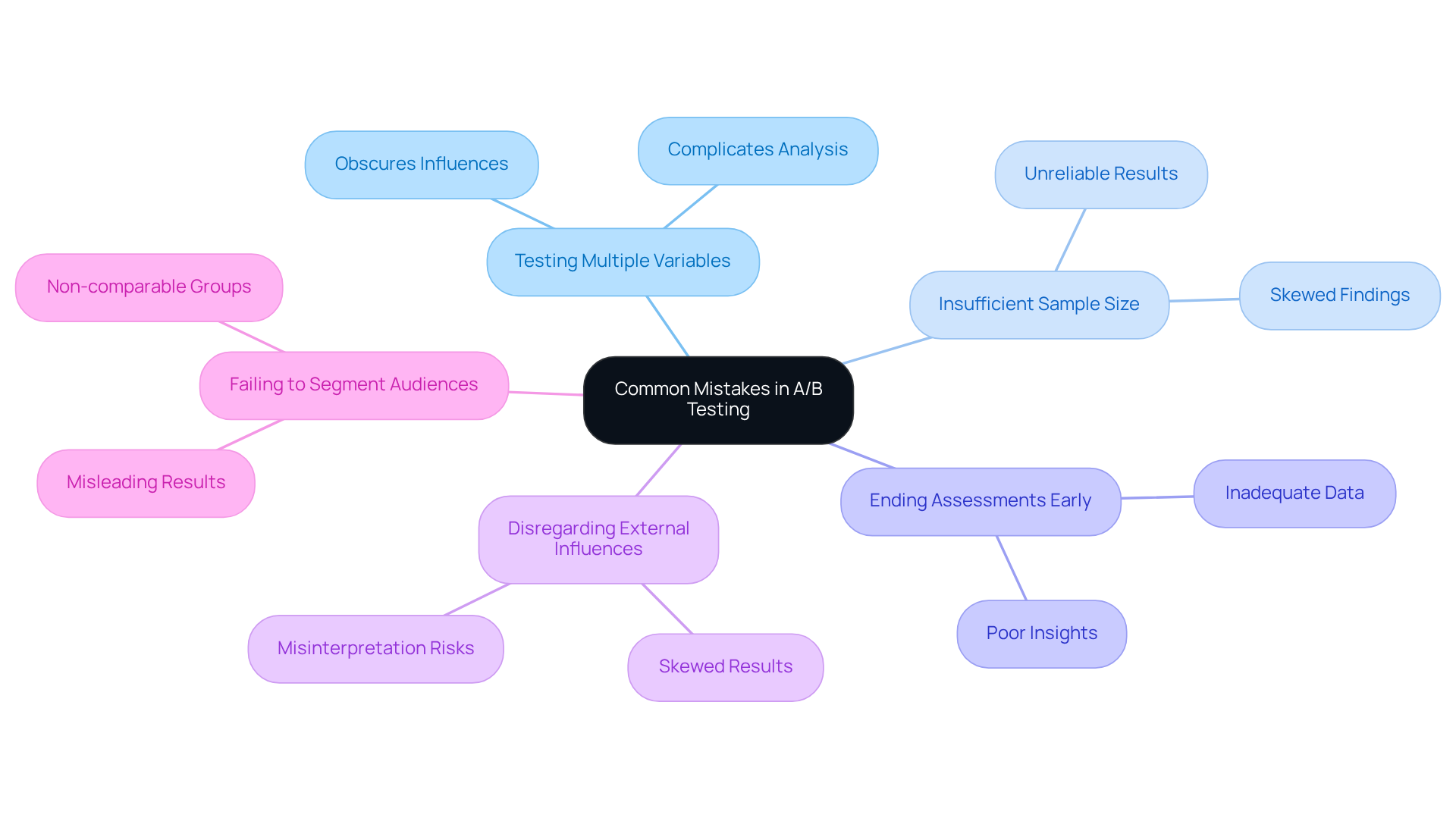
- Testing Multiple Variables: Avoid the pitfall of at once. This practice and obscures which changes truly influenced the outcomes. Focus on one variable at a time for clearer insights.
- Insufficient : A robust is crucial for achieving . Small samples can yield unreliable results, skewing your findings. Ensure your sample is large enough to draw .
- : Resist the urge to . Allow your tests to run their full course to gather adequate data for thorough analysis. This patience pays off in the quality of your insights.
- Disregarding : Be vigilant about external factors that might skew your results, such as seasonality or concurrent marketing campaigns. Recognizing these influences is key to accurate interpretation.
- Failing to : Neglecting to segment your audience can lead to misleading results. Ensure your test groups are comparable and representative of your overall audience to enhance the validity of your findings.
Conclusion
A/B testing multiple variants stands as a cornerstone strategy for marketers intent on optimizing their campaigns and boosting overall performance. By systematically comparing different versions of marketing elements, brands can make informed decisions that significantly enhance engagement and conversion rates. This data-driven approach minimizes uncertainty and ensures that marketing budgets are utilized effectively, maximizing return on investment.
Key steps in the A/B testing process include:
- Defining objectives
- Selecting variables
- Analyzing results
Each of these stages is crucial for deriving meaningful insights that can inform future marketing strategies. Avoiding common pitfalls - such as testing multiple variables simultaneously or concluding tests prematurely - is vital for achieving reliable outcomes. By adhering to best practices and continuously iterating on findings, marketers can refine their approaches and maintain a competitive edge.
Ultimately, embracing A/B testing transcends merely improving individual campaigns; it fosters a culture of experimentation and learning within an organization. By committing to this ongoing process, brands can adapt to changing consumer preferences, ensuring their marketing efforts remain relevant and impactful. The insights gained from A/B testing can unveil new opportunities for growth and innovation, solidifying its role as a fundamental element of successful marketing strategies.
Frequently Asked Questions
What is A/B testing?
A/B testing, also known as split experimentation, is a method for comparing two versions of a marketing element to determine which one performs better.
Why is A/B testing important?
A/B testing is important because it provides data-driven insights that help marketers make informed decisions, optimize campaigns, and enhance engagement and conversion rates.
What elements can be tested using A/B testing in digital advertising?
In digital advertising, A/B testing can involve testing different ad copies, images, or calls to action.
How does A/B testing reduce guesswork in marketing?
A/B testing reduces guesswork by identifying which variant resonates more with the audience, allowing marketers to make decisions based on data rather than assumptions.
What are the benefits of implementing A/B testing for brands?
Brands that implement A/B testing often see improvements in engagement metrics, leading to better campaign performance and more effective use of marketing budgets.
How does A/B testing contribute to continuous optimization?
A/B testing allows brands to regularly test and refine their marketing strategies, helping them stay relevant and ahead of the competition as consumer preferences evolve.
List of Sources
- Define A/B Testing and Its Importance
- unbounce.com (https://unbounce.com/a-b-testing/examples)
- 99firms.com (https://99firms.com/2025/08/01/ab-testing-statistics)
- ticketfairy.com (https://ticketfairy.com/blog/mastering-a-b-testing-for-event-marketing-in-2026-data-driven-wins-that-boost-ticket-sales)
- A/B Testing & CRO Stats Every Optimizer Should Know (https://convert.com/blog/a-b-testing/ab-testing-stats)
- Set Up Your A/B Test: Step-by-Step Process
- invespcro.com (https://invespcro.com/blog/ab-testing-statistics-made-simple)
- unbounce.com (https://unbounce.com/a-b-testing/examples)
- Statistical Significance in A/B Testing – a Complete Guide (https://blog.analytics-toolkit.com/2017/statistical-significance-ab-testing-complete-guide)
- optimizely.com (https://optimizely.com/insights/blog/sample-size-calculations-for-experiments)
- Google Ads A/B Testing Guide 2026: Proven Methods That Convert (https://causalfunnel.com/blog/google-ads-a-b-testing-the-2026-step-by-step-playbook-to-higher-conversions)
- Analyze Results and Implement Changes
- Statistical Significance in A/B Testing – a Complete Guide (https://blog.analytics-toolkit.com/2017/statistical-significance-ab-testing-complete-guide)
- loop11.com (https://loop11.com/case-studies-on-website-a-b-testing)
- namecheap.com (https://namecheap.com/guru-guides/a-b-testing-small-business)
- goodreads.com (https://goodreads.com/author/quotes/3873541.Ron_Kohavi)
- marketingexperiments.com (https://marketingexperiments.com/a-b-testing/3-ab-testing-case-studies-from-smart-brand-side-marketers)
- Avoid Common Mistakes in A/B Testing
- pmc.ncbi.nlm.nih.gov (https://pmc.ncbi.nlm.nih.gov/articles/PMC2493004)
- heyflow.com (https://heyflow.com/blog/a-b-testing-mistakes)
- linkedin.com (https://linkedin.com/top-content/employee-experience/avoiding-common-professional-pitfalls/how-to-avoid-a-b-testing-pitfalls)
Turn Your Paid Social Into a Scalable Creative Engine
Running ads is easy. Scaling creative is not.
If your performance depends on a few winning ads,
it’s time to build a system.
Explore our complete guide to paid social creative strategy.