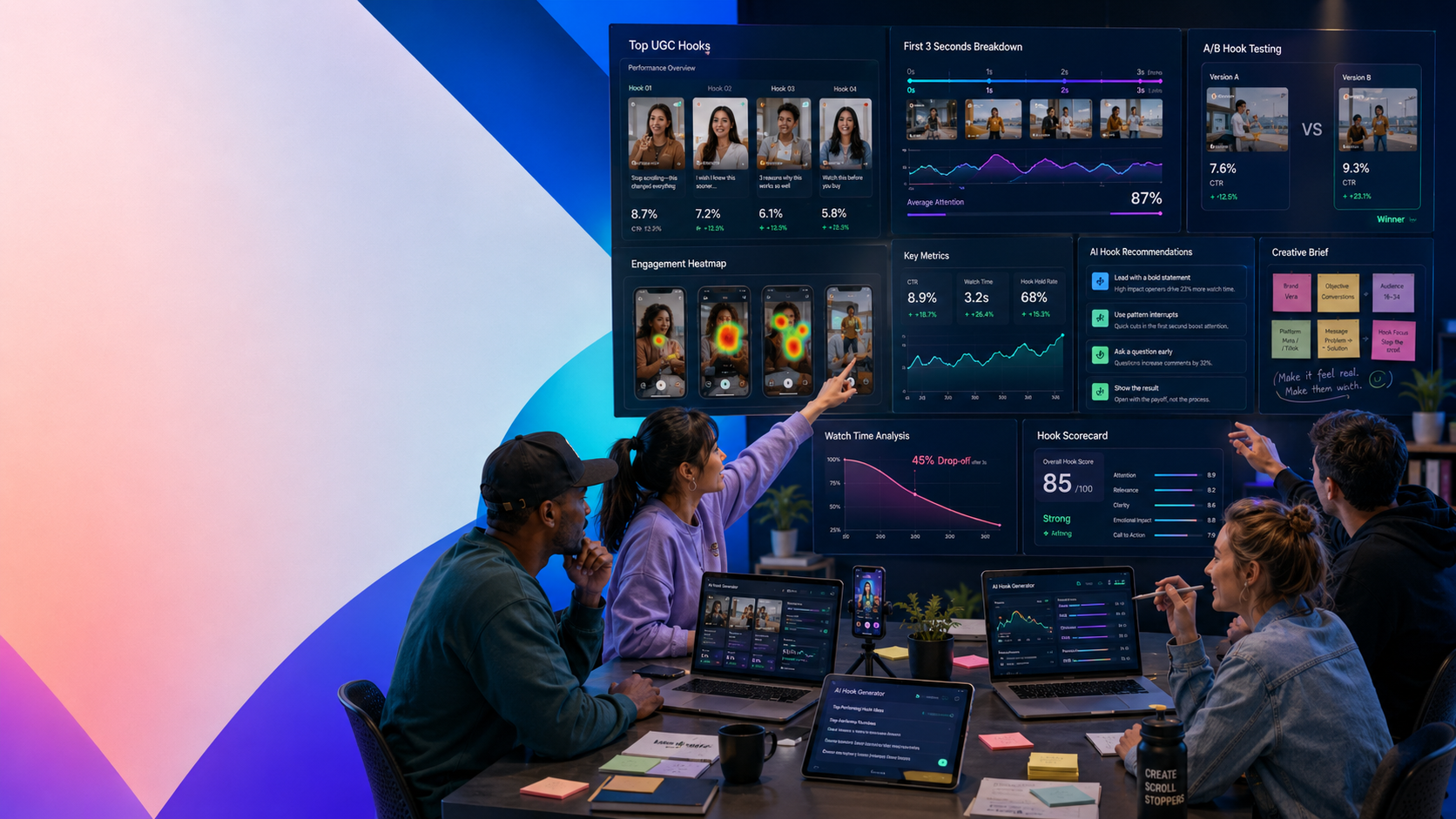
Best UGC Hooks for Paid Social Ads
The hook is one of the most important parts of a UGC ad.
It is the first line, visual, movement, or idea that gets someone to stop scrolling and pay attention.
In paid social, that first moment matters. If the hook does not create interest quickly, the rest of the ad may never have a chance to work.
A strong UGC hook can make the viewer feel seen, curious, challenged, understood, or ready to learn more. A weak hook can make even a good product, strong offer, or high-quality creator asset underperform.
That is why paid social teams need to test hooks consistently.
UGC ads are especially useful for hook testing because creators can deliver different openings in a natural, platform-native way. The same product can be introduced through a problem, a question, a personal story, a comparison, an objection, a list, or a surprising observation.
This guide breaks down the best UGC hooks for paid social ads, when to use each type, and how to turn hooks into a stronger creative testing system.
What Is a UGC Hook?
A UGC hook is the opening moment of a user-generated-style ad.
It can be:
- the first sentence a creator says;
- the first text overlay;
- the first visual frame;
- the first product shot;
- the first movement;
- the first problem presented;
- the first question asked.
The hook’s job is simple:
Get the viewer to keep watching.
In paid social, the hook usually needs to work fast. On platforms like TikTok, Instagram Reels, Facebook, and YouTube Shorts, people are moving quickly through the feed. If the ad feels irrelevant, slow, generic, or overly promotional, they will scroll past.
A good hook creates enough interest for the viewer to give the ad a few more seconds.
That extra attention gives the brand a chance to introduce the problem, show the product, communicate value, and drive action.
Why Hooks Matter for Paid Social
Paid social creative is judged quickly.
Before someone clicks, converts, or buys, they need to stop scrolling.
That makes the hook one of the most important creative variables to test.
Strong hooks can help improve:
- thumb-stop rate;
- video view rate;
- hold rate;
- CTR;
- engagement;
- creative testing quality;
- overall paid social performance.
Weak hooks can hurt performance even if the rest of the ad is strong.
A creator may explain the product clearly, the offer may be compelling, and the CTA may be strong. But if the first few seconds do not earn attention, the audience may never reach the best part of the ad.
This is why paid social teams should not treat hooks as an afterthought.
Hooks are not just creative copy.
They are performance inputs.
What Makes a Good UGC Hook?
A good UGC hook is specific, relevant, and connected to the viewer’s problem or curiosity.
The best hooks usually do at least one of the following:
- name a specific pain point;
- create curiosity;
- challenge an assumption;
- introduce a relatable situation;
- show an unexpected result;
- compare old way vs. new way;
- address an objection;
- promise a clear benefit;
- make the product feel immediately relevant;
- sound like something a real person would say.
A weak hook is usually too broad, too slow, too brand-led, or too generic.
For example:
Weak hook:
“You need to try this product.”
Stronger hook:
“If your paid social ads keep fatiguing before you have new creative ready, this is the problem.”
The second hook is more specific. It names the viewer, the pain, and the reason to keep watching.
That is what good hooks do.
They create relevance quickly.
UGC Hooks vs. Traditional Ad Openings
Traditional ads often open with the brand, product, or campaign message.
UGC ads usually work better when they open with the viewer’s world.
A traditional ad might begin with:
“Introducing our new solution for better performance.”
A UGC-style ad might begin with:
“If your best-performing ad stopped working after two weeks, you are not alone.”
The second opening feels more native to paid social because it starts with a real problem.
UGC hooks should feel conversational. They should sound like something a creator, customer, or category-aware person would actually say.
The goal is not to sound like an ad.
The goal is to earn attention in the feed.
The Best Types of UGC Hooks for Paid Social Ads
There is no single best hook for every campaign.
The best hook depends on the product, audience, platform, funnel stage, and campaign goal.
Here are the most useful UGC hook types to test.
1. Problem-Led Hooks
Problem-led hooks start with a pain point the viewer already understands.
They work well because they create immediate relevance.
Examples:
- “If you’re tired of [problem], this might help.”
- “I used to struggle with [problem] until I found this.”
- “The hardest part about [task] is not what most people think.”
- “If [problem] keeps happening, you may be missing this.”
- “I didn’t realize how much time I was wasting on [old process].”
- “This solved one of the most annoying parts of [routine].”
Best for:
- cold audiences;
- problem-aware audiences;
- direct-response ads;
- products with a clear pain point;
- awareness campaigns.
Why it works:
The viewer recognizes the problem before they need to understand the product.
2. Curiosity-Led Hooks
Curiosity-led hooks create an information gap.
They make the viewer want to know what happens next.
Examples:
- “I didn’t expect this to work, but…”
- “This is the one thing I wish I knew sooner.”
- “I tried this for a week, and here’s what happened.”
- “I almost skipped this, but I’m glad I didn’t.”
- “This changed the way I think about [category].”
- “I thought this was overhyped until I tried it.”
Best for:
- top-of-funnel campaigns;
- product discovery;
- TikTok and Reels;
- products with surprising benefits;
- creator-led storytelling.
Why it works:
The viewer keeps watching to close the curiosity gap.
3. Benefit-Led Hooks
Benefit-led hooks open with the outcome the audience wants.
They work well when the product has a clear and desirable result.
Examples:
- “This made [task] so much easier.”
- “I found a faster way to [achieve outcome].”
- “This helped me save time on [routine].”
- “If you want to [benefit] without [pain], try this.”
- “This is how I simplified [process].”
- “I finally found a way to [desired result].”
Best for:
- audiences already aware of the problem;
- consideration campaigns;
- product demo ads;
- conversion-focused ads.
Why it works:
The hook tells the viewer what they can gain.
4. Objection-Led Hooks
Objection-led hooks address a concern the audience may already have.
They are useful for retargeting, conversion, and higher-consideration products.
Examples:
- “I thought this would be too expensive, but…”
- “I didn’t think this would work for me either.”
- “I was skeptical at first, so I tested it.”
- “I know this sounds like another [category] product, but it’s different.”
- “If you’re wondering whether this is worth it, here’s what I noticed.”
- “I almost didn’t try it because of [objection].”
Best for:
- retargeting;
- warm audiences;
- conversion campaigns;
- premium products;
- products with skepticism or hesitation.
Why it works:
The creator names the viewer’s hesitation before the viewer has to.
5. Comparison Hooks
Comparison hooks contrast the old way with the new way.
They are useful when the product replaces an existing habit, tool, product, or behavior.
Examples:
- “I stopped using [old solution] after trying this.”
- “I used to do this manually, but this is much faster.”
- “Here’s the difference between [old way] and [new way].”
- “If you’re still using [old solution], this might be easier.”
- “I replaced my old [product/tool] with this.”
- “This is what I use instead of [alternative].”
Best for:
- competitive categories;
- products with clear differentiation;
- consideration campaigns;
- conversion campaigns;
- product education.
Why it works:
The viewer understands the product through contrast.
6. Testimonial Hooks
Testimonial hooks begin with a personal experience or result.
They work best when they feel specific and believable.
Examples:
- “I’ve been using this for [time period], and here’s what changed.”
- “I tried this because I was struggling with [problem].”
- “This became part of my routine after one week.”
- “I didn’t think I’d use this every day, but I do.”
- “Here’s what surprised me after trying [product].”
- “I was looking for something that could help with [problem], and this worked.”
Best for:
- consideration;
- retargeting;
- trust-building;
- social proof;
- UGC ads with real user-style delivery.
Why it works:
The viewer hears the message through someone’s experience, not just a brand claim.
7. “Things I Wish I Knew” Hooks
These hooks position the creator as someone sharing useful advice.
They work well because they feel helpful rather than sales-driven.
Examples:
- “Three things I wish I knew before buying [product/category].”
- “What I wish someone told me about [problem].”
- “If you’re new to [category], start here.”
- “Before you try [solution], watch this.”
- “Here’s what I learned after testing [product/category].”
- “I wish I knew this before wasting time on [old process].”
Best for:
- education;
- consideration;
- product categories with learning curves;
- audiences comparing options;
- higher-intent viewers.
Why it works:
It frames the ad as advice, not promotion.
8. Listicle Hooks
Listicle hooks promise a quick, structured set of points.
They are easy to understand and work well in short-form environments.
Examples:
- “Three reasons I keep using this.”
- “Five things that make this different.”
- “Three signs you need a better way to [task].”
- “Three mistakes I was making before I found this.”
- “Here are three ways this made [process] easier.”
- “Three reasons this is worth trying.”
Best for:
- TikTok;
- Instagram Reels;
- product education;
- benefit stacking;
- top and middle of funnel.
Why it works:
The viewer knows the structure and expects quick value.
9. Direct Question Hooks
Question hooks speak directly to the viewer.
They can work well when the question is specific and relevant.
Examples:
- “Are your ads fatiguing faster than you can replace them?”
- “Still trying to find creators manually?”
- “What if your next winning ad came from a better-fit creator?”
- “Do you actually have enough creative to scale?”
- “Are you testing enough UGC variations?”
- “Is your creative pipeline keeping up with your media spend?”
Best for:
- B2B paid social;
- problem-aware audiences;
- thought leadership-style UGC;
- direct-response ads;
- retargeting.
Why it works:
The viewer mentally answers the question.
10. Contrarian Hooks
Contrarian hooks challenge a common belief.
They are useful when the brand has a strong point of view.
Examples:
- “Follower count is not the best way to choose a UGC creator.”
- “More creators will not fix your creative problem if they are the wrong creators.”
- “Your ad account may not need a new strategy. It may need new creative.”
- “The best UGC ad is not always the most polished one.”
- “Creative fatigue is not just a media buying problem.”
- “A bigger creator does not always mean a better ad.”
Best for:
- educational content;
- thought leadership;
- B2B audiences;
- category differentiation;
- AI creator matching topics.
Why it works:
It creates tension and gives the viewer a reason to keep watching.
11. “Old Way vs. New Way” Hooks
These hooks show that the audience may be using an outdated or inefficient approach.
Examples:
- “The old way of finding UGC creators takes too long.”
- “I used to search creators manually. Now I do this instead.”
- “If your team is still waiting weeks for new creative, there’s a better way.”
- “Most brands are still treating UGC like one-off content.”
- “The old creative process was not built for paid social speed.”
- “This is a faster way to build your UGC pipeline.”
Best for:
- SaaS-style products;
- platforms;
- category education;
- performance marketing audiences;
- consideration campaigns.
Why it works:
It positions the product as a smarter alternative.
12. Urgency Hooks
Urgency hooks highlight a timely problem or missed opportunity.
They should be used carefully so they do not feel exaggerated.
Examples:
- “If your winning ad is already fatiguing, you need the next one ready.”
- “Don’t wait until CAC rises to refresh your creative.”
- “If your creative pipeline is empty, scaling gets harder.”
- “Your next ad test should be ready before performance drops.”
- “If your team waits weeks for new assets, you are already behind.”
- “Creative fatigue moves faster than most production timelines.”
Best for:
- paid social teams;
- retargeting;
- performance marketing audiences;
- creative fatigue messaging;
- campaign refresh offers.
Why it works:
It creates a reason to act sooner.
13. Product Demo Hooks
Product demo hooks open by showing the product in action.
They work well when the product is visually clear or easy to demonstrate.
Examples:
- “Here’s exactly how this works.”
- “Watch how fast this solves [problem].”
- “This is how I use it in my routine.”
- “Let me show you why this is easier.”
- “Here’s what happens when you try [product].”
- “This is the feature that made me switch.”
Best for:
- product education;
- ecommerce;
- apps;
- beauty;
- food;
- home;
- consumer tech;
- performance creative.
Why it works:
The viewer sees value quickly instead of waiting for explanation.
14. Social Proof Hooks
Social proof hooks use popularity, recommendation, or repeated use as the opening.
They should be specific and credible.
Examples:
- “I kept seeing people talk about this, so I tried it.”
- “There’s a reason people keep recommending this.”
- “I finally understand why this keeps showing up.”
- “I tried the product everyone in [category] is talking about.”
- “This is why I keep coming back to this.”
- “I saw this recommended for [problem], so I tested it.”
Best for:
- retargeting;
- consideration;
- trend-driven products;
- products with strong social proof;
- creator-led testimonial ads.
Why it works:
The viewer sees that the product has already earned attention from others.
15. Mistake Hooks
Mistake hooks identify something the audience may be doing wrong.
They work well when the product helps fix or avoid the mistake.
Examples:
- “I was making this mistake with [process] for months.”
- “The biggest mistake I made was waiting too long to try this.”
- “If you’re doing [old behavior], you may be making this harder than it needs to be.”
- “I didn’t realize this was slowing me down.”
- “Most brands make this mistake with UGC ads.”
- “If your creative tests are not working, check this first.”
Best for:
- educational ads;
- expert-style UGC;
- B2B audiences;
- product education;
- problem-aware viewers.
Why it works:
It creates tension and suggests useful information is coming.
How to Choose the Right Hook Type
The right hook depends on the campaign goal.
For Awareness
Use hooks that create fast relevance.
Best hook types:
- problem-led;
- curiosity-led;
- contrarian;
- direct question;
- listicle.
For Product Education
Use hooks that introduce clarity.
Best hook types:
- product demo;
- “things I wish I knew”;
- listicle;
- comparison;
- old way vs. new way.
For Consideration
Use hooks that build interest and trust.
Best hook types:
- testimonial;
- comparison;
- benefit-led;
- social proof;
- objection-led.
For Conversion
Use hooks that reduce hesitation and drive action.
Best hook types:
- objection-led;
- urgency;
- comparison;
- testimonial;
- direct question.
For Retargeting
Use hooks that meet the viewer where they are.
Best hook types:
- objection-led;
- social proof;
- “I was skeptical”;
- “why it’s worth it”;
- comparison.
A strong hook should match the viewer’s awareness level.
Cold audiences may need a problem.
Warm audiences may need proof.
High-intent audiences may need urgency or objection handling.
How to Test UGC Hooks
Hook testing should be structured.
If everything changes between ad variations, it becomes difficult to know whether the hook actually caused the performance difference.
A simple hook test might use:
- the same creator;
- the same product;
- the same format;
- the same core message;
- three different hooks.
Example:
Ad A: Problem-led hook
Ad B: Curiosity-led hook
Ad C: Benefit-led hook
This allows the team to compare which opening earns stronger attention.
You can also test:
- same hook across different creators;
- same creator with different hooks;
- same hook with different formats;
- same hook adapted for different platforms;
- same hook with different first frames.
Track metrics such as:
- hook rate;
- thumb-stop rate;
- video view rate;
- hold rate;
- CTR;
- CPC;
- CPA;
- ROAS.
The goal is not just to find the best hook once.
The goal is to learn which hook patterns work for your audience.
How Many Hooks Should You Ask a UGC Creator to Deliver?
For paid social, it is useful to ask creators for multiple hook variations.
A good starting point is three to five hooks per creator.
For example:
- one problem-led hook;
- one curiosity-led hook;
- one benefit-led hook;
- one objection-led hook;
- one comparison hook.
This gives the media team more flexibility without requiring a completely new shoot.
A single creator submission can become multiple ad variations if the brand collects enough hook options and raw footage.
This is one of the easiest ways to get more value from each UGC production round.
Common Hook Mistakes to Avoid
Mistake 1: Starting With the Brand
Most viewers do not care about the brand before they understand the problem or benefit.
Avoid opening with generic brand introductions.
Mistake 2: Being Too Broad
Hooks like “This product is amazing” or “You need this” are usually too vague.
Specificity is stronger.
Mistake 3: Taking Too Long to Get to the Point
Paid social hooks need to work quickly.
Avoid slow intros, unnecessary context, or long setup.
Mistake 4: Overpromising
Hooks should create interest, but they should not make exaggerated or unsupported claims.
This is especially important in health, finance, beauty, wellness, and regulated categories.
Mistake 5: Using the Same Hook Too Often
Even strong hooks can fatigue.
Paid social teams should continuously test new hook variations.
Mistake 6: Ignoring the Funnel Stage
A hook for cold audiences may not work for retargeting.
Match the hook to the viewer’s awareness level.
How NugVerse Helps Brands Test More UGC Hooks
Testing UGC hooks requires a steady flow of creators, briefs, and creative variations.
NugVerse helps brands connect with vetted UGC creators matched to their campaign goals.
Instead of manually sourcing creators every time your team needs new hooks, NugVerse uses AI-powered matching to help identify creators aligned with your audience, product category, content format, and paid social objective.
That makes it easier to:
- brief creators on multiple hook directions;
- produce more UGC ad variations;
- test different creator types;
- refresh fatigued ads;
- reduce manual sourcing;
- improve creator-brand fit;
- keep the creative pipeline full.
For paid social teams, the goal is not just to create more videos.
The goal is to create more useful openings, angles, and tests that help find the next winning ad.
Final Takeaway
UGC hooks are one of the most important variables in paid social creative.
A strong hook can earn attention, create relevance, introduce a problem, build curiosity, or reduce hesitation. A weak hook can make even a strong product or offer underperform.
The best paid social teams test hooks continuously.
They test problem-led hooks, curiosity hooks, testimonial hooks, comparison hooks, objection-led hooks, product demo hooks, direct questions, contrarian angles, and social proof openings.
UGC creators make this testing process more flexible because they can deliver multiple openings in a natural, platform-native style.
The stronger your hook testing system, the more chances your brand has to find creative that earns attention and drives action.
Ready to Test More UGC Hooks?
NugVerse connects brands with vetted UGC creators matched to their campaign goals.
Find better-fit creators. Produce more hook variations. Keep your paid social creative pipeline full.
Related Articles
- UGC Creators for Paid Social Ads: How to Find, Vet, and Scale Winning Creative
- How to Test Creative for Paid Social Campaigns
- What Are UGC Ads?
- How to Brief UGC Creators for Better Ads
FAQ
What is a UGC hook?
A UGC hook is the opening moment of a user-generated-style ad. It can be the first sentence, first visual, first text overlay, first product shot, or first idea that gets the viewer to keep watching.
Why are hooks important for paid social ads?
Hooks are important because they determine whether someone stops scrolling. A strong hook can improve attention, view rate, CTR, and overall creative performance.
What are the best UGC hooks for paid social?
Some of the best UGC hook types include problem-led hooks, curiosity hooks, benefit-led hooks, objection-led hooks, comparison hooks, testimonial hooks, listicle hooks, and product demo hooks.
How many hook variations should brands test?
Brands should usually test multiple hook variations. A good starting point is three to five hooks per creator or per concept, depending on the campaign goal and production scope.
What makes a good UGC hook?
A good UGC hook is specific, relevant, and connected to the viewer’s problem, curiosity, goal, or hesitation. It should feel natural and earn attention quickly.
What is an example of a problem-led UGC hook?
An example of a problem-led UGC hook is: “If your ads keep fatiguing before you have new creative ready, this might be the issue.”
What is an example of an objection-led UGC hook?
An example of an objection-led UGC hook is: “I thought this would be too expensive, but here’s why it was worth trying.”
How do you test UGC hooks?
To test UGC hooks, keep the creator, product, format, and core message as consistent as possible while changing the opening line or first visual. Then compare attention and performance metrics such as hook rate, hold rate, CTR, CPA, or ROAS.