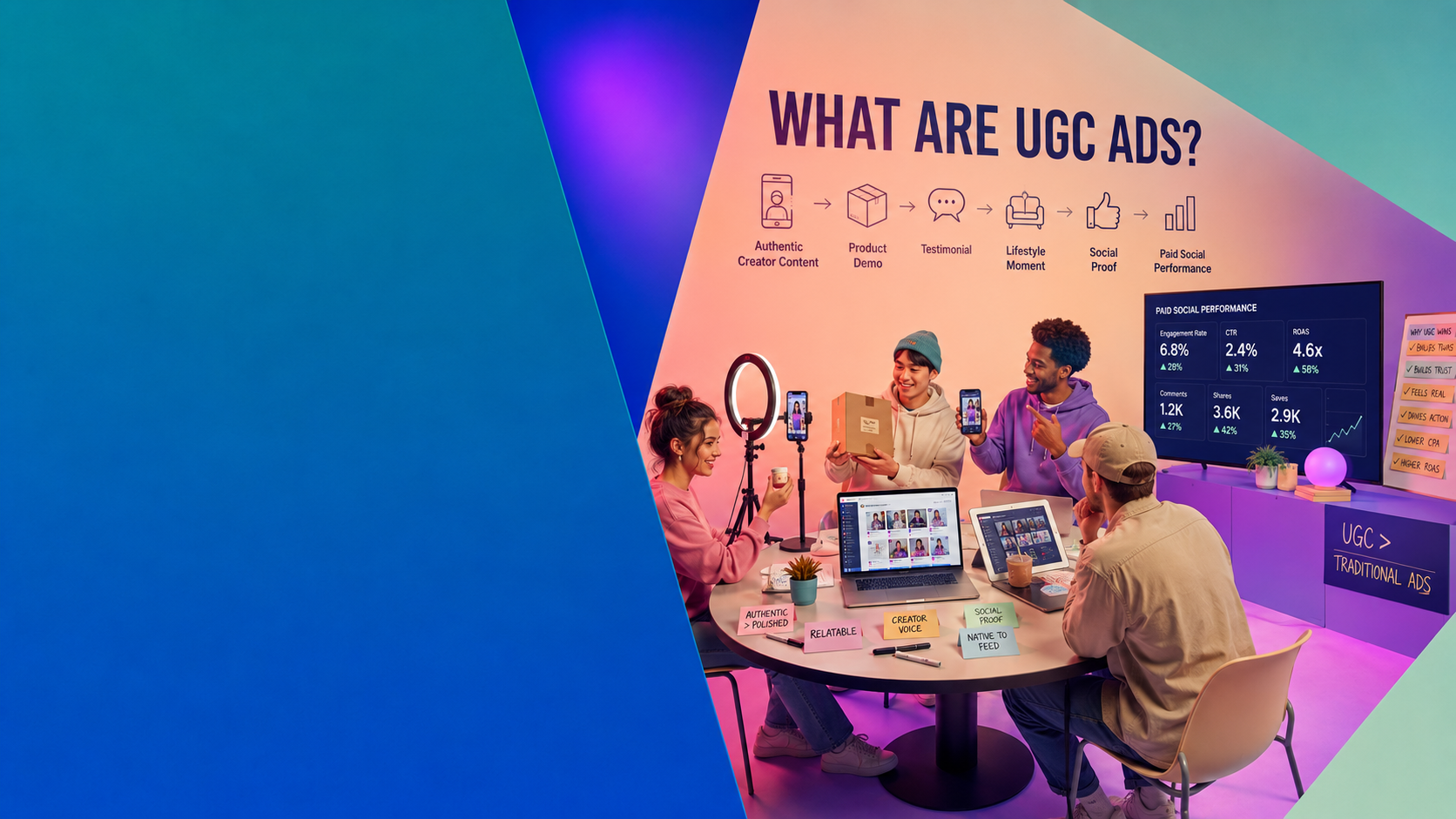
UGC ads are paid social ads built from user-generated-style content.
Instead of looking like traditional brand commercials, UGC ads are designed to feel native to the platforms where people already spend time: TikTok, Instagram, Facebook, YouTube Shorts, and other social feeds.
They often feature real people, creators, customers, or creator-style talent speaking directly to camera, showing a product, sharing a reaction, explaining a problem, or demonstrating how something works.
For brands, UGC ads have become a core part of paid social creative strategy because they can help make ads feel more relatable, more platform-native, and easier to test at scale.
But UGC ads are not just “authentic-looking videos.”
The best UGC ads are structured creative assets built to support performance. They combine the natural feel of creator content with the strategic direction of paid social advertising.
This guide explains what UGC ads are, why they work, how they differ from influencer content, which formats brands can test, and how to use UGC ads to build a stronger paid social creative pipeline.
What Does UGC Mean?
UGC stands for user-generated content.
Traditionally, UGC referred to content created organically by real customers or users, such as reviews, social posts, photos, videos, testimonials, and product mentions.
In marketing, the term has expanded.
Today, UGC often includes content created by UGC creators: people who produce user-generated-style content for brands. These creators may or may not post the content on their own channels. In many cases, the brand uses the content in its own paid social campaigns, organic channels, landing pages, product pages, and email marketing.
So when marketers talk about UGC ads, they usually mean paid ads made from creator-led or customer-style content.
The content is intentionally produced for advertising, but it is designed to feel more native, conversational, and human than a traditional ad.
What Are UGC Ads?
UGC ads are advertisements that use user-generated-style content as the creative asset.
They usually feature a person presenting, reviewing, demonstrating, or talking about a product or service in a way that feels natural to social media.
A UGC ad might look like:
- a creator explaining why they started using a product;
- a customer-style testimonial;
- a product demo filmed at home;
- a comparison between a product and an alternative;
- an unboxing video;
- a screen recording with voiceover;
- a day-in-the-life integration;
- a “things I wish I knew” video;
- a problem-solution story;
- a quick list of reasons to try a product.
The key difference is that UGC ads are made to blend more naturally into the feed.
They do not usually feel like polished campaign films. They feel closer to the content users already watch from creators, friends, reviewers, and everyday people.
That is why UGC ads can be especially useful for paid social.
They help brands create ads that feel less interruptive and more relatable.
Why UGC Ads Matter for Paid Social
Paid social is increasingly driven by creative quality and creative velocity.
Targeting, bidding, and budget still matter. But the creative is what earns attention. It is what stops the scroll, introduces the problem, makes the product feel relevant, and gives the viewer a reason to act.
UGC ads matter because they help brands produce more varied, native, and testable creative.
A strong UGC ad can help a brand:
- make the product feel more relatable;
- show the product in a real-life context;
- test different hooks and angles;
- bring new voices into the creative mix;
- reduce reliance on polished brand assets;
- fight creative fatigue;
- create more ad variations faster;
- support better paid social testing.
For many paid social teams, the challenge is not producing one good ad.
The challenge is continuously producing enough fresh creative to keep campaigns moving.
UGC ads are valuable because they can become part of that ongoing creative pipeline.
UGC Ads vs. Traditional Ads
Traditional ads are usually brand-led.
They often use polished production, scripted messaging, controlled visuals, and a clear brand voice. They can be powerful for brand building, product launches, high-impact storytelling, and premium campaigns.
UGC ads are usually creator-led.
They are often more casual, direct, conversational, and platform-native. They may be filmed on a phone, in a home, at a desk, in a bathroom, in a car, in a kitchen, or wherever the product naturally fits into everyday life.
The difference is not simply production quality.
The difference is how the ad feels to the viewer.
Traditional ads often say:
“Here is what our brand wants you to know.”
UGC ads often feel more like:
“Here is how this product fits into a real person’s life.”
For paid social, that difference can matter.
People are used to scrolling past polished ads. UGC ads can sometimes earn attention because they feel closer to the native content around them.
That does not mean traditional ads are no longer useful. The strongest paid social accounts often use both.
But UGC gives brands a more flexible way to test messages, formats, hooks, and creator types.
UGC Ads vs. Influencer Content
UGC ads and influencer content are related, but they are not the same.
Influencer content is usually built around distribution. The brand partners with an influencer because that person has an audience. The value comes from the influencer’s reach, credibility, community, and relationship with followers.
UGC ads are usually built around creative production. The brand works with a creator to produce content that the brand can use in its own paid media channels.
The creator does not always need to post the content on their own account.
For paid social, this distinction is important.
When hiring influencers, brands often ask:
“Who has access to the audience we want to reach?”
When hiring UGC creators, brands should ask:
“Who can create content our audience will respond to in paid social?”
A creator does not need a massive following to make a strong UGC ad.
They need to be believable, relevant, clear, and able to produce content that works as an ad.
Why UGC Ads Work
UGC ads can work for several reasons.
1. They Feel Native to Social Platforms
People use social platforms to watch content from creators, peers, friends, reviewers, experts, and communities.
UGC ads borrow from those behaviors.
They often use the same formats people already recognize: talking head videos, quick demos, casual reviews, listicles, routines, reactions, and product walkthroughs.
When done well, a UGC ad feels less like an interruption and more like something that belongs in the feed.
2. They Build Relatability
A creator can make a product feel more human.
Instead of seeing a brand explain the product, the viewer sees someone who may look, speak, or live like them.
That can make the message feel more immediate and relevant.
This is especially useful when the product solves a specific problem, fits into a routine, or needs to be seen in context.
3. They Help Explain Products Quickly
Many products need more than a static image or short headline.
UGC ads can show how a product works, why it matters, what problem it solves, and how it fits into daily life.
This is useful for:
- beauty products;
- apps;
- wellness brands;
- fitness products;
- food and beverage;
- home products;
- pet brands;
- fashion;
- consumer tech;
- subscription products;
- ecommerce brands;
- digital tools.
4. They Create More Testing Inputs
Paid social teams need creative variation.
UGC ads make it easier to test different creators, hooks, formats, messages, and angles.
One product can be presented through multiple perspectives:
- a customer testimonial;
- an expert explanation;
- a quick demo;
- a comparison;
- a routine integration;
- a before-and-after story;
- a first-person reaction;
- an objection-handling video.
The more useful variations a brand can produce, the more the media team can learn.
5. They Help Fight Creative Fatigue
Creative fatigue happens when an ad stops performing because the audience has seen it too often or because the creative no longer feels fresh.
UGC ads help brands introduce fresh creative into the account more consistently.
New creators, new hooks, new settings, and new formats can help keep the creative mix moving before performance starts to decline.
Common Types of UGC Ads
UGC ads can take many forms. The best format depends on the product, audience, funnel stage, and campaign goal.
Here are some of the most useful UGC ad formats for paid social.
1. Product Demo Ads
A product demo ad shows how the product works.
The creator may show the product in use, walk through a feature, demonstrate the result, or explain the process step by step.
Best for:
- products that need visual explanation;
- apps and software;
- beauty and skincare;
- home products;
- food and beverage;
- fitness products;
- tools and gadgets.
Example structure:
- Hook: “I didn’t realize how easy this was until I tried it.”
- Demo: Show the product in use.
- Benefit: Explain what changed.
- CTA: Invite the viewer to try it.
Product demos are useful because they reduce uncertainty. The viewer can see what the product actually does.
2. Testimonial Ads
A testimonial ad features a creator sharing their personal experience with a product or service.
The focus is usually on trust, transformation, satisfaction, or a specific benefit.
Best for:
- retargeting;
- trust-building;
- products with social proof;
- higher-consideration purchases;
- categories where buyers need reassurance.
Example structure:
- Hook: “I was skeptical at first, but…”
- Context: Explain the problem.
- Experience: Share what happened after trying the product.
- Result: Highlight the benefit.
- CTA: Encourage the viewer to learn more or try it.
Testimonial ads work best when they feel specific. Generic praise is less compelling than a clear before-and-after story.
3. Problem-Solution Ads
A problem-solution ad starts with a specific pain point and introduces the product as the solution.
Best for:
- cold audiences;
- problem-aware viewers;
- products with a clear functional benefit;
- direct-response campaigns.
Example structure:
- Problem: “I used to waste so much time on…”
- Frustration: Explain why the old way was annoying.
- Solution: Introduce the product.
- Benefit: Show why it works better.
- CTA: Tell the viewer what to do next.
This format is effective because it starts with the viewer’s pain instead of the brand’s product.
4. Comparison Ads
A comparison ad contrasts the product with an old habit, competitor, category alternative, or previous solution.
Best for:
- crowded categories;
- products with a clear advantage;
- audiences considering alternatives;
- objection handling.
Example structure:
- Hook: “I stopped using [old solution] because…”
- Contrast: Show the old way versus the new way.
- Difference: Explain why the product is better.
- Proof: Demonstrate or describe the benefit.
- CTA: Invite the viewer to switch or try.
Comparison ads should be handled carefully. Brands should avoid unsupported claims or misleading competitor references.
5. Unboxing Ads
An unboxing ad shows the creator opening and reacting to the product.
Best for:
- physical products;
- ecommerce;
- subscription boxes;
- beauty;
- fashion;
- food;
- lifestyle brands;
- giftable products.
Example structure:
- Hook: “I just got this and wanted to show you what’s inside.”
- Unboxing: Show packaging and first impressions.
- Product detail: Highlight key features.
- Reaction: Share initial opinion.
- CTA: Encourage the viewer to check it out.
Unboxing ads can help create curiosity and make the product feel tangible.
6. Routine Integration Ads
A routine integration ad shows how the product fits into the creator’s daily life.
Best for:
- wellness;
- beauty;
- food;
- fitness;
- home;
- apps;
- productivity tools;
- lifestyle brands.
Example structure:
- Hook: “This became part of my morning routine.”
- Context: Show the routine.
- Product use: Demonstrate how the product fits in.
- Benefit: Explain why it helps.
- CTA: Encourage the viewer to try it.
Routine-based ads work because they make the product feel practical and easy to imagine using.
7. Objection-Handling Ads
An objection-handling ad addresses a concern the audience may have before buying.
Best for:
- retargeting;
- higher-priced products;
- products with skepticism;
- new categories;
- complex services;
- subscription models.
Common objections include:
- “Is it worth the price?”
- “Will this actually work for me?”
- “Is it easy to use?”
- “How is this different?”
- “Do I really need this?”
- “Will it take too much time?”
Example structure:
- Hook: “I thought this would be too expensive, but…”
- Objection: Name the concern.
- Reframe: Explain why the product is worth considering.
- Proof: Show experience, feature, or benefit.
- CTA: Invite the viewer to learn more.
This format is useful because it meets the viewer where they already are in the buying process.
8. Listicle Ads
A listicle ad presents several reasons, benefits, tips, or observations in a quick sequence.
Best for:
- top-of-funnel;
- fast-paced platforms;
- product education;
- feature explanation;
- benefit stacking.
Example structure:
- Hook: “Three reasons I keep using this.”
- Point 1: Quick benefit.
- Point 2: Quick benefit.
- Point 3: Quick benefit.
- CTA: Invite the viewer to try it.
Listicle ads work well when the points are specific and easy to follow.
What Makes a Good UGC Ad?
A good UGC ad is not just casual content.
It still needs structure.
The best UGC ads usually include:
A Strong Hook
The opening needs to earn attention quickly.
Good hooks are specific, relevant, and connected to the viewer’s problem or curiosity.
Clear Audience Relevance
The viewer should understand quickly why the ad matters to them.
This can come from the creator, the setting, the problem, the language, or the situation being shown.
One Main Message
A strong UGC ad should usually focus on one primary idea.
If the ad tries to communicate every feature and benefit, the message may become diluted.
Natural Delivery
UGC should feel conversational.
The creator should sound like a real person, not like someone reading a brand script word for word.
Visible Product Use
Whenever possible, the product should be shown clearly.
This helps the viewer understand what is being advertised and how it works.
Tight Pacing
Paid social ads need to move quickly.
Long pauses, slow intros, and unnecessary context can weaken performance.
Clear CTA
The viewer should know what to do next.
Examples:
- Shop now.
- Learn more.
- Try it today.
- Get started.
- See how it works.
- Start your first project.
How Brands Use UGC Ads in Paid Social
UGC ads can be used across the full funnel.
Top of Funnel
At the awareness stage, UGC ads can introduce the problem, create curiosity, and make the brand feel relevant.
Useful formats:
- problem-solution;
- listicle;
- routine integration;
- creator story;
- product discovery.
Middle of Funnel
At the consideration stage, UGC ads can explain the product, show how it works, and build trust.
Useful formats:
- product demo;
- testimonial;
- comparison;
- expert-style explanation;
- “things I wish I knew.”
Bottom of Funnel
At the conversion stage, UGC ads can handle objections, reinforce value, and encourage action.
Useful formats:
- objection-handling;
- proof-driven testimonial;
- comparison;
- offer-led creator ad;
- FAQ-style video.
A strong paid social strategy uses UGC ads across multiple stages, not just prospecting.
How to Test UGC Ads
UGC ads are most valuable when they are part of a creative testing system.
Instead of producing one video and hoping it works, brands should test multiple variables.
Common variables include:
- creator type;
- hook;
- format;
- angle;
- CTA;
- product benefit;
- audience pain point;
- visual style;
- length;
- level of polish;
- opening scene.
For example, a brand might test:
- three creators with the same hook;
- one creator delivering three different hooks;
- one product demo versus one testimonial;
- one problem-solution ad versus one comparison ad;
- one polished edit versus one lo-fi edit;
- one CTA focused on urgency versus one CTA focused on education.
The goal is to identify patterns.
Which hooks drive attention? Which creators feel most believable? Which benefits convert? Which formats scale?
The more structured the test, the more useful the learning.
How UGC Ads Help Build a Creative Pipeline
A creative pipeline is the system a brand uses to continuously produce, test, analyze, and refresh paid social creative.
UGC ads are useful because they can feed that pipeline with fresh assets.
Instead of relying on a few internal brand videos, brands can work with multiple creators to create a steady flow of new creative.
A UGC-driven pipeline might include:
- monthly creator sourcing;
- new briefs based on performance data;
- multiple creators per campaign;
- hook variations;
- raw footage collection;
- edited cutdowns;
- platform-specific versions;
- creative performance review;
- new briefs based on winning angles.
This helps brands avoid the reactive cycle of waiting until ads fatigue before producing new creative.
The stronger the pipeline, the more prepared the paid social team is to keep testing.
Common Mistakes Brands Make With UGC Ads
Mistake 1: Treating UGC as Random Content
UGC ads should feel natural, but they still need a strategic role.
Every asset should be tied to a campaign objective, audience, angle, or test.
Mistake 2: Choosing Creators Only by Aesthetic
A creator with a polished feed is not always the right creator for paid social.
Brands should evaluate category fit, audience fit, delivery, reliability, and ability to follow a performance brief.
Mistake 3: Over-Scripting the Creator
If the creator sounds like they are reading a brand-approved script, the ad may lose the natural quality that makes UGC useful.
Brands should provide structure, not robotic scripts.
Mistake 4: Under-Briefing the Creator
Too little direction can lead to generic content.
A strong UGC brief should define the objective, audience, message, angle, required talking points, deliverables, and usage rights.
Mistake 5: Not Asking for Variations
One video is rarely enough.
Brands should ask for hook variations, CTA variations, raw footage, and multiple takes when possible.
Mistake 6: Ignoring Usage Rights
If usage rights are unclear, the brand may not be able to run the content as paid media or edit it into multiple versions.
Usage rights should be defined before production begins.
Mistake 7: Measuring UGC Ads Only by Engagement
Engagement can be useful, but paid social ads should also be evaluated by the role they play in the funnel.
Depending on the campaign, success may be measured by CTR, CPA, CAC, ROAS, conversion rate, or assisted performance.
How to Start Creating UGC Ads
Brands can start with a simple process.
Step 1: Identify the Creative Gap
Look at current paid social performance.
Ask:
- Are ads fatiguing?
- Do we need more hooks?
- Do we need better product demos?
- Do we need more testimonials?
- Do we need more creator diversity?
- Do we need to explain the product more clearly?
Step 2: Choose the Right Format
Select the UGC format based on the campaign goal.
For example:
- awareness: problem-solution or listicle;
- consideration: product demo or testimonial;
- conversion: objection-handling or comparison.
Step 3: Find the Right Creator
Look for creators who match the audience, category, format, and campaign goal.
The right creator should feel believable for the product and capable of producing the required asset.
Step 4: Write a Strong Brief
Define the objective, audience, core message, hook direction, deliverables, and usage rights.
A better brief usually leads to better content.
Step 5: Produce Variations
Ask for multiple hooks, raw footage, CTA options, or alternate takes.
This gives the media team more to test.
Step 6: Launch and Learn
Run the ads, monitor performance, and identify what worked.
Then use those learnings to brief the next round of UGC ads.
How NugVerse Helps Brands Create More UGC Ads
Creating strong UGC ads requires more than finding someone who can film a video.
Brands need creators who are aligned with the audience, campaign goal, product category, and paid social format.
NugVerse helps brands connect with vetted UGC creators matched to their campaign needs.
Instead of manually searching through profiles, reviewing portfolios, and hoping the creator is a fit, brands can use NugVerse to access a curated network of creators built for paid social content.
With AI-powered matching, NugVerse helps brands identify better-fit creators based on campaign objectives, audience, category, and content needs.
That makes it easier to:
- produce more UGC ads;
- test more hooks and angles;
- find better-fit creators;
- reduce manual creator sourcing;
- fight creative fatigue;
- keep the paid social creative pipeline full;
- turn creator content into performance assets.
For growth teams, paid media teams, and performance marketers, NugVerse helps make UGC ad production faster, more structured, and more scalable.
Final Takeaway
UGC ads are paid social ads built from user-generated-style content.
They are designed to feel native, relatable, and platform-friendly while still supporting performance goals.
For brands running paid social, UGC ads can help introduce fresh voices, test more creative angles, explain products more naturally, and reduce reliance on polished brand assets.
But the strongest UGC ads do not happen by accident.
They require the right creators, clear briefs, strong hooks, useful formats, and a testing system that turns performance data into the next round of creative.
UGC ads are not just content.
They are creative inputs for paid social growth.
Ready to Create More UGC Ads for Paid Social?
NugVerse connects brands with vetted UGC creators matched to their campaign goals.
Find better-fit creators. Test more hooks. Keep your paid social creative pipeline full.
Start your first project with NugVerse.
FAQ
What are UGC ads?
UGC ads are paid advertisements built from user-generated-style content. They often feature creators, customers, or real people presenting, reviewing, demonstrating, or talking about a product in a way that feels native to social platforms.
What does UGC stand for?
UGC stands for user-generated content. In advertising, it often refers to creator-led content that feels natural, relatable, and similar to the content people already watch on social platforms.
Are UGC ads the same as influencer ads?
Not exactly. Influencer ads usually rely on the influencer’s audience and distribution. UGC ads are usually created so the brand can use the content in its own paid media campaigns, even if the creator does not post it on their own channel.
Why do brands use UGC ads?
Brands use UGC ads because they can feel more relatable, native, and flexible than traditional ads. They also help paid social teams test more hooks, formats, creators, and messages.
What platforms are UGC ads used on?
UGC ads are commonly used on TikTok, Instagram, Facebook, YouTube Shorts, Snapchat, Pinterest, and other paid social platforms.
What makes a good UGC ad?
A good UGC ad usually has a strong hook, clear message, natural delivery, visible product use, tight pacing, audience relevance, and a clear call to action.
What are common types of UGC ads?
Common UGC ad types include product demos, testimonials, problem-solution videos, comparison ads, unboxings, routine integrations, objection-handling videos, and listicle ads.
How do UGC ads help with creative fatigue?
UGC ads help brands introduce fresh creators, hooks, formats, and messages into paid social campaigns. This gives media teams more creative variations to test and can reduce reliance on one or two winning ads.
How can brands start creating UGC ads?
Brands can start by identifying their creative gap, choosing the right format, finding creators who fit the audience and campaign goal, writing a strong brief, producing variations, and testing performance.
Related Articles
What Are UGC Ads?
How to Brief UGC Creators for Better Ads
What Is Creative Fatigue in Paid Social?
How to Build a Paid Social Creative Pipeline
UGC Creators for Paid Social Ads: How to Find, Vet, and Scale Winning Creative