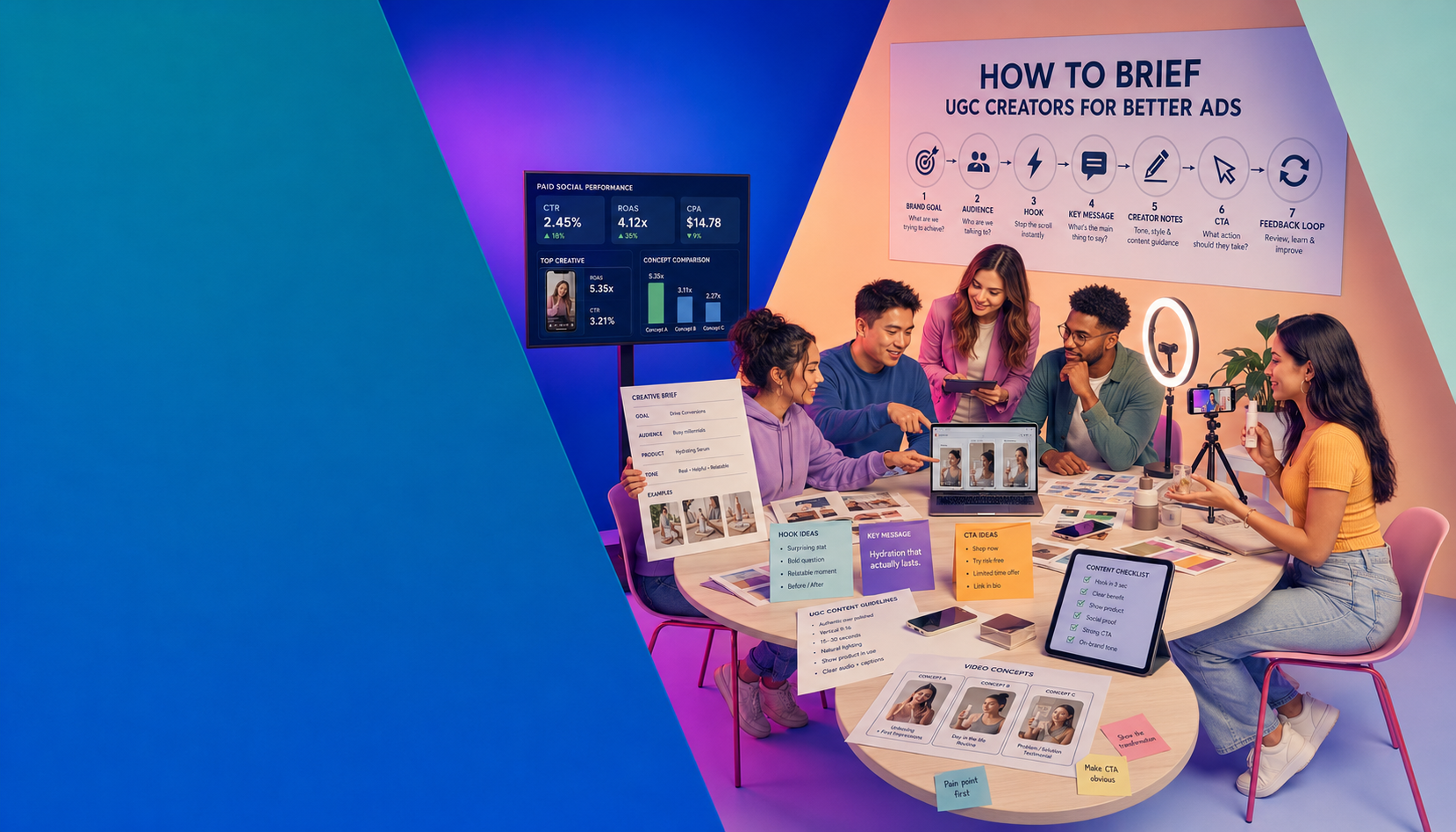
A good UGC ad starts before the camera turns on.
It starts with the brief.
For brands running paid social, the quality of the brief often determines whether the final asset becomes useful ad creative or just another piece of content that looks nice but does not perform.
UGC creators can bring authenticity, speed, and platform-native storytelling into your paid social campaigns. But even strong creators need direction. Without a clear brief, the content can become generic, unfocused, off-brand, or difficult to use in ads.
At the same time, over-controlling the creator can be just as damaging.
If the brief is too rigid, the final video may feel scripted, unnatural, or too much like a traditional brand ad. The strongest UGC ads usually sit between structure and authenticity: clear enough to support performance, but flexible enough to let the creator sound like a real person.
This guide explains how to brief UGC creators for better paid social ads, what to include in a creator brief, which mistakes to avoid, and how to turn creator content into stronger creative testing assets.
What Is a UGC Creator Brief?
A UGC creator brief is a document that gives creators the information they need to produce content for a brand.
For paid social, a UGC brief should explain:
- what the campaign is trying to achieve;
- who the ad is for;
- what message the content should communicate;
- what product details must be included;
- what format the creator should follow;
- what hooks or angles should be tested;
- what deliverables are required;
- how the brand can use the final content.
A strong brief does not just tell the creator what to say.
It explains the role the creative needs to play in the paid social campaign.
That distinction matters.
A creator brief for organic social might focus on brand awareness, storytelling, or general content quality. A creator brief for paid social needs to be more performance-oriented. It should help the creator produce assets that can be tested, edited, iterated, and used across ad platforms.
Why UGC Briefs Matter for Paid Social
Paid social creative has a job to do.
It needs to stop the scroll, communicate relevance quickly, create interest, build trust, and move the viewer toward action.
That does not happen by accident.
A strong UGC creator brief helps brands:
- get more usable assets from each creator;
- reduce revision cycles;
- improve message clarity;
- test more hooks and angles;
- avoid off-brand claims;
- make content easier to edit into ad variations;
- align creator content with campaign goals;
- produce assets that support paid media performance.
Without a brief, creators may produce content that looks good but lacks a strong hook, clear product benefit, or usable CTA.
With a strong brief, creators can bring their natural delivery into a structure that supports creative testing.
The goal is not to make every creator sound the same.
The goal is to give each creator enough direction to make the content useful for paid social.
The Difference Between a Brand Brief and a Paid Social UGC Brief
Many brands make the mistake of sending UGC creators a general brand brief.
A general brand brief may include brand values, visual guidelines, tone of voice, audience description, and product positioning. Those details are useful, but they are not enough for performance creative.
A paid social UGC brief needs to go further.
It should define what the specific ad needs to test.
For example:
- Is this ad testing a new hook?
- Is it explaining a product benefit?
- Is it handling an objection?
- Is it comparing the product to an alternative?
- Is it built for prospecting or retargeting?
- Is it meant to feel educational, testimonial, or demo-led?
- Is the creator supposed to sound like a customer, expert, reviewer, or peer?
A brand brief protects consistency.
A paid social UGC brief drives performance.
Brands need both, but they should not confuse one for the other.
What to Include in a UGC Creator Brief
A strong UGC creator brief should be clear, practical, and easy to follow.
Here are the most important sections to include.
1. Campaign Objective
Start by explaining the goal of the campaign.
Creators should know what the ad is supposed to accomplish. This helps them understand the role of the content, not just the topic of the video.
Examples of campaign objectives:
- introduce a new product;
- drive first purchases;
- increase app installs;
- generate trial signups;
- explain a key feature;
- overcome a specific objection;
- increase retargeting conversions;
- compare the product to an alternative;
- create fresh creative to fight ad fatigue.
A vague objective leads to vague content.
Instead of saying:
“Create a video about our product.”
Say:
“Create a short product demo that shows how our product helps busy professionals save time during their morning routine.”
Or:
“Create a testimonial-style video that addresses the objection that our product is too expensive by showing why it is worth the investment.”
The more specific the objective, the more useful the final asset will be.
2. Target Audience
The creator needs to know who they are speaking to.
A strong audience section should explain more than basic demographics. It should include the audience’s context, motivations, pain points, and objections.
Include details such as:
- age range;
- lifestyle;
- job role;
- interests;
- buying motivations;
- pain points;
- current alternatives;
- awareness level;
- emotional triggers;
- common objections.
For example:
Target audience:
Women ages 25–40 who are interested in skincare but feel overwhelmed by complicated routines. They want products that feel effective, simple, and trustworthy. They may be skeptical of brands that overpromise or use overly polished beauty advertising.
This gives the creator a clear sense of how to speak to the viewer.
The best UGC ads feel like they come from someone who understands the audience’s problem.
3. Product or Service Overview
Creators need enough product context to speak accurately and naturally.
This section should explain:
- what the product is;
- who it is for;
- what problem it solves;
- how it works;
- what makes it different;
- what the creator should show;
- what the creator should avoid saying.
Keep this section practical.
Creators do not need a full internal positioning deck. They need the clearest version of what the product does and why the viewer should care.
Example:
Product overview:
This is a subscription-based meal planning app for busy professionals who want to eat better without spending hours planning meals. The app creates weekly meal plans, grocery lists, and quick recipes based on dietary preferences and schedule.
This gives the creator enough information to create a believable use case.
4. Core Message
Every UGC ad should have one main message.
Trying to communicate too many points in one video usually makes the ad weaker.
The core message is the one idea the viewer should remember after watching.
Examples:
- “This product makes the process faster.”
- “This product helps you avoid a common frustration.”
- “This app is easier than the old way.”
- “This brand gives you a better version of something you already use.”
- “This product is worth trying because it solves a specific problem.”
For paid social, the core message should connect directly to the campaign objective.
If the objective is awareness, the message might focus on the problem.
If the objective is conversion, the message might focus on proof, urgency, or objection handling.
If the objective is retargeting, the message might focus on why the product is worth buying now.
5. Creative Angle
The creative angle is the perspective the creator should use to communicate the message.
Different angles can make the same product feel completely different.
Examples of UGC ad angles:
Problem-Solution
The creator introduces a pain point and shows how the product solves it.
Example:
“I used to waste so much time trying to figure out what to cook during the week. This app made it much easier.”
Before-and-After
The creator shows what changed after using the product.
Example:
“Before using this, my routine was all over the place. Now I can get everything done in under ten minutes.”
Product Demo
The creator shows how the product works.
Example:
“Here’s exactly how I use it.”
Comparison
The creator compares the product to an old habit, competitor, or alternative.
Example:
“I used to do this manually, but this is much faster.”
Testimonial
The creator speaks from a personal experience or recommendation.
Example:
“I tried this for a week, and here’s what I noticed.”
Objection Handling
The creator addresses a concern the audience may have.
Example:
“I thought this would be too expensive, but here’s why it actually made sense.”
Briefing a specific angle helps avoid generic content.
It also gives the media team cleaner variables to test across campaigns.
6. Hook Directions
The hook is one of the most important parts of a paid social ad.
On platforms like TikTok, Instagram, and Facebook, the first few seconds determine whether the viewer keeps watching or scrolls away.
A good brief should include several hook directions.
Examples:
- “I wish I knew this before…”
- “If you struggle with [problem], try this.”
- “I stopped using [alternative] because…”
- “Here’s why I keep coming back to this.”
- “I didn’t expect this to work, but…”
- “This is what finally helped me with [problem].”
- “Three things I noticed after trying [product].”
- “This made [routine/task/problem] so much easier.”
- “I thought this was overhyped until I tried it.”
- “If you’re still doing [old behavior], this is for you.”
The hook should match the audience’s problem and the campaign objective.
For creative testing, ask creators to deliver multiple hook variations. This gives the media team more options without requiring an entirely new shoot.
7. Required Talking Points
Required talking points are the details the creator must include.
This section helps prevent missing information and reduces revision rounds.
Examples:
- product name;
- key benefit;
- feature mention;
- offer;
- discount;
- website or app mention;
- disclaimer;
- usage instruction;
- CTA;
- approved claim;
- product demonstration moment.
Be careful not to overload the creator with too many required lines.
If every sentence is mandatory, the content may feel stiff.
A useful structure is:
Must include:
- Mention that the product is designed for busy professionals.
- Show the app interface.
- Explain that it creates weekly meal plans.
- End with a clear CTA.
Optional:
- Mention grocery list generation.
- Mention dietary preferences.
- Share a personal reaction.
This gives creators enough structure without removing flexibility.
8. Content Format
Define the format you want the creator to produce.
UGC ads can take many different shapes. If the format is unclear, the creator may deliver something that is difficult to use in paid media.
Examples of formats:
- talking head;
- product demo;
- unboxing;
- testimonial;
- screen recording;
- day-in-the-life;
- routine integration;
- comparison video;
- reaction video;
- listicle;
- direct-response script;
- voiceover with b-roll.
For paid social, format matters because it changes how the creative will be edited, tested, and launched.
If the goal is to show the product clearly, a demo may work best.
If the goal is trust, a testimonial may be stronger.
If the goal is education, a voiceover or expert-style format may work better.
9. Visual Direction
UGC should feel native, but that does not mean the visual direction should be ignored.
The brief should explain what the content should look and feel like.
Include guidance on:
- lighting;
- framing;
- background;
- product visibility;
- wardrobe;
- location;
- props;
- camera orientation;
- pacing;
- level of polish.
For most paid social UGC ads, vertical 9:16 video is the standard format.
Example visual direction:
Shoot vertical 9:16. Use natural lighting. Keep the product visible in the first five seconds. The video should feel casual and native to TikTok or Instagram Reels, not like a polished commercial.
This gives the creator enough direction while preserving the UGC feel.
10. Deliverables
Be very specific about what the creator needs to deliver.
This avoids confusion and makes production easier to manage.
Examples:
- 1 edited video, 30 seconds max;
- 3 raw video takes;
- 5 hook variations;
- 2 CTA variations;
- 10 product b-roll clips;
- raw footage plus edited final cut;
- captions included or not included;
- vertical 9:16 format;
- no music, so the brand can add platform-safe audio later.
For paid social, raw footage is often valuable because the brand can edit multiple versions from the same creator submission.
A strong deliverables section might look like this:
Deliverables:
- 1 edited 30-second vertical video;
- 3 alternate hooks;
- 2 CTA endings;
- 5 raw b-roll clips showing product use;
- raw footage files;
- no background music;
- no embedded captions.
This gives the brand more flexibility for testing.
11. Usage Rights
Usage rights are essential for paid social.
Brands need to clarify how, where, and for how long the content can be used.
Include details such as:
- organic usage;
- paid media usage;
- whitelisting or creator licensing;
- platform usage;
- duration of rights;
- geographic usage;
- editing rights;
- landing page usage;
- email usage;
- website usage.
For example:
The brand may use the final video and raw footage for paid and organic marketing across TikTok, Instagram, Facebook, YouTube Shorts, landing pages, email, and website placements for 12 months. The brand may edit the content into multiple ad variations.
This protects both the brand and the creator.
It also avoids confusion after the content is delivered.
12. Do’s and Don’ts
A clear do’s and don’ts section helps creators stay aligned with brand and compliance requirements.
Examples:
Do:
- speak naturally;
- show the product clearly;
- open with a strong hook;
- keep the pacing tight;
- use your own voice;
- make the problem feel specific;
- include the required CTA.
Don’t:
- make unsupported claims;
- mention competitors unless approved;
- use copyrighted music;
- make medical, financial, or legal claims without approval;
- over-polish the video;
- read the script word for word;
- hide the product until the end.
This section is especially useful for regulated categories or brands with strict messaging guidelines.
13. Examples and References
Creators benefit from seeing examples.
Include references that show:
- pacing;
- tone;
- visual style;
- hook structure;
- product demonstration style;
- editing style;
- level of polish.
But make it clear that references are inspiration, not templates to copy.
A useful note:
Use these examples as directional references for pacing and structure. Do not copy the scripts or recreate the videos exactly. We want the content to feel natural to your own voice.
This helps creators understand the creative territory while keeping the output original.
14. Timeline and Review Process
Set expectations for timing and revisions.
Include:
- brief delivery date;
- first draft deadline;
- revision window;
- final delivery date;
- number of revision rounds;
- how feedback will be shared;
- where files should be uploaded.
Example:
Timeline:
- Brief sent: Monday
- Creator questions due: Tuesday
- First draft due: Friday
- Feedback shared: Monday
- Final assets due: Wednesday
Clear timelines help keep the creative pipeline moving.
UGC Creator Brief Template
Here is a simple structure brands can use.
Campaign Overview
- Brand:
- Product:
- Campaign objective:
- Platform:
- Funnel stage:
- Target audience:
Creative Strategy
- Core message:
- Creative angle:
- Hook direction:
- Key benefit:
- Main objection to address:
- Desired viewer takeaway:
Creator Direction
- Role of creator:
- Tone:
- Format:
- Visual style:
- Required scenes:
- Product usage requirements:
Talking Points
- Must include:
- Optional points:
- Claims to avoid:
- Approved CTA:
Deliverables
- Number of videos:
- Raw footage:
- Hook variations:
- CTA variations:
- Format:
- Length:
- Captions:
- Music:
Usage Rights
- Paid media:
- Organic:
- Platforms:
- Duration:
- Editing rights:
- Whitelisting:
Timeline
- First draft due:
- Feedback date:
- Final assets due:
- File delivery method:
Example UGC Creator Brief
Here is what a simplified brief could look like.
Campaign Objective
Create a paid social UGC ad that introduces the product to cold audiences and positions it as a faster, easier alternative to the current way they solve the problem.
Target Audience
Busy professionals ages 25–40 who want to simplify their weekly routine but feel overwhelmed by planning, decision-making, and time-consuming tasks.
Core Message
This product helps users save time and make their routine easier.
Creative Angle
Problem-solution. Start with the frustration of the old way, then show how the product makes the process easier.
Hook Options
- “I wish I had found this sooner.”
- “If your week always feels chaotic, this helps.”
- “I stopped wasting time on [old behavior] after trying this.”
- “This made my weekly routine so much easier.”
Required Talking Points
- Mention the product name.
- Show the product in use.
- Explain the main benefit.
- Include one personal reaction.
- End with a CTA.
Visual Direction
Shoot vertical 9:16. Use natural lighting. Keep the video casual, conversational, and native to TikTok or Instagram Reels. Show the product within the first five seconds.
Deliverables
- 1 edited video, 30 seconds max;
- 3 alternate hooks;
- 2 CTA variations;
- raw footage;
- no music;
- no embedded captions.
Usage Rights
Brand may use the content across paid and organic social channels, landing pages, email, and website placements for 12 months. Brand may edit the content into multiple ad variations.
Common Mistakes When Briefing UGC Creators
Mistake 1: Giving Creators Too Much Freedom
UGC should feel natural, but creators still need direction.
If the brief is too open-ended, the final content may not include the right message, hook, product shots, or CTA.
Mistake 2: Over-Scripting Every Line
If the creator is forced to read a rigid script, the content may lose the authenticity that makes UGC effective.
A better approach is to provide talking points, structure, and hook options while allowing the creator to speak naturally.
Mistake 3: Not Defining the Funnel Stage
A top-of-funnel ad and a retargeting ad should not have the same brief.
Cold audiences may need problem education. Warm audiences may need proof, urgency, comparison, or objection handling.
Mistake 4: Asking One Video to Do Too Much
One UGC ad should not communicate every feature, benefit, use case, and proof point.
Each asset should have one primary job.
Mistake 5: Ignoring Usage Rights
If usage rights are unclear, the brand may not be able to use the content in paid social the way it intended.
Always define rights before production begins.
Mistake 6: Forgetting About Editing Flexibility
Paid social teams often need to create multiple versions from one creator submission.
Ask for raw footage, alternate hooks, and CTA variations to give the editing team more flexibility.
Mistake 7: Not Connecting the Brief to Performance Learnings
The best briefs are based on what the brand has already learned from paid media.
If a hook, objection, or format has performed well, use that insight to shape the next brief.
How to Turn One UGC Brief Into Multiple Ad Variations
A strong brief should help the brand produce more than one ad.
For example, one creator brief can generate:
- one full-length edited video;
- three hook tests;
- two CTA tests;
- one shorter cutdown;
- one product-focused version;
- one testimonial-style version;
- one retargeting edit;
- one native TikTok-style version;
- one Instagram Reels version.
This is important because paid social performance depends on variation.
The more structured the brief, the easier it becomes to turn one creator submission into multiple testing assets.
That helps teams produce more creative without starting from scratch every time.
How NugVerse Helps Brands Brief Better UGC Creators
A strong brief matters. But so does the creator receiving it.
Even the best brief will struggle if the creator is not aligned with the campaign, audience, category, or paid social format.
NugVerse helps brands connect with vetted UGC creators matched to their campaign goals.
Instead of manually searching for creators and hoping they can deliver performance-ready assets, brands can use NugVerse to find creators based on fit, niche, audience, and content needs.
With AI-powered matching, NugVerse helps brands identify creators who are better suited for the brief before production begins.
That makes it easier to:
- find better-fit UGC creators;
- brief creators more efficiently;
- produce more usable paid social assets;
- test more hooks and angles;
- reduce revision cycles;
- keep the creative pipeline moving.
For paid social teams, the goal is not just to create content.
The goal is to create assets that can be tested, optimized, and scaled.
NugVerse helps make that process faster and more structured.
Final Takeaway
A strong UGC creator brief gives creators the structure they need to produce better paid social ads.
It defines the campaign goal, target audience, core message, creative angle, hook direction, deliverables, and usage rights. It also gives creators enough flexibility to sound natural and authentic.
The best briefs are not overly vague or overly scripted.
They sit in the middle: clear enough to support performance, flexible enough to preserve the creator’s voice.
For brands running paid social, better briefs lead to better creative inputs. Better creative inputs lead to better tests. Better tests lead to stronger learnings.
And stronger learnings help brands build a creative pipeline that keeps campaigns moving.
Ready to Brief Better UGC Creators?
NugVerse connects brands with vetted UGC creators matched to their campaign goals.
Find better-fit creators. Produce more paid social assets. Turn stronger briefs into better ads.
Start your first project with NugVerse.
FAQ
What is a UGC creator brief?
A UGC creator brief is a document that gives creators the information they need to produce content for a brand. For paid social, it should include the campaign objective, target audience, core message, creative angle, deliverables, usage rights, and timeline.
Why is a UGC brief important?
A UGC brief helps creators produce content that is more aligned with the brand’s campaign goals. It reduces confusion, improves message clarity, shortens revision cycles, and makes the final content more useful for paid social testing.
What should a UGC creator brief include?
A strong UGC creator brief should include the campaign objective, target audience, product overview, core message, creative angle, hook options, required talking points, visual direction, deliverables, usage rights, examples, and timeline.
Should UGC creators be scripted?
UGC creators should usually receive structure, not a rigid script. Talking points, hook directions, and required messages are useful, but creators should have enough flexibility to speak naturally in their own voice.
How long should a UGC ad be?
Many UGC ads for paid social are between 15 and 30 seconds, but the ideal length depends on the platform, funnel stage, message complexity, and creative format. Shorter videos often work well for hooks and product demos, while longer videos may be useful for education or objection handling.
How many hooks should I ask a UGC creator to deliver?
Asking for three to five hook variations is often useful because it gives the paid media team more options to test without requiring a full new production round.
Why are usage rights important in UGC briefs?
Usage rights define how and where the brand can use the creator’s content. This is especially important for paid social because the brand may want to run the content as ads across platforms, edit it into variations, or use it on landing pages and email campaigns.
How can brands get better UGC ads?
Brands can get better UGC ads by working with vetted creators, writing clearer briefs, defining the campaign objective, testing multiple hooks and angles, asking for raw footage, and using performance data to shape future briefs.
Related Articles
What Are UGC Ads?
How to Brief UGC Creators for Better Ads
What Is Creative Fatigue in Paid Social?
How to Build a Paid Social Creative Pipeline
UGC Creators for Paid Social Ads: How to Find, Vet, and Scale Winning Creative