
Introduction
The advertising landscape presents a complex tapestry woven from diverse strategies and approaches. Here, the choice of agency can significantly influence a brand's trajectory. Full-service agencies offer a comprehensive suite of marketing solutions, promising seamless integration and a wealth of resources. In contrast, boutique firms pride themselves on personalized service and specialized expertise. As brands navigate the decision between these two distinct options, they face a critical question: which type of agency will best align with their unique goals and challenges in an ever-evolving market?
Furthermore, understanding the implications of this choice is essential. Brands must consider not only their immediate needs but also their long-term vision. Will a full-service agency provide the breadth of services necessary for growth, or will a boutique firm’s tailored approach better suit their specific objectives? This decision is not merely about services offered; it’s about finding a partner that resonates with the brand's ethos and aspirations.
In addition, successful case studies illustrate the impact of agency choice on brand success. For instance, brands that have partnered with full-service agencies often report enhanced visibility and market reach. Conversely, those that have engaged boutique firms frequently highlight the value of personalized strategies that cater to their unique challenges.
Ultimately, the choice of agency is a pivotal step in a brand's journey. As you weigh your options, consider what aligns best with your vision and goals. Engaging with the right agency can set the stage for remarkable growth and success.
Defining Full-Service and Boutique Advertising Agencies
represent the pinnacle of marketing solutions, offering a comprehensive array of services that include strategy development, creative design, media purchasing, and analytics. With larger teams and extensive resources, these firms are equipped to across diverse platforms. Conversely, carve out their niche as smaller, specialized entities that focus on specific offerings. They pride themselves on delivering , emphasizing creativity and flexibility over sheer volume. often excel in areas such as , , or branding, catering to clients who desire a more customized approach.
In a landscape where , the choice between full-service and boutique firms can significantly . Are you ready to explore which option aligns best with your goals? Engage with MediaNug to discover how we can .

Evaluating the Strengths and Weaknesses of Full-Service Agencies
present , offering a diverse range of services that streamline promotional efforts. Their ability to integrate various marketing channels ensures consistent messaging and branding across multiple platforms, which is essential for preserving brand integrity. Moreover, these organizations typically draw from a , allowing them to leverage specialized skills tailored to specific campaign needs. Engel O’Neill points out that "this leads to fresh, innovative ideas that wouldn’t emerge in an isolated digital firm," underscoring the collaborative strengths of .
However, come with inherent challenges. The significant overhead often results in higher costs, which can deter some clients. Additionally, the scale of operations may lead to a less . Campaigns might be viewed as parts of a larger portfolio, resulting in generic strategies that overlook . This lack of tailored approaches can diminish the effectiveness of promotional initiatives, especially in a landscape where is increasingly crucial for success.
Research indicates that unified employed by can significantly enhance campaign effectiveness. Yet, the challenge remains in balancing extensive offerings with the need for personalized focus. As companies navigate this complex environment, understanding the pros and cons of becomes vital for making informed decisions about their promotional partnerships.

Assessing the Advantages and Challenges of Boutique Agencies
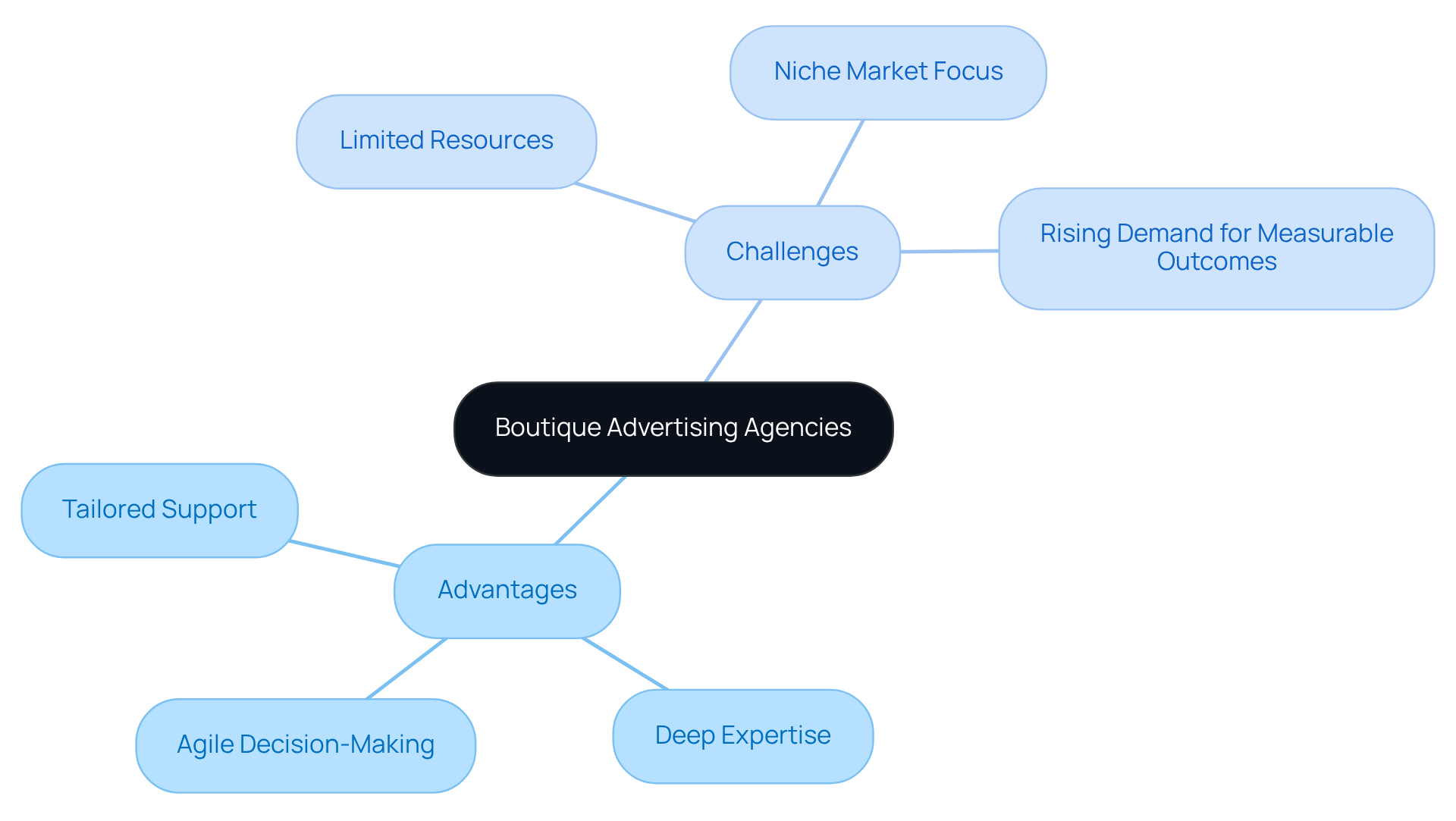
stand out by offering and possessing deep expertise in specific marketing fields, which enables them to develop . Their smaller size fosters , often resulting in quicker turnaround times-an essential advantage for companies needing . However, these organizations encounter , including limited resources that can hinder their ability to effectively expand campaigns or provide a broad range of services. Moreover, their focus on may limit their appeal to larger brands that seek comprehensive solutions.
For example, many boutique firms grapple with the rising demand for , as clients increasingly desire tangible results over mere activity. This shift calls for a commitment to and maintaining open communication, which are vital for of delivering results. Furthermore, the competitive landscape is evolving, with numerous highly skilled professionals either launching their own boutique firms or joining smaller organizations, intensifying competition for clients.
Consequently, must continuously adapt to these challenges while leveraging their unique advantages to remain relevant in a rapidly changing promotional landscape. Are you ready to explore how these firms can thrive amidst such competition?
Comparative Analysis: Choosing the Right Agency for Your Brand
Choosing between a and requires careful consideration of several key factors, including budget, campaign scope, and the desired level of personalization. s are often ideal for larger companies with extensive marketing needs, as they can provide cohesive strategies across multiple channels. Notably, companies that collaborate with report a satisfaction rate of 58%, underscoring their ability to manage intricate campaigns efficiently.
Conversely, boutique firms excel in delivering specialized knowledge and tailored service, making them perfect for or those targeting niche markets. Research indicates that , and a more flexible approach to project management. Additionally, 72% of businesses express greater satisfaction when partnering with smaller companies, reinforcing the argument for boutique firms.
When evaluating collaboration options, companies should also consider the and adaptability. Boutique firms typically operate with lower overhead and fewer bureaucratic hurdles, enabling quicker responses to market changes and more competitive pricing. In contrast, larger organizations may face inefficiencies due to excessive meetings and approval layers, which can lead to confusion and unexpected expenses.
Ultimately, , target audience, and specific . As the landscape evolves, brands increasingly recognize the value of leveraging creators and to inform their strategies. This makes the choice of agency partner more critical than ever.

Conclusion
Choosing between boutique advertising agencies and full-service options is a critical decision for brands aiming to implement effective marketing strategies. Each agency type presents unique advantages and challenges that shape how businesses address their promotional needs. Recognizing these differences is vital for aligning agency capabilities with brand objectives and ensuring successful campaign outcomes.
Full-service agencies offer a comprehensive range of services that can streamline marketing efforts. However, they often lack the personalized touch that boutique firms excel in. Conversely, boutique agencies bring specialized knowledge and agility, focusing on specific market segments with tailored strategies. Both agency types possess distinct strengths: the collaborative creativity of full-service firms and the focused expertise of boutique agencies can significantly enhance client satisfaction and campaign effectiveness.
Ultimately, the choice of advertising agency depends on a brand’s specific goals, budget, and desired level of personalization. As the marketing landscape evolves, brands must thoughtfully evaluate their options, balancing the benefits of comprehensive strategies against the personalized service provided by smaller firms. By making informed decisions, businesses can fully leverage their marketing efforts, driving engagement and achieving their objectives in an increasingly competitive environment.
Frequently Asked Questions
What is a full-service advertising agency?
A full-service advertising agency offers a comprehensive range of marketing solutions, including strategy development, creative design, media purchasing, and analytics, and is equipped to manage large-scale campaigns across various platforms.
What distinguishes boutique advertising agencies from full-service agencies?
Boutique advertising agencies are smaller, specialized firms that focus on specific offerings and prioritize personalized attention and tailored strategies over sheer volume, often excelling in areas like social media promotion, content creation, or branding.
What are the advantages of working with a full-service advertising agency?
The advantages include access to larger teams and extensive resources, enabling the management of complex, large-scale marketing campaigns across diverse platforms.
What benefits do boutique advertising agencies offer?
Boutique advertising agencies provide a customized approach, emphasizing creativity and flexibility, which can lead to more personalized marketing strategies for clients.
How can the choice between a full-service and a boutique agency impact a brand's success?
The choice can significantly influence a brand's success by aligning the marketing strategy with the brand's specific goals and needs, as each type of agency offers different strengths and focuses.
List of Sources
- Defining Full-Service and Boutique Advertising Agencies
- pstechglobal.com (https://pstechglobal.com/blog/50-powerful-quotes-on-advertisements-52)
- designrush.com (https://designrush.com/agency/creative-agencies/trends/what-is-a-boutique-creative-agency)
- 42courses.com (https://42courses.com/blog/home/great-quotes-about-advertising)
- designity.com (https://designity.com/blog/full-service-marketing-agency)
- Advertising Agencies in the US Industry Analysis, 2026 (https://ibisworld.com/united-states/industry/advertising-agencies/1433)
- Evaluating the Strengths and Weaknesses of Full-Service Agencies
- engeloneill.com (https://engeloneill.com/why-full-service-agencies-deliver-better-results-than-digital-only-agencies)
- 100 ad leaders predict 2026 marketing trends—what’s next for AI, agencies, creativity, media and more (https://tritondigital.com/news-item/January-05-2026/100-ad-leaders-predict-2026-marketing-trends-what-s-next-for-ai-agencies-creativity-media-and-more)
- 4 reasons why full-service digital agencies are the backbone of brand transformation in the digital age - Agility PR Solutions (https://agilitypr.com/pr-news/pr-news-trends/4-reasons-why-full-service-digital-agencies-are-the-backbone-of-brand-transformation-in-the-digital-age)
- adage.com (https://adage.com/trends-predictions/business-forecast/aa-agency-leaders-to-watch-in-2026)
- Predictions 2026: Marketing Agencies Resign Their Agency (https://forrester.com/blogs/predictions-2026-marketing-agencies-resign-their-agency)
- Assessing the Advantages and Challenges of Boutique Agencies
- bestmediainfo.com (https://bestmediainfo.com/mediainfo/advertising/will-2026-be-the-game-changer-for-creative-agencies-10942347)
- capitolcommunicator.com (https://capitolcommunicator.com/2026-will-be-a-unique-opportunity-for-clients-seeking-an-agency)
- prnewswire.com (https://prnewswire.com/news-releases/new-report-finds-triple-threat-facing-marketing-agencies-including-ai-302254173.html)
- 100 ad leaders predict 2026 marketing trends—what’s next for AI, agencies, creativity, media and more (https://tritondigital.com/news-item/January-05-2026/100-ad-leaders-predict-2026-marketing-trends-what-s-next-for-ai-agencies-creativity-media-and-more)
- entrepreneur.com (https://entrepreneur.com/growing-a-business/why-marketing-agencies-are-struggling-in-2025/495568)
- Comparative Analysis: Choosing the Right Agency for Your Brand
- martiancraft.com (https://martiancraft.com/blog/2025/08/big-agencies-vs-boutiquefirms)
- designity.com (https://designity.com/blog/full-service-marketing-agency)
- What successful brand-agency partnerships look like in 2026 (https://searchengineland.com/what-successful-brand-agency-partnerships-look-like-in-2026-466647)
- bestmediainfo.com (https://bestmediainfo.com/mediainfo/advertising/will-2026-be-the-game-changer-for-creative-agencies-10942347)
- campaignlive.com (https://campaignlive.com/article/question-week-adlands-2026-predictions-creators-ad-agencies-talent/1943071)