
Introduction
The advertising landscape is experiencing a profound transformation as content creators ascend to prominence, challenging the entrenched dominance of traditional advertising methods. This analysis explores the dynamic interplay between these two marketing approaches, emphasizing the distinct advantages that content creators offer. As brands navigate the shifting preferences of consumers, a critical question arises: can traditional advertising adapt to the authenticity and engagement that content creators consistently provide?
Furthermore, the rise of content creators is not merely a trend; it represents a fundamental shift in how brands connect with their audiences. With the ability to foster genuine relationships and deliver tailored content, these creators are reshaping consumer expectations. In addition, the effectiveness of their strategies is evident in numerous successful case studies, showcasing how brands can thrive in this new environment.
As we delve deeper into this topic, it becomes clear that understanding this evolution is essential for brands aiming to remain relevant. The challenge lies not just in keeping pace but in embracing the innovative approaches that content creators bring to the table. Are you ready to explore how your brand can leverage this shift?
Define Content Creators and Traditional Advertising
In the , pivotal players generate captivating material that spans videos, blogs, and social media posts. Their work is crafted to engage viewers on platforms like TikTok, Instagram, and YouTube. By leveraging creativity and authenticity, these individuals or organizations cultivate communities and build trust with their followers. Platforms such as empower these artists, offering opportunities to collaborate with reputable brands that value their craft and ensure fair compensation for every project.
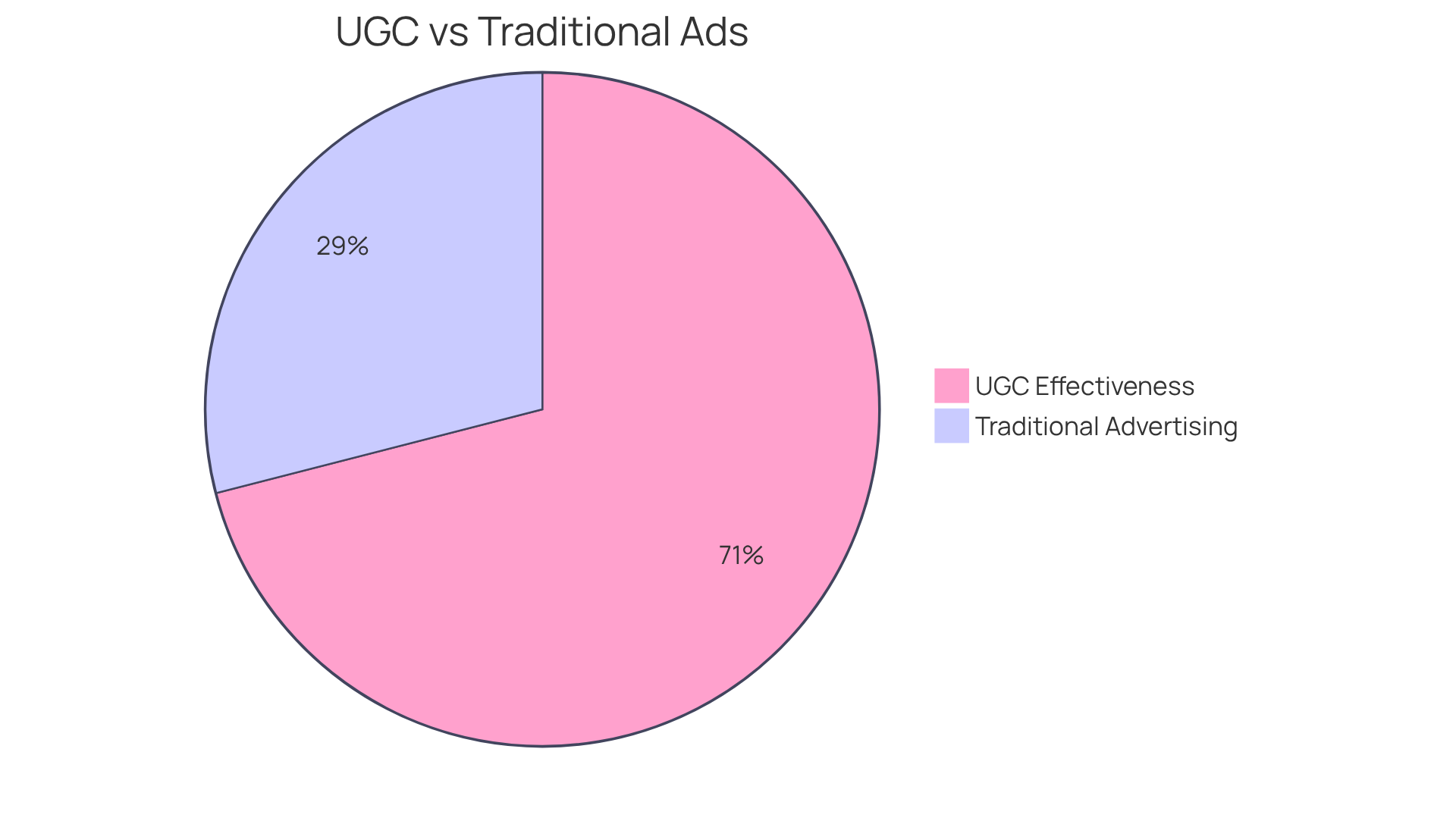
In contrast, relies on established methods like television commercials, print ads, and billboards, which focus on directly promoting products or services to a broad audience. This approach typically follows a one-way communication model. However, information producers foster , facilitating a more personalized and relatable marketing strategy. Current trends indicate a significant shift in advertising effectiveness, with . For instance, achieve four times higher click-through rates than traditional advertisements, and brands utilizing UGC report 29% more web conversions compared to campaigns that lack user-generated material.
As viewers increasingly tailor their media consumption, the line between user-generated and professionally produced content continues to blur. Producers often employ high-quality production techniques similar to those found in conventional media. The role of content producers in the is becoming increasingly vital, as they not only enhance engagement but also influence purchasing decisions. Studies reveal that , and .
This evolution underscores the necessity for brands to adapt their strategies, embracing the that influencers bring to the table. Are you ready to harness the power of in your marketing efforts?
Evaluate Effectiveness: Content Creators vs. Traditional Advertising
Recent research reveals that content created by influencers and artists often garners significantly higher engagement rates than . For instance, creator-led campaigns can achieve click-through rates (CTR) that are four times greater than those of standard ads. Moreover, a striking 94% of brands report that (ROI) compared to conventional advertising methods. This effectiveness stems from the , who forge personal connections with audiences, fostering trust and driving conversions. Conversely, frequently encounters ad fatigue and diminishing returns as consumers grow increasingly desensitized to standard promotional tactics.
As the economy surrounding the is projected to exceed $376.6 billion by 2030, brands are recognizing the imperative to integrate . Additionally, the evolving landscape of marketing strategies is being shaped by AI, which enhances the effectiveness of . However, it is crucial to acknowledge that the returns from can vary, necessitating a strategic approach. As Lex Bradshaw-Zanger emphasizes, cultivating is essential for achieving optimal results.

Compare Costs and ROI: Content Creators and Traditional Advertising
When it comes to costs, often demands in media buying, production, and distribution. For instance, producing and airing a single television commercial can set brands back hundreds of thousands of dollars. Conversely, collaborating with producers allows for a more , as many individuals offer competitive rates for . Recent reports indicate that the average ROI for stands at an impressive $5.78 for every dollar spent, significantly eclipsing , which averages around $2 for the same investment. This , positions producers as an appealing choice for brands eager to .

Analyze Audience Engagement: Content Creators vs. Traditional Advertising
Producers excel at fostering engagement among viewers through interactive and relatable material. They employ storytelling techniques, live interactions, and community-building strategies that cultivate a sense of belonging among their supporters. Platforms like TikTok and Instagram enable individuals to interact directly with their followers through comments, polls, and Q&A sessions, leading to considerably higher levels of engagement. In contrast, conventional advertising often relies on passive consumption, where viewers are less inclined to engage with the material. This lack of interaction can result in lower retention rates and diminished brand loyalty, as consumers may feel disconnected from the brand's message.
As conventional media must adapt to create content that attracts viewers rather than losing them to creators, frequently notice . Research indicates that:
- 70% of Gen Z shoppers find very useful in their purchasing process.
- 84% of millennials express a dislike for .
This shift not only strengthens customer relationships but also boosts the overall effectiveness of marketing strategies, as audiences increasingly prefer authentic, over conventional advertising approaches.
Furthermore, , including trend jacking and livestreams, is essential for maintaining relevance. This emphasizes the need for brands to transition from control to collaboration to remain competitive. By embracing these strategies, brands can not only enhance their engagement but also foster a deeper connection with their audience.

Assess Adaptability and Innovation: Content Creators vs. Traditional Advertising
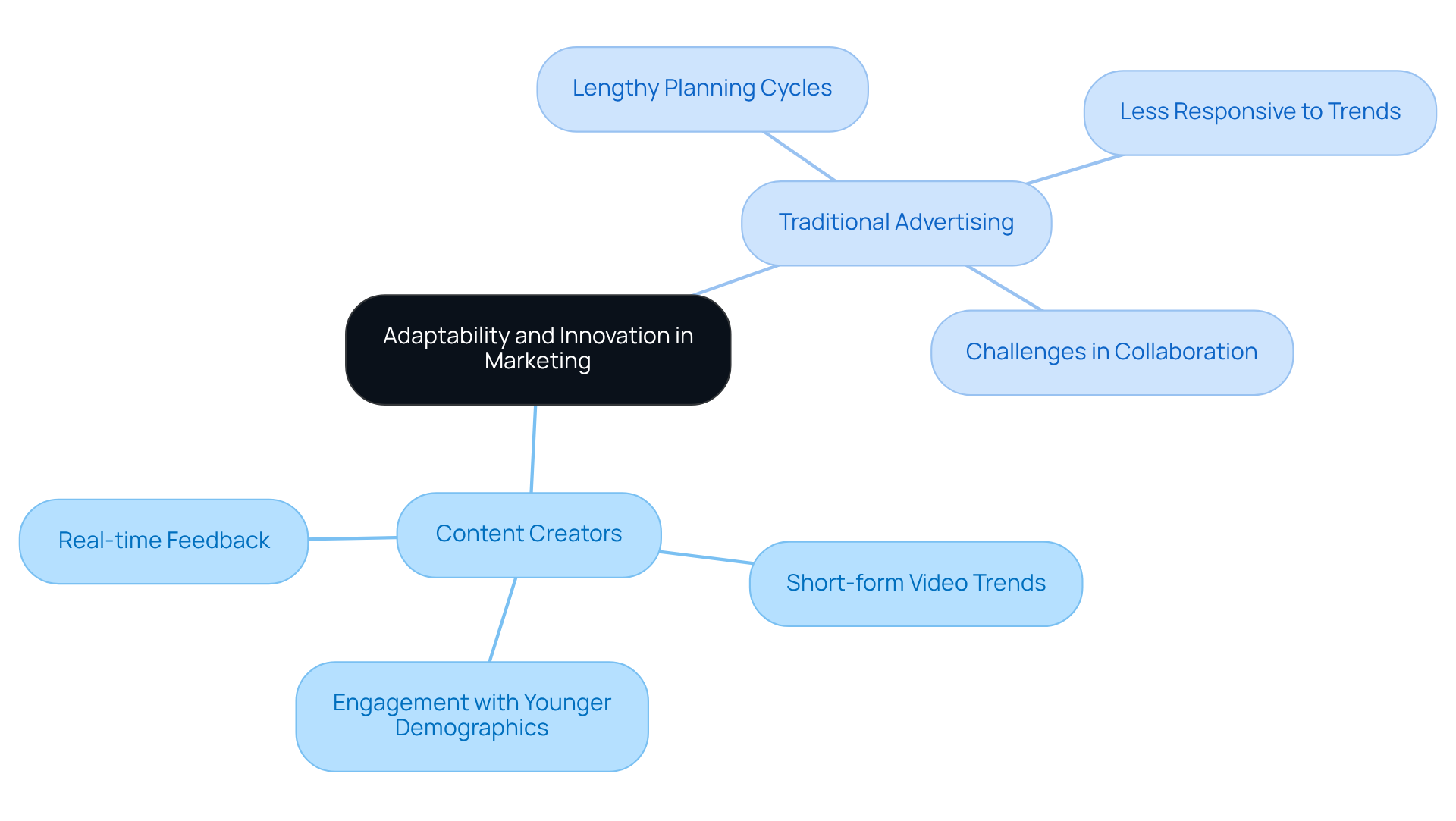
are adept at adapting to shifting trends and consumer preferences, leveraging real-time feedback to refine their strategies. Their ability to pivot quickly in response to viewer reactions and emerging trends is evident in the surge of on platforms like TikTok and Instagram Reels. This trend has contributed to over 36 billion hours of , as reported by Stream Hatchet. Such a shift enables producers to connect efficiently with younger demographics, capitalizing on current trends with remarkable flexibility.
In contrast, often struggles with lengthy planning and production cycles, making it less responsive to market dynamics. Brands that prioritize in the can harness innovative strategies that resonate deeply with their target audiences, ensuring sustained relevance in an increasingly competitive landscape. As Jason Davis highlighted, has become a permanent fixture in global marketing strategies, underscoring the importance of integrating to foster brand loyalty and enhance performance.
Moreover, the partnership between artists and brands, as demonstrated in Julian Sarafian's work with CalMatters, showcases the tangible benefits of allowing artists to express their genuine voice. This approach boosts engagement and relatability, making a significant impact on audience connection. As the , addressing challenges such as creator burnout will be essential for maintaining a sustainable and effective partnership model.
Conclusion
The advertising landscape is experiencing a profound transformation, with content creators stepping into pivotal roles that challenge traditional methods. By leveraging creativity and authenticity, these creators engage audiences in ways that resonate personally, moving beyond the outdated one-way communication model of conventional advertising. This shift underscores the necessity for brands to embrace the unique advantages presented by the content creators marketplace.
Key insights reveal that content generated by influencers not only garners higher engagement rates but also delivers superior ROI compared to traditional advertising. As brands navigate a marketplace projected to surpass $376.6 billion by 2030, the urgency for innovative strategies that harness user-generated content becomes undeniable. The effectiveness of content creators lies in their capacity to forge genuine connections with audiences, fostering trust and driving conversions that traditional ads often fail to achieve.
As the advertising industry evolves, the message is clear: brands must pivot towards collaboration with content creators to remain relevant and effective. By embracing the authenticity and relatability of influencers, businesses can cultivate deeper relationships with their target audiences, enhancing both engagement and brand loyalty. The future of advertising transcends merely reaching consumers; it’s about creating meaningful connections that resonate and inspire.
Frequently Asked Questions
What are content creators and how do they differ from traditional advertising?
Content creators are individuals or organizations that produce engaging material, such as videos, blogs, and social media posts, to connect with audiences on platforms like TikTok, Instagram, and YouTube. Unlike traditional advertising, which uses methods like TV commercials and print ads to promote products directly to a broad audience, content creators foster two-way interactions and build trust with their followers through authenticity and creativity.
How effective is user-generated content (UGC) compared to traditional advertising?
User-generated content (UGC) is significantly more effective than traditional advertising. UGC-based ads achieve four times higher click-through rates and brands using UGC report 29% more web conversions compared to those that do not use user-generated material.
What impact do content creators have on consumer engagement and purchasing decisions?
Content creators enhance engagement and influence purchasing decisions significantly. Studies show that 60% of TikTok brand interactions come from user-generated content, and 93% of marketers using such media report better results compared to traditional branded content.
What trends are influencing the effectiveness of content creators in marketing?
The effectiveness of content creators in marketing is influenced by the growing consumer preference for authenticity and relatability. As the content creators marketplace is expected to exceed $376.6 billion by 2030, brands are increasingly integrating creator strategies into their marketing plans to maximize impact and engagement.
How does the return on investment (ROI) for influencer-generated content compare to traditional advertising?
Influencer-generated content typically delivers a superior return on investment (ROI), with 94% of brands reporting better results compared to conventional advertising methods. This is attributed to the authentic connections that content creators establish with their audiences.
What challenges does traditional advertising face in the current market?
Traditional advertising faces challenges such as ad fatigue and diminishing returns, as consumers become desensitized to standard promotional tactics. This has led to a shift in marketing strategies towards more engaging and relatable content created by influencers.
How is AI shaping the landscape of influencer marketing?
AI is enhancing the effectiveness of influencer marketing by allowing brands to better analyze data and optimize their campaigns. However, it is important for brands to cultivate long-term and authentic relationships with content creators to achieve optimal results.
List of Sources
- Define Content Creators and Traditional Advertising
- digitalcontentnext.org (https://digitalcontentnext.org/blog/2025/12/18/from-skepticism-to-strategy-media-adapts-to-the-creator-economy)
- theguardian.com (https://theguardian.com/media/2025/jun/10/social-media-creators-to-overtake-traditional-media-in-ad-revenue-this-year)
- The Top Creator Marketing Stats you Need to Know (https://tribegroup.co/blog/top-creator-marketing-statistics)
- aspire.io (https://aspire.io/blog/creator-ads-vs-brand-ads-2025-data-you-need)
- Evaluate Effectiveness: Content Creators vs. Traditional Advertising
- newsleader.com (https://newsleader.com/press-release/story/25938/new-research-on-influencer-marketing-trends-finds-widening-roi-gaps-as-spend-nears-40b)
- socialnative.com (https://socialnative.com/articles/why-creator-marketing-is-the-2026-growth-engine-for-brands)
- Journalism, media, and technology trends and predictions 2026 (https://reutersinstitute.politics.ox.ac.uk/journalism-media-and-technology-trends-and-predictions-2026)
- warc.com (https://warc.com/content/feed/future-of-media-2026-the-creator-effectiveness-gap/en-GB/11270)
- The Creator Economy In 2026: The Era Of Consolidation (https://forbes.com/sites/jasondavis/2026/01/26/the-creator-economy-in-2026---the-era-of-consolidation)
- Compare Costs and ROI: Content Creators and Traditional Advertising
- How Influencer Marketing Is Moving Into Scalable Performance Channels (https://forbes.com/councils/forbesagencycouncil/2026/02/09/beyond-the-feed-the-evolution-of-influencer-marketing-into-scalable-performance-channels)
- socialnative.com (https://socialnative.com/articles/driving-creator-marketing-roi-in-2026-and-why-it-matters)
- 2026 State of Influencer Marketing – Linqia (https://linqia.com/2026-state-of-influencer-marketing)
- Influencer Marketing Trends 2026: Performance Insights (https://impact.com/influencer/influencer-marketing-trends-performance)
- 2026 Influencer Marketing Statistics: ROI, Trends & Platform Data (https://sociallyin.com/influencer-marketing-statistics)
- Analyze Audience Engagement: Content Creators vs. Traditional Advertising
- cmdagency.com (https://cmdagency.com/blog/brands-vs-creators-the-battle-for-audience-attention)
- Audiences overwhelmingly prefer user-generated content over standard ads, AI (https://emarketer.com/content/audiences-overwhelmingly-prefer-user-generated-content-over-standard-ads--ai)
- What can we learn from the rise of content creators? (https://inma.org/blogs/newsroom-initiative-newsletter/post.cfm/what-can-we-learn-from-the-rise-of-content-creators)
- pulse-advertising.com (https://pulse-advertising.com/news/the-rise-of-community-creators-and-real-time-content-in-2025)
- swaygroup.com (https://swaygroup.com/traditional-advertising-vs-influencer-marketing)
- Assess Adaptability and Innovation: Content Creators vs. Traditional Advertising
- netinfluencer.com (https://netinfluencer.com/news-creators-rival-traditional-media-for-audience-attention-global-study-shows)
- How Influencer Marketing Is Changing in 2026 (https://vogue.com/article/how-influencer-marketing-is-changing-in-2026)
- The Creator Economy In 2026: The Era Of Consolidation (https://forbes.com/sites/jasondavis/2026/01/26/the-creator-economy-in-2026---the-era-of-consolidation)
- americanpressinstitute.org (https://americanpressinstitute.org/what-content-creators-want-you-to-know)
- contentgrip.com (https://contentgrip.com/long-term-creator-marketing-strategy)