Introduction
Grasping the complexities of social media marketing costs is crucial for businesses aiming to maximize their return on investment. With various platforms presenting a spectrum of pricing models and numerous factors influencing expenses - from audience targeting to content quality - navigating this landscape can feel overwhelming.
How can marketers effectively optimize their budgets while ensuring impactful engagement? This article explores essential strategies and insights to master the pricing of social media marketing, equipping you with the tools needed to enhance your campaigns and drive success.
Identify Key Factors Influencing Social Media Marketing Costs
To effectively manage your budget, it’s crucial to pinpoint the for .
- Platform Selection: vary significantly across platforms. For example, TikTok's (CPL) ranges from $8 to $15, while Facebook offers a more budget-friendly median CPL of $6.49, making it particularly effective for B2C companies. Understanding these differences allows for based on the price for in relation to where your is most active.
- : The accuracy of your audience targeting can greatly impact expenses. Platforms often charge more for ads aimed at niche demographics. For instance, LinkedIn commands higher prices for targeted B2B audiences, with CPLs ranging from $15 to $350. Utilize audience insights to refine your targeting strategy and ensure the price for is optimized.
- : typically yields better results, leading to lower expenses per engagement. Investing in professional visuals and engaging text can enhance ad performance, ultimately reducing the expense per lead. Brands that create authentic, captivating content on platforms like TikTok often see improved engagement rates, validating higher upfront investments. Notably, organic leads convert to customers at rates 30-50% higher than paid leads across most industries, underscoring the value of quality content.
- Ad Format: Different ad formats come with varying costs. Video advertisements, for instance, may require a larger financial allocation due to production costs but generally result in higher engagement rates. Understanding the price for social media marketing can help you plan your finances more effectively.
- Objectives: Your campaign goals-whether for brand awareness, lead generation, or conversions-will influence your . For example, conversion campaigns should receive 40-50% of the budget, focusing on driving sales or signups. Adjust your strategy based on how each objective impacts costs.
- : Costs can fluctuate based on seasonal demand and current trends. During peak advertising seasons, businesses may need to increase their social media advertising budgets by 30-50% to remain competitive. Monitoring industry trends and adjusting your financial plan accordingly can help you capitalize on peak times for your .
By understanding these factors, you can develop a more effective financial plan that aligns with your marketing goals, ensuring that the price for social media marketing contributes to your overall success.

Explore Different Pricing Models for Social Media Marketing
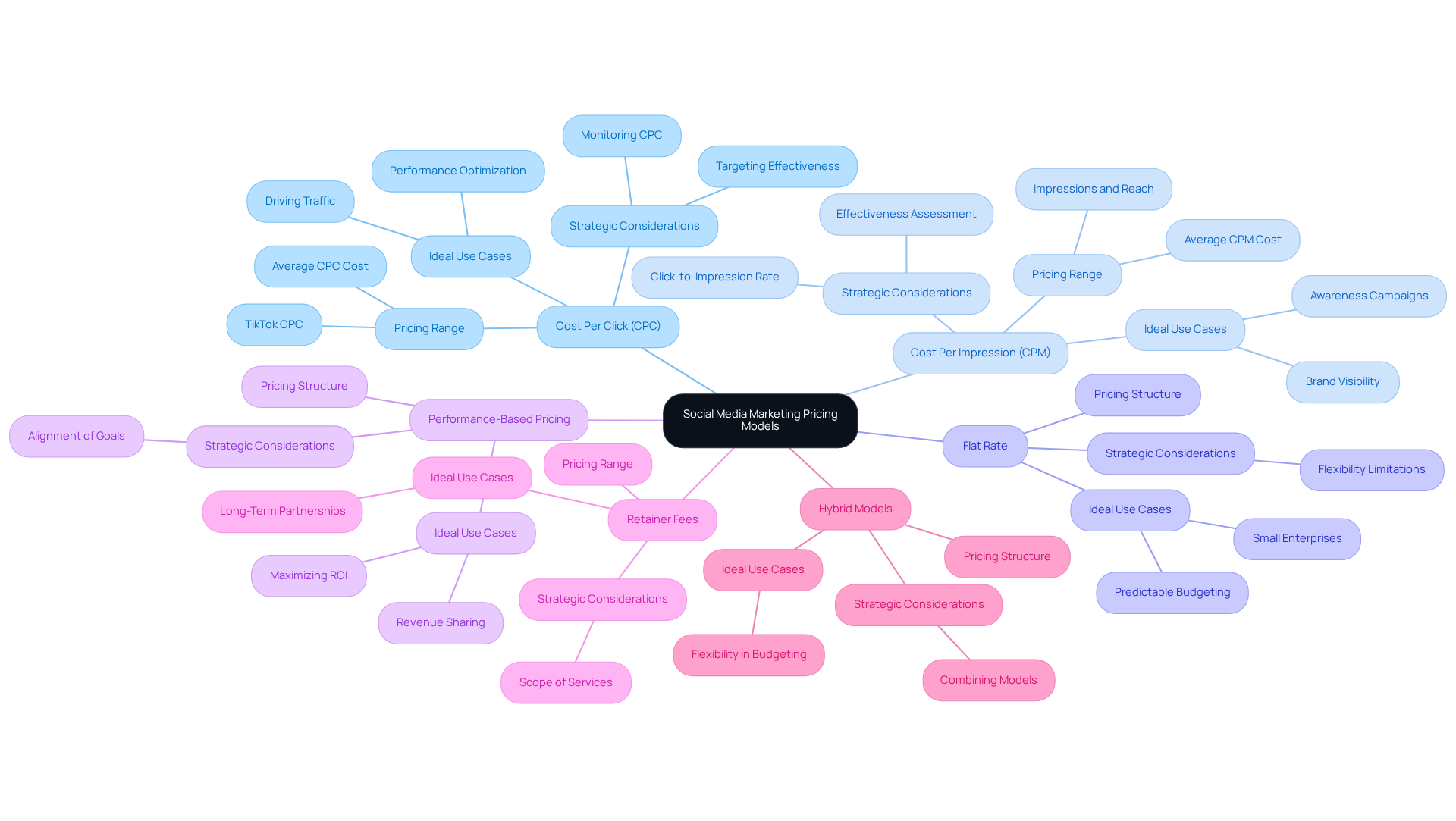
When planning your budget, it’s essential to consider various pricing models that can significantly impact your strategy:
- (CPC): This model charges advertisers based on the number of clicks their ads receive, making it ideal for campaigns focused on driving traffic to a website. In 2026, CPC pricing on platforms like TikTok varies from $0.17 to $1.50, allowing companies to optimize their spending based on performance metrics. Monitoring your CPC is crucial to ensure it aligns with your conversion goals. Effective targeting can yield significant returns, as CPC pricing generates 2.8 times more clicks than CPM. This reinforces the importance of to avoid wasting budget on poorly targeted ads.
- (CPM): Advertisers pay for every 1,000 impressions their ads receive. This model is particularly suitable for awareness campaigns where visibility is key. The average CPM for social media ads in 2026 is projected to be around $138.06 for 151,544 impressions, reaching 59,271 users with 759 clicks. Understanding the click-to-impression rate for CPM, which stands at 1 click per 159 impressions, helps assess the effectiveness of your reach and overall brand visibility.
- : Some agencies or platforms offer a for a set number of posts or ads. This model provides predictability in budgeting but may lack flexibility for performance-based adjustments. It is frequently utilized by smaller enterprises seeking straightforward pricing without the complexities of fluctuating expenses.
- : This model ties costs to the performance of the ads, such as conversions or leads generated. It’s advantageous for companies aiming to , as you only pay for successful outcomes. Performance-oriented models can incorporate revenue-sharing agreements, ensuring that both the agency and the company are aligned in their goals.
- : Numerous agencies impose a monthly retainer for continuous services, which can include strategy development, content creation, and management of promotions. This model is appropriate for companies seeking a long-term partnership, with typical retainers ranging from $1,000 to $25,000+ per month, depending on the scope of services.
- : Some companies may benefit from a combination of these models, allowing for flexibility and optimization based on campaign performance. For instance, a brand might use a for basic posts while employing CPC for targeted ads. Assess your needs and choose a model that best fits your marketing strategy, ensuring effective allocation of your marketing resources.
By understanding these pricing models, you can select the one that aligns with your goals and budget, ensuring effective allocation of your marketing resources, including the price for .
Assess the ROI of Your Social Media Marketing Investment
To effectively assess the ROI of your efforts, follow these essential steps:
- : Establish specific, measurable goals for your initiatives - think increasing website traffic, generating leads, or boosting sales. Clear objectives are crucial for accurately measuring success and aligning strategies with business outcomes.
- : Utilize analytics tools to monitor essential metrics, including engagement rates, conversion rates, and customer acquisition costs. These metrics provide valuable insights into initiative performance and help identify areas for enhancement.
- : Include all expenses related to the price for efforts, such as ad spend, , and agency fees. Understanding your total investment is vital for , as it encompasses all resources dedicated to your activities.
- : Keep an eye on the revenue produced from your social media initiatives. This can include direct sales, leads converted into customers, or any other quantifiable financial advantage. This step is essential for grasping the financial impact of your marketing efforts.
- : Use the formula:
ROI = (Revenue - Costs) / Costs x 100. This calculation yields a percentage that indicates the return on your investment. A positive ROI shows that your initiatives are profitable, while a negative ROI highlights areas needing attention. - : Assess your ROI outcomes to determine which initiatives succeeded and which did not. Use this information to enhance upcoming initiatives, redistributing funds to the most effective approaches. Continuous testing and refinement based on data-driven insights are key to maximizing ROI.
By regularly assessing your ROI, you can ensure that your efforts are driving value and contributing to your overall business goals. In 2026, is projected to generate approximately $5.20 in revenue for every dollar spent, translating to a remarkable 420% ROI. This underscores the importance of effective measurement and optimization.

Implement Strategies to Optimize Social Media Marketing Costs
To optimize your , consider these powerful strategies:
- Leverage Data Analytics: Analytics tools are essential for tracking performance metrics like Cost Per Click (CPC) and . By identifying which promotions yield the best results, you can focus your budget on high-performing ads and consider the to maximize your return on investment. Remarkably, up to 90% of marketers report a social media-driven increase in product visibility, underscoring the importance of .
- Test and Iterate: Regularly testing different ad creatives, formats, and targeting options is crucial. helps determine what resonates best with your audience. For instance, companies that engage in systematic testing can significantly reduce wasted expenditure, with some campaigns achieving up to a 40% improvement in performance through iterative adjustments.
- Utilize : Encourage your audience to create content related to your brand. UGC is a cost-effective way to generate authentic content that resonates with potential customers, minimizing the need for expensive production. In fact, 47% of marketers are prioritizing UGC video as they approach 2026, recognizing its substantial impact on engagement and conversion.
- Optimize Ad Scheduling: Analyze when your audience is most active and schedule your ads accordingly. Running advertisements during peak engagement times can enhance performance and lower costs. For example, businesses that align their ad schedules with audience activity often see significant increases in , which can ultimately affect the , as supported by various case studies.
- Focus on Organic Reach: While paid ads are vital, don’t overlook . Engaging with your audience through consistent posts, stories, and community interaction can foster loyalty without incurring extra expenses. With 64% of marketers reducing investment in organic social, those who maintain a strong organic presence can stand out in a crowded market.
- Collaborate with Influencers: Partnering with influencers can provide access to their audience at a lower cost than traditional advertising. Choose influencers whose values align with your brand for authentic promotion. Brands that allocate 10-20% of their advertising budget to often experience better conversion rates and lower cost-per-acquisition, effectively stretching their social media advertising budget.
By implementing these strategies, you can effectively manage your price for while achieving your desired outcomes.

Conclusion
Understanding the complexities of social media marketing costs is vital for any business aiming to optimize its marketing budget. By pinpointing key factors like platform selection, audience targeting, content quality, ad formats, and seasonal trends, companies can allocate their resources strategically. Each of these elements significantly influences the overall cost-effectiveness of social media campaigns, ultimately affecting the return on investment.
This article explores various pricing models, including:
- Cost Per Click
- Cost Per Impression
- Performance-based pricing
These models enable marketers to customize their strategies to meet specific objectives. Moreover, the significance of evaluating ROI through clear objectives, tracking key metrics, and continuously optimizing campaigns cannot be overstated. By harnessing data analytics and experimenting with different approaches, businesses can effectively lower costs while boosting engagement and conversion rates.
In today's fast-paced digital landscape, it’s essential for marketers to stay updated on current trends and adjust their strategies accordingly. Embracing innovative practices such as:
- User-generated content
- Influencer collaborations
- Organic reach
can yield substantial savings and enhance marketing outcomes. By adopting these strategies and prioritizing data-driven decisions, businesses can master the costs associated with social media marketing, ensuring that every dollar spent contributes to their overall success.
Frequently Asked Questions
What are the key factors influencing social media marketing costs?
The key factors include platform selection, target audience, content quality, ad format, campaign objectives, and seasonality/trends.
How does platform selection affect social media marketing costs?
Advertising expenses vary significantly across platforms. For example, TikTok's cost per lead (CPL) ranges from $8 to $15, while Facebook has a median CPL of $6.49, making it more budget-friendly for B2C companies.
In what way does the target audience impact social media marketing expenses?
The accuracy of audience targeting can greatly affect costs, with platforms charging more for ads aimed at niche demographics. For instance, LinkedIn has higher CPLs for targeted B2B audiences, ranging from $15 to $350.
Why is content quality important for social media marketing costs?
High-quality content typically yields better results, leading to lower expenses per engagement. Investing in professional visuals and engaging text can enhance ad performance and reduce the expense per lead.
How do different ad formats influence marketing costs?
Different ad formats come with varying costs. For example, video advertisements may require a larger financial allocation due to production costs but generally result in higher engagement rates.
How do campaign objectives affect the budget for social media marketing?
Campaign goals, such as brand awareness, lead generation, or conversions, will influence financial strategies. For instance, conversion campaigns should receive 40-50% of the budget to focus on driving sales or signups.
What role do seasonality and trends play in social media marketing costs?
Costs can fluctuate based on seasonal demand and current trends, with businesses potentially needing to increase their advertising budgets by 30-50% during peak advertising seasons to remain competitive.
List of Sources
- Identify Key Factors Influencing Social Media Marketing Costs
- madgicx.com (https://madgicx.com/blog/social-media-advertising-cost)
- How Marketers are Spending Their Money in 2026 (https://neilpatel.com/blog/marketing-budget-trends-2026)
- youromega.com (https://youromega.com/post/which-social-media-platforms-are-worth-it-for-businesses-in-2026)
- ampifire.com (https://ampifire.com/blog/average-social-media-cost-per-lead-2025-compared-ads-vs-content)
- influenceflow.io (https://influenceflow.io/resources/social-media-advertising-budget-complete-guide-for-2026)
- Explore Different Pricing Models for Social Media Marketing
- Social Media Management Pricing 2026 (https://freshcontentsociety.com/social-media-management-pricing-2026-guide)
- influenceflow.io (https://influenceflow.io/resources/digital-marketing-agency-pricing-complete-2026-guide-to-costs-models-roi)
- eclincher.com (https://eclincher.com/articles/social-media-management-pricing-rates-and-costs-for-2026)
- twosixtech.com (https://twosixtech.com/blog/comparing-the-cpc-and-cpm-pricing-models-for-facebook-advertisements)
- digitaloort.com (https://digitaloort.com/social-media-marketing-cost)
- Assess the ROI of Your Social Media Marketing Investment
- brazzellmarketing.com (https://brazzellmarketing.com/Marketing-Matters/in-2026-businesses-need-to-re-evaluate-social-media-roi)
- 59 Social Media Marketing Statistics You Need to Know 2026 (https://goatagency.com/blog/social-media-marketing-statistics)
- wizardofadschuckmckay.com (https://wizardofadschuckmckay.com/what-good-social-media-roi-looks-like-2026)
- Digital Marketing ROI Measuring Success in 2026 (https://thriveagency.com/news/digital-marketing-roi-measuring-success-in-2026)
- Social Media ROI: How to Track, Measure & Grow It (2026) (https://improvado.io/blog/social-media-roi)
- Implement Strategies to Optimize Social Media Marketing Costs
- 2026 Social Media Trends Small Businesses Should Leverage (https://sbdc.uh.edu/sbdc/2026-social-media-trends-small-business.asp)
- 6 Predictions That Will Shape Social Media Strategies In 2026 (https://forbes.com/councils/forbescommunicationscouncil/2026/01/02/the-next-social-wave-the-top-6-predictions-that-will-shape-social-media-strategies-in-2026)
- The Importance of Social Media Marketing in 2026 - JCT Growth (https://jctgrowth.com/why-social-media-marketing-matters-more-than-ever-in-2026)
- How Marketers are Spending Their Money in 2026 (https://neilpatel.com/blog/marketing-budget-trends-2026)
- influenceflow.io (https://influenceflow.io/resources/social-media-advertising-budget-complete-guide-for-2026)