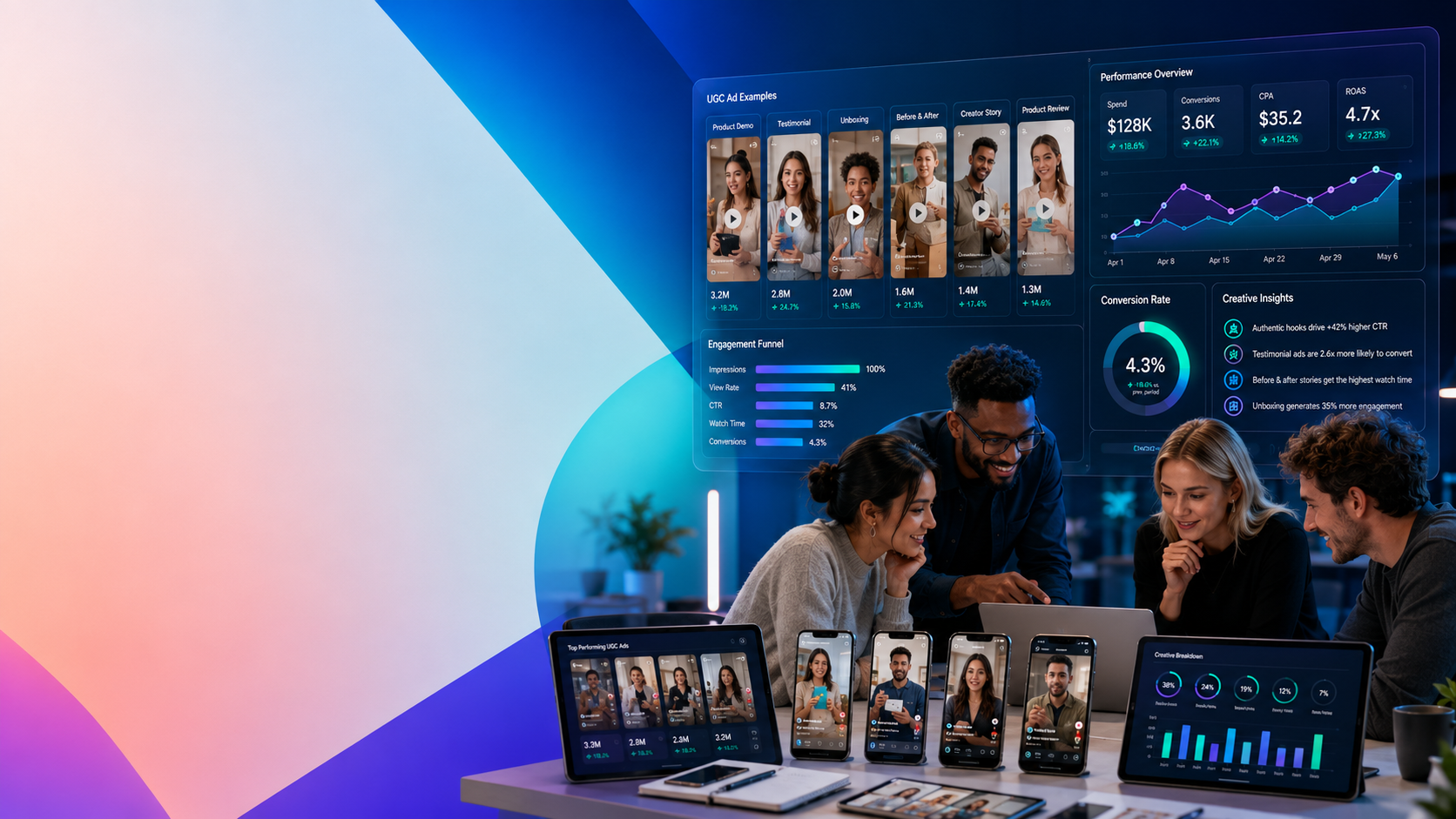
UGC Ads Examples for Paid Social
UGC ads are one of the most useful creative formats for paid social because they give brands more ways to test what actually resonates with an audience.
Instead of relying only on polished brand videos, UGC ads use creator-led content to make products feel more native, relatable, and believable in the feed.
But not every UGC ad should follow the same structure.
A product demo ad has a different job than a testimonial. A comparison ad has a different job than an unboxing. An objection-handling ad has a different job than a top-of-funnel problem-solution video.
That is why paid social teams need a range of UGC ad examples and formats.
The goal is not just to create “authentic content.”
The goal is to produce creative assets that can be tested across different hooks, audiences, funnel stages, product benefits, objections, and campaign goals.
This guide breaks down common UGC ads examples for paid social, when to use each format, and how brands can brief creators to produce better ad variations.
What Are UGC Ads?
UGC ads are paid social ads built from user-generated-style content.
They often feature creators, customers, or real people demonstrating, reviewing, explaining, or reacting to a product in a natural, platform-native way.
UGC ads are commonly used on:
- TikTok;
- Instagram Reels;
- Facebook;
- YouTube Shorts;
- Snapchat;
- Pinterest;
- LinkedIn.
A UGC ad can look like:
- a product demo;
- a testimonial;
- an unboxing;
- a comparison video;
- a problem-solution story;
- a creator review;
- a routine integration;
- a listicle;
- an objection-handling video;
- a screen recording;
- a direct-response creator ad.
The strongest UGC ads combine natural creator delivery with a clear paid social structure.
They should feel human, but they still need a purpose.
Why UGC Ads Work for Paid Social
UGC ads work well for paid social because they feel closer to the type of content people already consume in social feeds.
They are often more conversational than traditional brand ads.
They can show the product in context, explain value quickly, and use creators who feel relatable to the audience.
For paid social teams, UGC ads are especially useful because they make creative testing easier.
With UGC ads, brands can test:
- different creators;
- different hooks;
- different product benefits;
- different formats;
- different CTAs;
- different levels of polish;
- different funnel stages;
- different audience angles.
This helps teams learn what actually drives attention, clicks, conversions, and creative longevity.
UGC ads are not just content.
They are creative testing inputs.
How to Use UGC Ads Examples
UGC ads examples are most useful when you treat them as creative frameworks, not fixed templates.
The goal is not to copy a format exactly.
The goal is to understand the role each format plays.
Before choosing a UGC ad example, define:
- the campaign objective;
- the target audience;
- the funnel stage;
- the product benefit;
- the main objection;
- the creative angle;
- the platform;
- the CTA;
- the creator profile.
Then choose the UGC ad format that best fits the job.
For example:
- If the audience does not understand the product, use a product demo.
- If the audience needs trust, use a testimonial.
- If the audience is comparing options, use a comparison ad.
- If the audience has hesitation, use an objection-handling ad.
- If the audience is cold, use a problem-solution ad.
- If the brand needs creative variety, test multiple formats at once.
The best UGC ad example depends on what the campaign needs to accomplish.
1. Product Demo UGC Ad
A product demo UGC ad shows how the product works.
This is one of the most useful UGC ad formats because it makes the product easier to understand.
Instead of telling the viewer what the product does, the creator shows it in action.
Best For
Product demo UGC ads work well for:
- ecommerce products;
- beauty products;
- apps;
- food and beverage;
- home products;
- consumer tech;
- wellness products;
- tools;
- subscription products;
- products with a visual use case.
Example Structure
- Open with a problem or use case.
- Introduce the product.
- Show the product being used.
- Explain one or two key benefits.
- End with a clear CTA.
Example Hook
“I didn’t realize how much time I was wasting on this until I tried this.”
Example Script
“I used to spend way too much time trying to manage this manually. Then I tried [product]. Here’s how it works. First, you [step one]. Then, it helps you [key benefit]. What I like is that it makes [task] feel much easier. If you’ve been looking for a faster way to [solve problem], this is worth checking out.”
Why It Works
Product demos help reduce confusion.
They are especially useful when the product benefit is easier to understand visually than verbally.
For paid social, product demos can also create strong mid-funnel and retargeting assets because they help viewers see how the product fits into real life.
2. Testimonial UGC Ad
A testimonial UGC ad features a creator sharing their personal experience with a product.
The goal is to build trust.
A good testimonial should feel specific, natural, and believable.
Best For
Testimonial UGC ads work well for:
- consideration campaigns;
- retargeting campaigns;
- social proof;
- products with strong customer outcomes;
- higher-consideration purchases;
- subscriptions;
- services;
- wellness, beauty, fitness, and lifestyle products.
Example Structure
- Start with the creator’s original problem.
- Explain why they tried the product.
- Share what changed.
- Highlight the most important benefit.
- End with a recommendation or CTA.
Example Hook
“I didn’t think I’d use this every day, but now it’s part of my routine.”
Example Script
“I started using [product] because I was struggling with [problem]. At first, I wasn’t sure if it would actually make a difference, but after using it for [time period], I noticed [specific change]. The biggest thing for me is [benefit]. If you’ve been dealing with [problem], I’d definitely take a look.”
Why It Works
Testimonials work because they make the product feel more credible.
Instead of hearing the brand talk about itself, the viewer hears a creator describe a specific experience.
The key is specificity.
Generic praise is less convincing than a clear before-and-after story.
3. Problem-Solution UGC Ad
A problem-solution UGC ad starts with a pain point and then introduces the product as the solution.
This format is useful for cold audiences because it creates relevance quickly.
Best For
Problem-solution UGC ads work well for:
- top-of-funnel campaigns;
- cold audiences;
- products that solve a clear pain point;
- direct-response ads;
- creative testing;
- awareness campaigns.
Example Structure
- Name the problem.
- Make the problem feel familiar.
- Introduce the product.
- Show how it solves the problem.
- End with the next step.
Example Hook
“If you’re tired of [problem], this might help.”
Example Script
“If you’re tired of [problem], I found something that actually makes this easier. I used to [old behavior], but it always felt [pain point]. Then I tried [product]. It helps by [key benefit], and now I can [desired outcome] without [old frustration]. If this sounds familiar, check it out.”
Why It Works
Problem-solution ads work because they begin with the viewer’s world, not the product.
The viewer does not need to already know the brand.
They only need to recognize the problem.
4. Comparison UGC Ad
A comparison UGC ad contrasts the product with an alternative.
This can be a competitor, an old behavior, a manual process, or a common category habit.
The goal is to make the product’s value easier to understand through contrast.
Best For
Comparison UGC ads work well for:
- consideration campaigns;
- conversion campaigns;
- competitive categories;
- product switching;
- SaaS and app products;
- ecommerce products;
- retargeting;
- audiences comparing options.
Example Structure
- Introduce the old way or alternative.
- Explain what was frustrating about it.
- Introduce the new solution.
- Compare the difference.
- End with a clear recommendation.
Example Hook
“I stopped using [old solution] after trying this.”
Example Script
“I used to use [old solution] for [task], but it always felt [frustration]. Then I tried [product], and the biggest difference is [benefit]. With [old solution], I had to [pain point]. With [product], I can [new outcome]. If you’re still doing it the old way, this is worth trying.”
Why It Works
Comparison ads help audiences understand why the product matters.
They are especially useful when the viewer already knows the category but has not decided which option to choose.
5. Unboxing UGC Ad
An unboxing UGC ad shows the creator receiving, opening, and reacting to the product.
This format is useful when the packaging, product experience, or first impression matters.
Best For
Unboxing UGC ads work well for:
- ecommerce products;
- beauty;
- fashion;
- food and beverage;
- home goods;
- wellness;
- subscription boxes;
- gifting products;
- premium products.
Example Structure
- Show the package.
- Open the product.
- React to the presentation.
- Highlight product details.
- Show first use or impression.
- End with a CTA.
Example Hook
“I just got this, and I want to show you what’s inside.”
Example Script
“I just got my order from [brand], and the first thing I noticed was [packaging detail]. Inside, there’s [product detail]. I really like how [specific feature]. I’m going to try it now, but first impression: this feels [benefit or quality]. If you’ve been looking for [use case], this is a good one to check out.”
Why It Works
Unboxing ads create curiosity and make the product feel tangible.
They can be especially useful for products where the buying experience, packaging, or first impression supports the brand’s value.
6. Routine Integration UGC Ad
A routine integration UGC ad shows how the product fits into the creator’s daily life.
This format is useful because it makes the product feel natural and easy to adopt.
Best For
Routine integration ads work well for:
- beauty;
- wellness;
- fitness;
- food;
- productivity;
- home products;
- lifestyle brands;
- subscription products;
- products used repeatedly.
Example Structure
- Introduce the routine or moment.
- Show the product being used naturally.
- Explain why it fits.
- Highlight the main benefit.
- End with a CTA.
Example Hook
“This became part of my morning routine faster than I expected.”
Example Script
“This has become one of my favorite parts of my [morning/evening/workout/work] routine. I use [product] when I [specific moment], and it helps me [benefit]. What I like is that it does not feel like an extra step. It fits right into what I’m already doing. If you’re trying to make [routine] easier, this is worth checking out.”
Why It Works
Routine integration ads help the viewer imagine using the product.
They are especially effective when the product’s value depends on habit, consistency, or lifestyle fit.
7. Objection-Handling UGC Ad
An objection-handling UGC ad addresses a reason the audience may hesitate before buying, signing up, or taking action.
This format is especially useful for retargeting and conversion campaigns.
Best For
Objection-handling ads work well for:
- retargeting;
- conversion campaigns;
- premium products;
- subscriptions;
- higher-consideration offers;
- products with skepticism;
- products that require explanation.
Example Structure
- Name the objection.
- Make the hesitation feel understandable.
- Reframe the concern.
- Explain the value.
- End with a CTA.
Example Hook
“I thought this would be too expensive, but here’s why I changed my mind.”
Example Script
“I almost didn’t try [product] because I thought [objection]. But once I actually used it, I realized [reframe]. The reason it was worth it for me is [specific benefit]. If you’re on the fence because of [objection], here’s what I’d consider: [value point].”
Why It Works
Objection-handling ads meet the viewer where they are.
Instead of pretending hesitation does not exist, they address it directly.
This can make the ad feel more honest and persuasive.
8. Listicle UGC Ad
A listicle UGC ad organizes the message into a numbered list.
This format works well because it is easy to follow.
Best For
Listicle UGC ads work well for:
- product education;
- awareness;
- consideration;
- benefit stacking;
- TikTok;
- Instagram Reels;
- YouTube Shorts;
- products with multiple use cases.
Example Structure
- Introduce the list.
- Share point one.
- Share point two.
- Share point three.
- End with a CTA.
Example Hook
“Three reasons I keep using this.”
Example Script
“Three reasons I keep using [product]. First, it helps me [benefit one]. Second, it makes [task] much easier because [reason]. Third, it actually fits into my routine, which is why I keep coming back to it. If you’ve been looking for [use case], this is worth trying.”
Why It Works
Listicles create structure.
The viewer knows what to expect, and the creator can deliver multiple value points quickly.
They are especially useful when the product has several benefits that are easy to understand.
9. “I Tried It” UGC Ad
An “I tried it” ad frames the creator as someone testing the product and sharing an honest reaction.
This format works well because it creates curiosity and lowers the feeling of a hard sell.
Best For
“I tried it” ads work well for:
- product discovery;
- social proof;
- beauty;
- wellness;
- food;
- apps;
- lifestyle products;
- top and middle of funnel;
- creator-led storytelling.
Example Structure
- Explain why the creator tried the product.
- Show the product in use.
- Share the first impression.
- Explain what stood out.
- End with a recommendation or CTA.
Example Hook
“I tried this so you don’t have to.”
Example Script
“I kept seeing [product/category] and wanted to know if it was actually worth it, so I tried [product]. Here’s what happened. First, [first impression]. Then, after using it for [time period], I noticed [specific result or benefit]. I didn’t expect [surprising point], but that’s what stood out most.”
Why It Works
This format makes the ad feel like a creator review rather than a brand pitch.
It works best when the creator sounds specific and balanced.
10. Before-and-After UGC Ad
A before-and-after UGC ad shows contrast between the viewer’s previous situation and the improved situation after using the product.
This does not always need to be visual. It can also be behavioral, emotional, or practical.
Best For
Before-and-after ads work well for:
- beauty;
- fitness;
- wellness;
- productivity;
- home organization;
- apps;
- services;
- products with clear transformation;
- consideration campaigns.
Example Structure
- Explain the “before.”
- Introduce the product.
- Show the change.
- Explain the most important benefit.
- End with a CTA.
Example Hook
“Before I found this, I was still doing [old behavior].”
Example Script
“Before I found [product], I was still [old behavior], and it made [task] feel so much harder. After using it, the biggest change has been [benefit]. Now I can [new outcome] without [old frustration]. If you’re still dealing with [problem], this might help.”
Why It Works
Before-and-after ads make value tangible.
They show the difference between the old state and the new state, which helps the viewer understand the product’s role.
11. Screen Recording UGC Ad
A screen recording UGC ad uses on-screen footage to show how an app, platform, website, or digital product works.
This format is especially useful for SaaS, apps, ecommerce experiences, and digital tools.
Best For
Screen recording ads work well for:
- apps;
- SaaS products;
- marketplaces;
- creator platforms;
- ecommerce sites;
- digital services;
- product walkthroughs;
- feature education.
Example Structure
- Start with the problem.
- Show the screen.
- Walk through the key feature.
- Explain the benefit.
- End with the CTA.
Example Hook
“Here’s exactly how I use this to [achieve outcome].”
Example Script
“Here’s exactly how I use [product] to [achieve outcome]. First, I open [feature]. Then I can [step one]. From there, it helps me [key benefit]. What makes this useful is [specific value]. If you want a faster way to [task], this is where I’d start.”
Why It Works
Screen recordings remove ambiguity.
They show the viewer what the product actually does and how easy it is to use.
12. Expert-Style UGC Ad
An expert-style UGC ad uses a creator who speaks with authority or category knowledge.
This does not always mean a formal expert. It can be a professional, experienced user, founder, specialist, or creator with strong category credibility.
Best For
Expert-style ads work well for:
- high-consideration products;
- education;
- B2B;
- health and wellness;
- finance;
- beauty;
- SaaS;
- complex products;
- trust-building campaigns.
Example Structure
- Introduce a common mistake or misconception.
- Explain the issue.
- Introduce the product or solution.
- Clarify why it matters.
- End with a CTA.
Example Hook
“Most people make this mistake when choosing [category/product].”
Example Script
“Most people make this mistake when choosing [category]. They focus on [surface-level factor], but what actually matters is [important factor]. That’s why [product] is useful. It helps by [benefit], which makes [outcome] easier. If you’re comparing options, this is what I’d pay attention to.”
Why It Works
Expert-style ads build credibility.
They are especially useful when the audience needs education before taking action.
13. Founder-Style UGC Ad
A founder-style UGC ad features a founder, team member, or brand representative explaining the product in a personal, direct way.
It still uses a UGC-style format, but the voice comes from inside the brand.
Best For
Founder-style ads work well for:
- product launches;
- brand story;
- B2B;
- SaaS;
- premium products;
- mission-driven brands;
- trust-building;
- retargeting.
Example Structure
- Explain why the product was created.
- Name the problem.
- Show the solution.
- Explain what makes it different.
- Invite the viewer to take action.
Example Hook
“We built this because brands kept running into the same problem.”
Example Script
“We built [product] because we kept seeing brands struggle with [problem]. They had [pain point], but no simple way to [desired outcome]. So we created [product] to help them [benefit]. If your team is trying to [goal], this is exactly what it was built for.”
Why It Works
Founder-style ads can make the brand feel more human.
They work best when the message is clear, direct, and not overly corporate.
14. Raw Reaction UGC Ad
A raw reaction UGC ad captures the creator’s immediate reaction to using or experiencing the product.
This format can feel spontaneous and native to social platforms.
Best For
Raw reaction ads work well for:
- beauty;
- food;
- unboxings;
- product discovery;
- lifestyle products;
- surprising features;
- products with a clear first impression.
Example Structure
- Show the creator trying the product.
- Capture the reaction.
- Explain what surprised them.
- Highlight the benefit.
- End with a CTA.
Example Hook
“Wait, I didn’t expect this.”
Example Script
“Wait, I didn’t expect this. I’m trying [product] for the first time, and the first thing I noticed is [reaction]. It feels [specific description], and I can see why people use it for [use case]. I’m going to keep testing it, but first impression: [benefit].”
Why It Works
Raw reaction ads feel less scripted.
They can create curiosity and make the product experience feel more immediate.
15. Myth-Busting UGC Ad
A myth-busting UGC ad challenges a common belief in the category.
This format is useful for brands that need to educate the audience or shift how people think.
Best For
Myth-busting ads work well for:
- category education;
- B2B;
- wellness;
- beauty;
- finance;
- SaaS;
- higher-consideration products;
- thought leadership-style UGC.
Example Structure
- State the myth.
- Explain why it is incomplete or wrong.
- Introduce a better way to think about the problem.
- Connect the product to the new approach.
- End with a CTA.
Example Hook
“Follower count is not the best way to choose a UGC creator.”
Example Script
“Follower count is not the best way to choose a UGC creator, especially if you’re creating ads for paid social. What matters more is whether the creator fits the campaign goal, audience, product category, and format. That’s where [product/platform] helps. It matches brands with creators based on fit, not just popularity.”
Why It Works
Myth-busting ads create tension.
They give the viewer a reason to keep watching because the ad challenges something they may already believe.
How to Choose the Right UGC Ad Example
The right UGC ad example depends on the campaign goal.
If the Goal Is Awareness
Use formats that create quick relevance.
Best examples:
- problem-solution ads;
- curiosity-led ads;
- listicles;
- routine integrations;
- raw reaction ads.
If the Goal Is Product Education
Use formats that explain clearly.
Best examples:
- product demos;
- screen recordings;
- expert-style ads;
- comparison ads;
- listicles.
If the Goal Is Consideration
Use formats that build trust and preference.
Best examples:
- testimonials;
- comparisons;
- before-and-after ads;
- “I tried it” ads;
- expert-style ads.
If the Goal Is Conversion
Use formats that reduce hesitation.
Best examples:
- objection-handling ads;
- testimonial ads;
- comparison ads;
- offer-led creator ads;
- founder-style ads.
If the Goal Is Creative Testing
Use multiple formats at once.
Best examples:
- product demo vs. testimonial;
- expert creator vs. customer-style creator;
- problem hook vs. curiosity hook;
- comparison ad vs. objection-handling ad;
- lo-fi creator ad vs. polished edit.
The format should match the job the ad needs to do.
How to Brief Creators Using UGC Ad Examples
UGC ad examples are useful when briefing creators, but they should not be used to over-script the content.
A strong brief should give creators enough direction while leaving room for natural delivery.
Include:
- campaign objective;
- target audience;
- product overview;
- key message;
- creative angle;
- example format;
- hook options;
- required talking points;
- product shots needed;
- deliverables;
- usage rights;
- timeline;
- CTA.
For example, instead of saying:
“Make a testimonial video.”
Say:
“Create a 30-second testimonial-style UGC ad for retargeting audiences who visited the product page but did not purchase. Open by addressing skepticism, explain what changed after using the product, and end with a clear CTA.”
That level of detail makes the creator’s role much clearer.
How to Test UGC Ad Examples
Paid social teams should test UGC ad examples in a structured way.
Start with one main question.
Examples:
- Does a product demo outperform a testimonial?
- Does a comparison ad outperform a problem-solution ad?
- Does an expert-style creator outperform an everyday user?
- Does an objection-handling ad improve retargeting performance?
- Does a lo-fi creator ad outperform a polished brand edit?
Then create variations around that question.
To make the test easier to interpret, try to avoid changing every variable at once.
For example:
- Test the same creator with different hooks.
- Test the same hook across different creators.
- Test the same message in different formats.
- Test the same format with different CTAs.
- Test different creator types with the same product benefit.
Track metrics based on the campaign objective.
For awareness, look at attention and engagement.
For consideration, look at CTR and landing page behavior.
For conversion, look at CPA, CAC, ROAS, or conversion rate.
The goal is not just to find one winning ad.
The goal is to learn which UGC formats and creator types should be briefed next.
Common Mistakes With UGC Ad Examples
Mistake 1: Copying Examples Too Literally
UGC ad examples should guide the structure, not create identical ads.
The best UGC content still needs to feel natural to the creator and relevant to the brand.
Mistake 2: Using the Wrong Format for the Funnel Stage
A product demo may be better for education than immediate conversion.
An objection-handling video may be more useful for retargeting than cold audiences.
Match the format to the viewer’s awareness level.
Mistake 3: Forgetting the Hook
Even a strong format needs a strong opening.
Do not just brief the format. Brief hook options too.
Mistake 4: Over-Scripting the Creator
UGC should not sound like a brand script read by a creator.
Give structure, but allow the creator to speak naturally.
Mistake 5: Not Asking for Variations
One UGC ad rarely gives enough learning.
Ask for alternate hooks, CTAs, raw footage, or additional takes when possible.
Mistake 6: Choosing Creators Based Only on Aesthetic
A creator may look good but still be wrong for the format, audience, message, or campaign goal.
Choose creators based on fit.
How NugVerse Helps Brands Create More UGC Ad Examples to Test
NugVerse helps brands connect with vetted UGC creators matched to their campaign goals.
Instead of manually searching for creators every time your team needs new UGC ad examples, NugVerse uses AI-powered matching to help identify creators aligned with your audience, category, format, and paid social objective.
That makes it easier to:
- produce more UGC ad formats;
- test more hooks and angles;
- match creators to campaign goals;
- improve creator-brand fit;
- create product demos, testimonials, comparisons, and objection-handling ads;
- reduce manual creator sourcing;
- fight creative fatigue;
- keep the paid social creative pipeline full.
For growth teams, paid media teams, and performance marketers, NugVerse helps turn UGC production into a repeatable creative testing system.
The goal is not just to collect examples.
The goal is to create more assets your team can actually test.
Final Takeaway
UGC ads can take many forms.
Product demos, testimonials, comparison ads, unboxings, routine integrations, objection-handling videos, listicles, screen recordings, and expert-style ads all serve different roles in paid social.
The best UGC ad example depends on the campaign goal, funnel stage, audience, product, message, and creative test.
For paid social teams, the value of UGC is not just that it feels authentic.
The value is that it creates more ways to test.
More creators. More hooks. More formats. More angles. More learnings.
When brands use UGC ad examples strategically, they can build a stronger creative pipeline, refresh campaigns faster, and create more opportunities to find the next winning ad.
Ready to Create More UGC Ads for Paid Social?
NugVerse connects brands with vetted UGC creators matched to their campaign goals.
Find better-fit creators. Test more formats. Keep your paid social creative pipeline full.
Start your first project with NugVerse.
Related Articles
- UGC Creators for Paid Social Ads: How to Find, Vet, and Scale Winning Creative
- What Are UGC Ads?
- Best UGC Hooks for Paid Social Ads
- How to Brief UGC Creators for Better Ads
FAQ
What are UGC ads examples?
UGC ads examples are common creator-led ad formats brands can use in paid social, such as product demos, testimonials, comparison ads, unboxings, problem-solution videos, routine integrations, and objection-handling ads.
What is the best UGC ad format for paid social?
There is no single best format for every campaign. Product demos work well for education, testimonials build trust, comparison ads support consideration, and objection-handling ads are useful for retargeting and conversion.
What makes a good UGC ad?
A good UGC ad has a strong hook, clear message, natural creator delivery, visible product integration, audience relevance, tight pacing, and a clear CTA.
How do brands use UGC ads in paid social?
Brands use UGC ads to test different creators, hooks, formats, product benefits, objections, and CTAs across platforms like TikTok, Instagram, Facebook, and YouTube Shorts.
Are UGC ads only for TikTok?
No. UGC ads can be used across TikTok, Instagram, Facebook, YouTube Shorts, Snapchat, Pinterest, LinkedIn, landing pages, product pages, and other marketing channels.
How many UGC ad examples should a brand test?
Brands should usually test multiple UGC ad examples rather than relying on one format. A good starting point is to test product demos, testimonials, comparison ads, and problem-solution videos.
How should brands brief creators for UGC ads?
Brands should brief creators with the campaign objective, audience, product details, creative angle, hook options, required talking points, format, deliverables, usage rights, and CTA.
How do UGC ads help with creative fatigue?
UGC ads help fight creative fatigue by giving paid social teams fresh creators, hooks, formats, messages, and creative angles to test and rotate before existing ads lose performance.