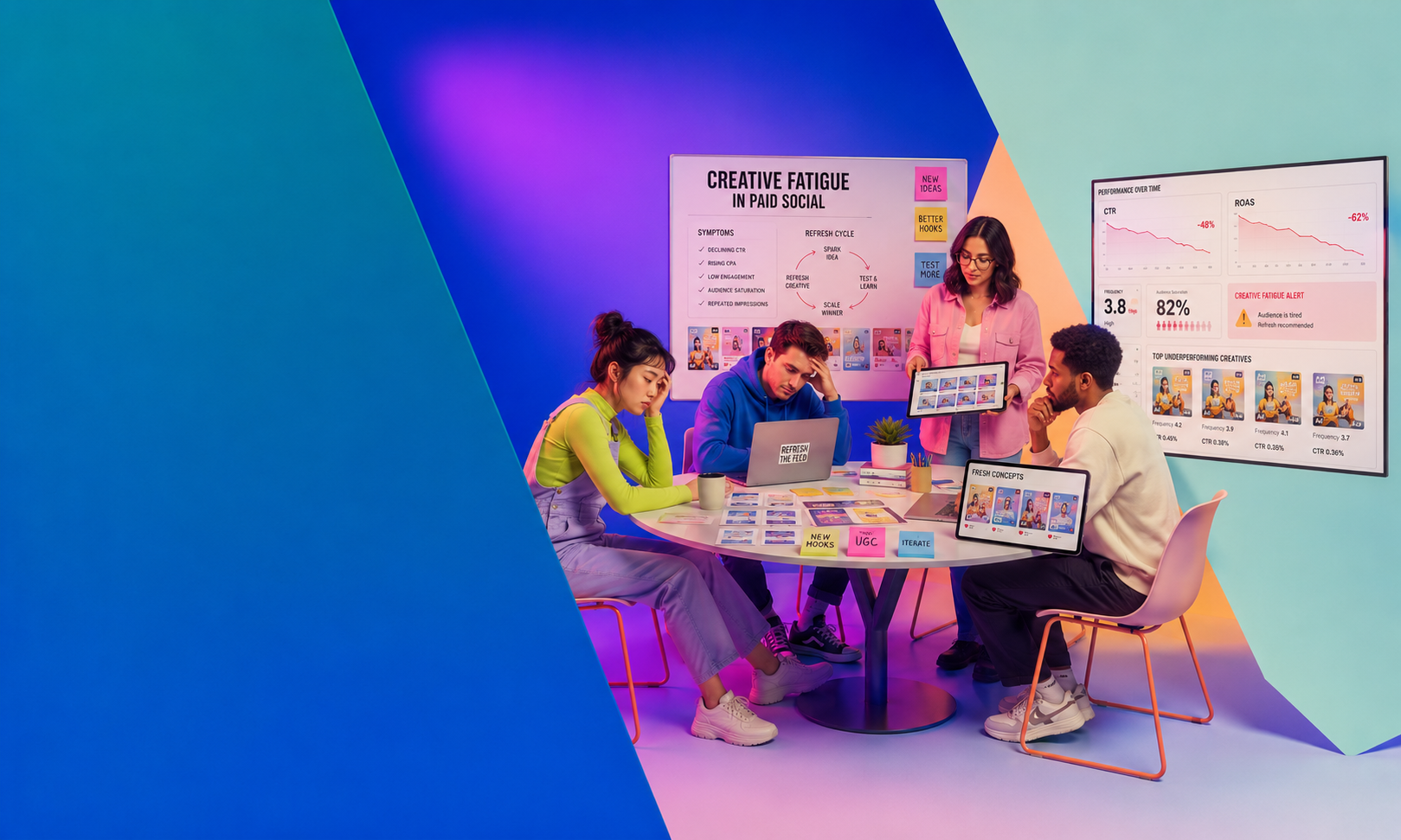
What Is Creative Fatigue in Paid Social?
Creative fatigue is one of the most common reasons paid social campaigns stop performing.
An ad launches. Performance looks strong. CTR is healthy. CAC is within target. ROAS is moving in the right direction. The team increases spend.
Then, after a few days or weeks, performance starts to decline.
The audience stops responding. Click-through rate drops. Cost per acquisition rises. The ad that once looked like a winner becomes harder to scale.
That is creative fatigue.
In paid social, creative fatigue happens when an audience has seen the same ad too many times, or when the creative no longer feels fresh, relevant, or attention-worthy.
It does not always mean the product is weak. It does not always mean the offer is wrong. It does not always mean the media buying strategy is broken.
Sometimes, the creative has simply run out of momentum.
For brands that rely on paid social, this is a major growth problem. If the creative pipeline cannot keep up with the speed of media spend, performance eventually slows down.
This guide explains what creative fatigue is, how to identify it, why it happens, and how brands can use fresh UGC ads and a stronger creative pipeline to keep campaigns moving.
What Is Creative Fatigue?
Creative fatigue happens when an ad loses effectiveness because the target audience has been exposed to it too often or because the message no longer feels compelling.
In paid social, this usually means that a once-performing ad starts to show weaker results over time.
The creative may still look good. The message may still be clear. The offer may still be relevant. But the audience has stopped reacting to it with the same level of interest.
Creative fatigue can affect almost every paid social platform, including:
- TikTok;
- Instagram;
- Facebook;
- YouTube Shorts;
- Snapchat;
- Pinterest;
- LinkedIn.
It is especially common on platforms where users consume large volumes of short-form content and expect constant novelty.
The more often people see the same creative, the easier it becomes for them to ignore it.
That is why paid social teams need a steady flow of new creative assets.
Creative Fatigue vs. Ad Fatigue: What’s the Difference?
The terms “creative fatigue” and “ad fatigue” are often used interchangeably.
They are closely related, but there is a slight difference.
Ad fatigue usually refers to the broader decline in performance that happens when an audience sees the same ad too many times.
Creative fatigue focuses specifically on the creative asset itself: the video, image, hook, message, format, or visual concept that is no longer generating the same response.
For example, if frequency is high and CTR starts dropping, that may be ad fatigue.
If multiple audiences have seen the same video and the hook is no longer driving attention, that is creative fatigue.
In practice, both issues are connected. A tired creative often leads to ad fatigue. And ad fatigue often signals that the creative needs to be refreshed, replaced, or reworked.
Why Creative Fatigue Matters in Paid Social
Paid social performance depends heavily on creative.
Targeting, bidding, budget, and optimization all matter. But without strong creative, campaigns have limited room to grow.
Creative is what earns attention. It is what introduces the problem. It is what makes the product feel relevant. It is what gives the audience a reason to click, learn more, or buy.
When creative starts to fatigue, the entire campaign can suffer.
Creative fatigue can lead to:
- lower click-through rates;
- higher CPMs;
- higher CPCs;
- rising CAC;
- lower conversion rates;
- declining ROAS;
- weaker engagement;
- reduced ability to scale spend;
- overdependence on one or two winning ads.
This is why creative fatigue is not just a creative problem.
It is a growth problem.
If a brand cannot produce enough fresh creative, media buyers eventually run out of useful assets to test. Campaigns become harder to scale. The team starts recycling the same winners. Performance becomes less predictable.
A strong paid social account needs more than one good ad.
It needs a system for finding the next good ad before the current one stops working.
Signs of Creative Fatigue
Creative fatigue usually shows up in performance data before it becomes obvious visually.
An ad may still look strong from a brand perspective, but the audience response tells a different story.
Here are some common signs.
Declining CTR
If click-through rate starts falling, the creative may no longer be earning attention.
This can mean the hook is becoming too familiar, the visual no longer stands out, or the message is not creating enough curiosity or urgency.
Rising CAC
When cost per acquisition increases, creative fatigue may be one of the causes.
If the same ad is reaching the same audience too often, fewer people may convert, making each new customer more expensive.
Lower ROAS
A decline in return on ad spend can indicate that the creative is no longer producing enough revenue relative to media investment.
This is especially important for brands scaling spend aggressively.
Higher Frequency
Frequency measures how often the same person sees an ad over a period of time.
High frequency is not always bad. But if frequency rises while CTR and conversion rate decline, the audience may be tired of the creative.
Lower Engagement
If likes, comments, shares, saves, or other engagement signals start dropping, the creative may no longer feel relevant or interesting to the audience.
Slower Scaling
Sometimes the ad still performs at a small budget but struggles when spend increases.
This can happen when the creative works for a limited segment but does not have enough freshness or relevance to scale across a broader audience.
Performance Drops After Initial Success
Creative fatigue often happens after a strong start.
A new ad performs well, gets more budget, reaches more people, and then begins to decline. This does not mean the ad failed. It may simply mean the brand needs the next wave of creative ready.
Why Creative Fatigue Happens
Creative fatigue can happen for several reasons.
1. The Audience Has Seen the Ad Too Many Times
Paid social platforms can expose the same users to the same creative repeatedly, especially in smaller audiences or retargeting campaigns.
After repeated exposure, users start ignoring the ad.
Even if the message is still relevant, it loses the ability to interrupt the feed.
2. The Hook Stops Working
The first few seconds of a paid social ad are critical.
If the opening line, visual, or concept becomes familiar, the audience may scroll past before the message has a chance to land.
This is especially important for UGC ads, TikTok ads, Reels ads, and other short-form formats.
3. The Brand Relies Too Much on One Winning Concept
Many brands find one strong creative and keep pushing it until it stops working.
That can produce short-term results, but it also creates dependency.
When the winning ad fatigues, the team may not have enough tested alternatives ready.
4. There Is Not Enough Creative Variation
Small edits are not always enough.
Changing the caption, trimming the video, or swapping the thumbnail can help in some cases. But if the core concept is tired, the brand may need new hooks, new creators, new formats, or new angles.
5. The Creative Pipeline Is Too Slow
Some teams wait until performance drops before producing new creative.
By that point, the account may already be under pressure.
A slow pipeline creates a reactive cycle: performance drops, the team rushes to produce, new assets arrive late, and the same issue repeats.
6. The Creative Does Not Match the Audience
Creative can fatigue faster when it is not strongly aligned with the audience.
If the creator, message, or format does not feel relevant, the audience may lose interest quickly.
This is why creator-brand fit and audience fit matter so much in UGC campaigns.
Why Creative Fatigue Is More Common in Paid Social Today
Paid social has become more creative-intensive.
Several trends have made creative fatigue harder to avoid.
Short-Form Content Has Raised Audience Expectations
Users are exposed to a constant stream of new videos, creators, sounds, formats, and trends.
This makes audiences less tolerant of ads that feel repetitive, generic, or overly polished.
Platform-Native Creative Matters More
Ads need to feel like they belong in the feed.
Traditional brand assets often struggle when they are repurposed into short-form paid social environments. The creative needs to match platform behavior, not just brand guidelines.
Creative Testing Has Become a Growth Lever
Paid social teams are no longer just testing audiences and bids.
They are testing hooks, angles, formats, creators, offers, and landing page messages.
That requires more creative volume.
Winning Ads Fatigue Faster at Scale
The more aggressively a brand spends, the faster the audience sees the same creative.
This means that brands with higher paid social budgets often need a larger creative pipeline to keep performance stable.
Brands Need More Than Polished Campaign Assets
Polished production still has a role. But for ongoing paid social testing, brands often need faster, more flexible, more varied assets.
This is one reason UGC ads have become so important.
How UGC Ads Help Fight Creative Fatigue
UGC ads can help brands fight creative fatigue because they create more variation in the paid social account.
Instead of relying only on brand-produced assets, UGC allows brands to introduce fresh faces, voices, settings, hooks, and formats.
A single campaign can test multiple creator types, including:
- customers;
- niche creators;
- lifestyle creators;
- product reviewers;
- subject-matter experts;
- category enthusiasts;
- direct-response creators.
This gives the brand more creative inputs.
UGC ads can also help test different formats, such as:
- product demos;
- testimonials;
- comparison videos;
- unboxings;
- problem-solution videos;
- “things I wish I knew” videos;
- objection-handling videos;
- routine-based content;
- before-and-after narratives;
- direct-response scripts.
The goal is not just to make ads look more authentic.
The goal is to create a larger testing system.
When brands work with multiple UGC creators, they can test more angles faster and identify which messages resonate with different audiences.
That makes it easier to replace fatigued ads with new creative before performance declines too far.
How to Prevent Creative Fatigue
Creative fatigue cannot always be avoided completely. Every strong ad has a lifecycle.
But brands can reduce its impact by building a more proactive creative system.
1. Build a Creative Pipeline
The most important step is to stop treating creative as a one-off task.
A paid social creative pipeline gives your team a consistent process for producing, testing, analyzing, and refreshing creative.
This helps ensure that new assets are ready before current ads fatigue.
2. Track Creative Performance Weekly
Monitor creative-level performance regularly.
Look for changes in CTR, CPC, CAC, ROAS, engagement, frequency, and conversion rate.
The earlier you identify fatigue, the easier it is to respond.
3. Test Multiple Hooks
The hook is often the first part of the ad to fatigue.
Create multiple opening lines or first-frame concepts for the same core message.
For example:
- problem-led hook;
- curiosity-led hook;
- benefit-led hook;
- objection-led hook;
- comparison hook;
- testimonial hook.
4. Rotate Creator Types
Different creators can make the same product feel relevant in different ways.
Testing multiple creator types can help the brand understand which voices, lifestyles, and audience cues perform best.
5. Refresh Formats, Not Just Edits
Minor edits are useful, but they are not always enough.
If the core concept has fatigued, test new formats:
- demo instead of testimonial;
- comparison instead of unboxing;
- creator story instead of product feature;
- expert explanation instead of lifestyle integration.
6. Turn Winners Into Variations
When an ad works, do not simply keep spending against the same version.
Break it down.
Ask:
- Was it the hook?
- Was it the creator?
- Was it the product benefit?
- Was it the format?
- Was it the offer?
- Was it the visual style?
Then create new variations around the winning element.
7. Use Performance Data to Brief New Creative
Creative production should be connected to media learnings.
If performance data shows that a specific objection matters, create objection-handling ads. If a product demo performs well, brief more demo-led content. If a specific creator type works, source more creators with similar characteristics.
The best creative systems use every test to improve the next round.
What to Do When Creative Fatigue Is Already Happening
If your ads are already showing signs of fatigue, the first step is to diagnose the issue.
Do not automatically assume you need a full strategy reset.
Start by asking:
- Is the fatigue happening across all ads or only one creative?
- Is frequency increasing?
- Is CTR declining?
- Is conversion rate declining?
- Is CAC rising?
- Is the drop happening in prospecting, retargeting, or both?
- Are the same hooks being used too often?
- Are the same creator types appearing repeatedly?
- Are we testing enough new concepts?
Once you identify the pattern, you can respond more effectively.
Possible actions include:
- launching new UGC ads;
- testing new hooks;
- refreshing the opening three seconds;
- rotating new creators;
- producing new demo formats;
- creating new objection-handling assets;
- testing new CTAs;
- building new variations of past winners;
- pausing fatigued assets;
- reducing reliance on one creative concept.
The goal is not just to replace one tired ad.
The goal is to understand what your next creative round should test.
Creative Fatigue Is a Pipeline Problem
Many brands treat creative fatigue as an ad-level issue.
But most of the time, it is a pipeline issue.
The problem is not only that one ad stopped working.
The bigger problem is that the team did not have enough fresh creative ready to replace it.
That is why brands need a repeatable process for creative production.
A strong paid social creative pipeline includes:
- ongoing creative analysis;
- structured testing plans;
- strong creator briefs;
- access to reliable UGC creators;
- multiple creative variations;
- clear performance feedback;
- regular creative refresh cycles.
When this system is in place, creative fatigue becomes easier to manage.
Instead of waiting for performance to drop, the brand continuously feeds the account with new assets.
How NugVerse Helps Brands Fight Creative Fatigue
NugVerse helps brands keep their paid social creative pipeline full with vetted UGC creators matched to their campaign goals.
Instead of manually searching for creators every time performance starts to decline, brands can use NugVerse to access a curated network of UGC creators built for paid social content.
With AI-powered creator matching, NugVerse helps brands find creators based on factors such as campaign objective, audience, category, content needs, and creator fit.
That makes it easier to:
- produce fresh UGC ads;
- test more hooks and angles;
- source creators faster;
- reduce manual creator search;
- improve creator-brand fit;
- keep paid social campaigns supplied with new creative;
- respond to creative fatigue before it slows growth.
For growth teams and paid media teams, NugVerse is designed to solve one of the most important creative challenges in paid social:
Keeping enough high-quality creative in motion.
Final Takeaway
Creative fatigue is not a sign that paid social is broken.
It is a sign that paid social needs fresh creative.
Every winning ad has a lifecycle. The brands that scale are not the ones that avoid fatigue forever. They are the ones that build systems to respond to it faster.
That means producing more variations, testing more hooks, working with better-fit creators, and turning performance insights into the next round of creative.
UGC ads can play a major role in that system because they give brands more native, flexible, and testable creative inputs.
The stronger your creative pipeline, the less your growth depends on one winning ad.
The goal is simple: keep producing, keep testing, and keep giving your audience something new to respond to.
Ready to Fight Creative Fatigue Before It Slows Your Growth?
NugVerse connects brands with vetted UGC creators matched to their campaign goals.
Create more ads. Test more angles. Keep your paid social creative pipeline full.
Start your first project with NugVerse.
FAQ
What is creative fatigue in paid social?
Creative fatigue happens when an ad loses effectiveness because the audience has seen it too many times or because the creative no longer feels fresh, relevant, or engaging. It often leads to lower CTR, higher CAC, and weaker paid social performance.
What causes creative fatigue?
Creative fatigue can be caused by high frequency, repeated exposure, weak variation, overreliance on one winning ad, slow creative production, or creative that does not strongly match the target audience.
How do you know if an ad is fatigued?
Common signs include declining CTR, rising CPC, rising CAC, lower ROAS, weaker engagement, higher frequency, and difficulty scaling spend. These signals suggest the audience may need fresh creative.
How can brands prevent creative fatigue?
Brands can prevent creative fatigue by building a paid social creative pipeline, testing multiple hooks and formats, rotating creator types, producing new UGC ads regularly, and using performance data to brief new creative.
How do UGC ads help with creative fatigue?
UGC ads help brands introduce fresh faces, voices, formats, and messages into their paid social campaigns. This gives media teams more creative variations to test and reduces reliance on one or two winning ads.
How often should brands refresh paid social creative?
The right cadence depends on budget, audience size, frequency, and performance trends. Brands spending heavily on paid social may need new creative weekly or biweekly, while smaller accounts may refresh creative monthly.
Is creative fatigue the same as ad fatigue?
They are closely related. Ad fatigue usually refers to the broader decline in ad performance caused by repeated exposure. Creative fatigue focuses specifically on the creative asset losing its ability to capture attention or drive action.
What is the best way to fix creative fatigue?
The best way to fix creative fatigue is to launch new creative variations based on performance insights. This may include new hooks, new creators, new formats, new angles, new CTAs, or a stronger UGC creative testing system.
Related Articles
What Are UGC Ads?
How to Brief UGC Creators for Better Ads
What Is Creative Fatigue in Paid Social?
How to Build a Paid Social Creative Pipeline
UGC Creators for Paid Social Ads: How to Find, Vet, and Scale Winning Creative